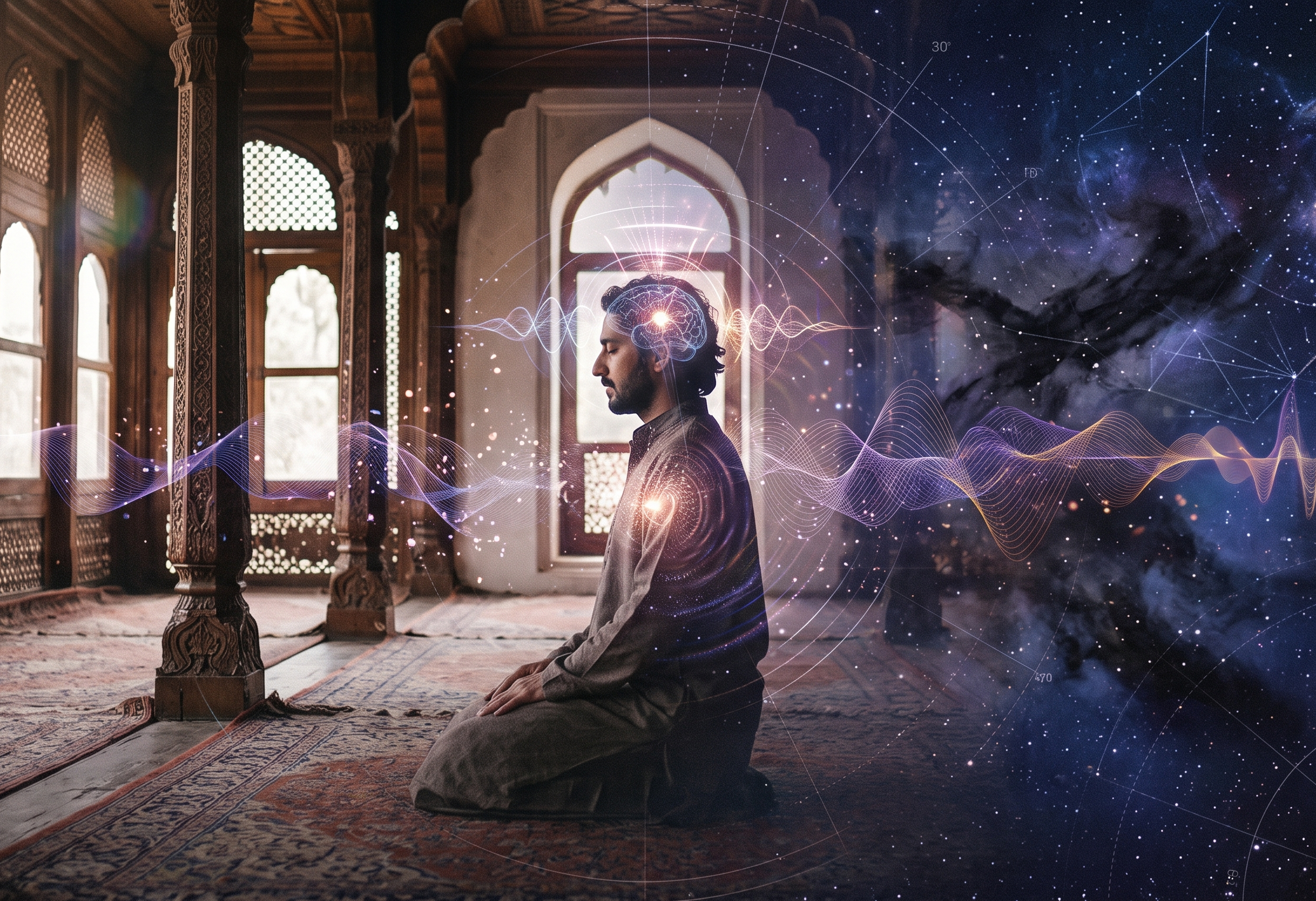
Modern astrophysics confirms that visible light accounts for only a microscopic sliver of the cosmic architecture.
By Malik Sadia Shabir
We routinely constrain our understanding of existence to what our senses can physically register, yet both contemporary quantum physics and ancient spiritual traditions converge on a humbling truth: objective reality extends infinitely beyond sensory reach. Consider the narrow corridor through which humanity perceives the cosmos. Human sight is confined entirely to the visible spectrum, abbreviated as VIBGYOR violet, indigo, blue, green, yellow, orange, and red. This optical band accounts for an astonishing fraction of the electromagnetic spectrum, representing less than one percent of the physical radiation enveloping our world.
At this very instant, through the air and through our living tissue, Wi-Fi signals, radio waves, ultraviolet rays, cosmic radiation, and infrared heat stream unhindered. They remain entirely imperceptible to the naked eye, yet their presence and measurable effects are undeniable. It is within this vast, unperceived electromagnetic domain that traditional metaphysics finds an intriguing modern parallel.
Classical folklore and spiritual texts speak of unseen entities such as the jinn, whose nature is described as immaterial or fiery. If entities exist beyond the visible extremes of violet and infrared, possessing the capacity to shift their frequencies into the optical range, the human eye would register them only when their vibrational state intersects our optical bandwidth. In Kashmiri lore, such metamorphic phenomena are often remembered in vernacular memory through concepts like tasrub or the ten shifting forms (dasroup), reflecting an ancestral awareness that living forms may alter their outward manifestation through hidden mechanics.
In Islamic metaphysics, this vast territory of existence lying beyond empirical observation is termed Al-Ghayb, the Unseen. Modern cosmology arrives at a strikingly complementary realization through its exploration of the cosmic web. Astrophysical research indicates that visible matter constitutes roughly five percent of the observable universe, while the remaining ninety-five percent consists of dark matter and dark energy. These unseen forces exert the gravitational scaffolding necessary to bind rotating galaxies together and drive cosmic expansion, yet they cannot be directly imaged, isolated, or resolved by contemporary scientific instrumentation. Human civilization resides within an exceedingly fragile bubble of the perceived, afloat in an unfathomable ocean of the unperceived.
Within this vast cosmological architecture, Islamic tradition elevates humanity to the station of Ashraf al-Makhluqat, the noblest of all creations. This supreme designation stands out remarkably, especially given that angels are created immaculate, possessing uninterrupted devotion and an incapacity for transgression. Humanity’s elevated status arises not from moral perfection, but from the endowment of intellect (aql) and deliberate free will: the extraordinary, dangerous liberty to seek truth amidst concealment, to navigate uncertainty, and to consciously choose transcendence over ignorance.
The human brain represents the pinnacle of this endowed intellect, standing as the most intricate, self-organizing machine known to science. Its capacity defies rigid ceiling limits; neural pathways adapt, reorganize, and consolidate through experience in an ongoing process of neuroplasticity. The deliberate direction of mental focus fundamentally rewires neural architecture. Every book read, idea entertained, image consumed, and exchange held whether constructive or toxic inscribes impressions upon the subconscious mind, quietly calibrating our future decisions and emotional baselines.
Neuroscience demonstrates that human consciousness never interfaces with the external world in an unmediated state. What we experience as external reality is an elaborate internal reconstruction generated by the brain, which translates chaotic electrochemical signals received from sensory organs into coherent visual, auditory, and tactile models. Every individual inhabits a neurological simulation rendered entirely within the cranium. As the psychologist and philosopher William James observed, human beings can alter their lives by altering their attitudes of mind, an insight echoed by the classical Hermetic principle of correspondence: the outer conditions of life inevitably reflect the internal state of consciousness.
This interface between internal consciousness and external reality also illuminates contemporary colloquialisms. The informal phrase “vibes,” often dismissed as generational slang, holds genuine biological and physical foundations. Human emotions correspond to measurable, oscillatory electromagnetic rhythms generated by neural activity and the cardiac system. Under the principles of biological resonance and field interactions, these subtle oscillations ripple outward into our surrounding environment. When an individual instinctively registers another person’s presence, hostility, or warmth, they are not invoking superstition; they are processing subtle somatic data, micro-expressions, and bio-electromagnetic signals that the conscious intellect often trails behind.
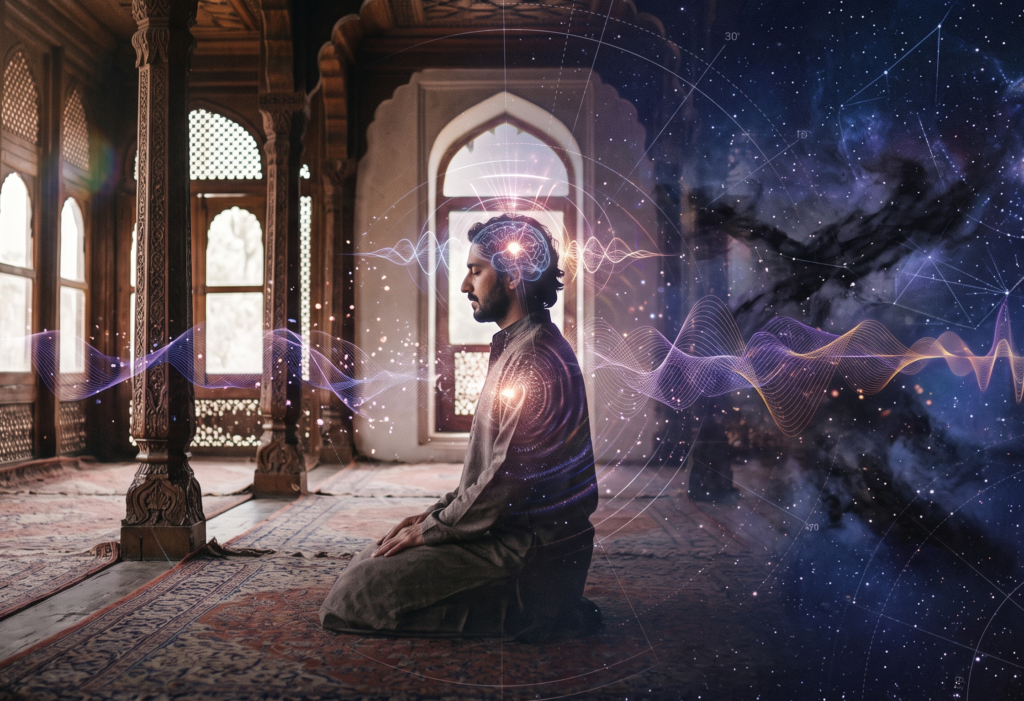
At a deeper theoretical scale, quantum mechanics introduces the observer effect, where the measurement or conscious interrogation of a subatomic system influences its physical state. While science remains cautious about conflating microscopic mechanics with macroscopic reality, this principle offers an evocative philosophical mirror to the spiritual doctrine of Niyyah, or conscious intention. When a believer engages in Dua (supplication), consciousness is directed toward an ultimate purpose while standing before an expansive field of divine possibility. Genuine intention acts as an active, conscious alignment between inner resolve and divine will.
Humanity, however, is not merely a biological receiver or cognitive engine; it is sustained by an animating soul (Ruh). The pervasive psychological exhaustion and inner disquiet modern societies define as bekarari or besukooni often point beyond clinical neurochemistry to spiritual atrophy. While human beings carefully tend to physical survival, bathing, hydrating, eating, resting, and dressing, the subtle soul is routinely starved of its native sustenance. The soul languishes without regular contemplative prayer (Salah), silent meditation, moral rectitude, and genuine humility. Just as bacteria poison the bloodstream, deep-seated spiritual afflictions chief among them hasad (destructive envy), gheebat (backbiting and malice), and takabbur (haughty arrogance) infect the human spirit, yielding chronic unrest.
The ultimate flaw in human reasoning is not that sensory perception is limited, but that humanity continually mistakes the boundary of sight for the boundary of existence. While science systematically maps the mysteries of the cosmos, perennial spirituality has maintained for millennia that the deepest realities defy physical optics. The unseen was never intended for the eyes; it was meant to be perceived through disciplined intellect, ethical clarity, reflective faith, and the inner sight of the soul.
Disclaimer: The views expressed in this feature article are solely those of the author and do not necessarily reflect the official editorial stance or opinions of this publication. The author can be reached at [email protected]
Leave a Reply