Deeply rooted in Central Asian baking traditions, the sesame-crusted Chochvor remains an enduring symbol of Kashmiriyat. While modernity reshapes the Valley, this humble tandoori loaf still brings communities together over morning tea.

In the bustling streets and meandering alleys of Kashmir, amidst the relentless clamour of modernity, there exists an enduring relic of our cultural richness, a culinary tradition that resolutely refuses to be forgotten. This is the customary Chochvor, also known as Telvor, a traditional savoury, yeast-leavened local bread that thrives to this day at the very heart of the Valley’s food culture. While Kashmir boasts a renowned pantheon of traditional breads crafted by the local bakers, the Kandur Tchot, ranging from flaky bakirkhani and paper-thin lavasa to sweet sheermal and crumbly kulcha, the humble Chochvor stands apart, serving as a fragrant reminder of the enduring necessity to preserve our heritage.
Chochvor is far more than an everyday accompaniment to tea; it is an emblem of antiquity, sustainability, community life, and cultural resilience. Long before dawn breaks over the snow-dusted peaks, the traditional subterranean clay tandoors of Kashmir are stoked, filling the crisp morning air with the intoxicating aroma of freshly baked dough. As generations gather around warming cups of tea, savoring the distinct flavors of these tandoori delicacies, Chochvor keeps the flame of this ancient baking craft burning bright.
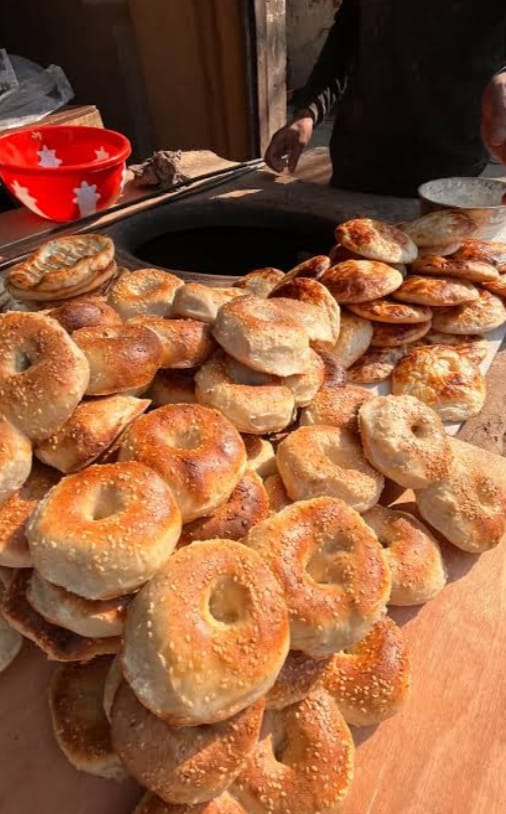
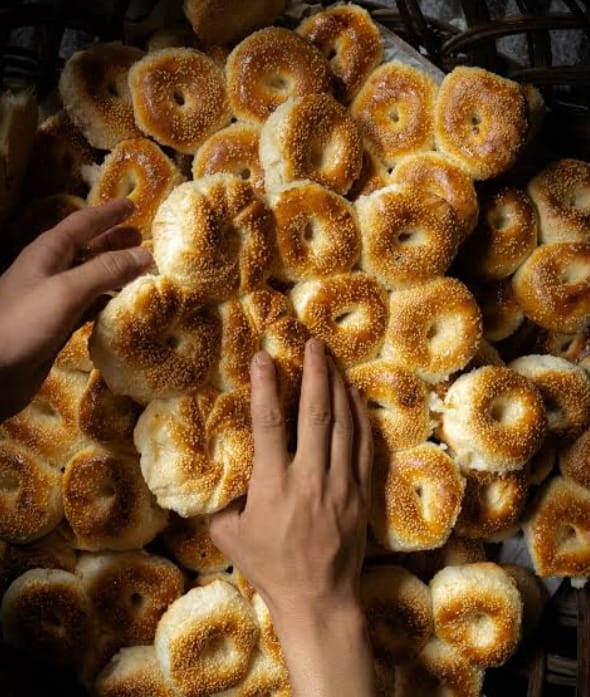
Modest in size, Chochvor commands immense fame across the length and breadth of the Valley. Often compared to a dense, artisanal bagel or doughnut, it boasts a soft, stretchy, and chewy interior coupled with a distinctive hollow in the center. Its golden, crusty crown is generously encrusted with roasted sesame seeds, or til, an embellishment that lends the bread its alternate name, Telvor. When tapped, its crust gives a subtle hollow sound, yielding upon the first bite to reveal a pillowy crumb that absorbs butter or clotted cream with sublime grace.
Traditionally savored alongside steaming cups of salted pink Nun Chai or saffron-infused Kehwa during breakfast or as an evening snack, Chochvor carries a venerable lineage. In popular folklore and historical accounts, the technique of baking these breads in underground clay tandoors is widely believed to have traveled straight from Central Asia and Persia during the fourteenth century alongside the revered Sufi saint Mir Sayyid Ali Hamadani, known affectionately as Shah-e-Hamadan. Over the centuries, the recipe became intrinsically woven into the fabric of Kashmiri hospitality. Unlike many other confections that wax and wane with contemporary trends, Chochvor holds an irreplaceable place in the daily routine of Kashmiris. At the crack of dawn, queues form outside local bakeries as it sells like hot cakes. Praised for being light and gentle on the stomach, it remains in perpetual demand across every district.
Historically, the bread served as an indispensable travel companion. In bygone eras, when journeys across rugged mountain passes were arduous, travelers invariably packed Chochvor in their bundles, confident in its ability to retain its moisture, stay fresh for days, and reliably satiate hunger. For centuries, this specialized craft remained the exclusive preserve of the traditional Kandur community, whose clay ovens have anchored neighborhood social life for generations. In recent decades, however, the yearning for this quintessential taste has transcended the Kandur’s shop, prompting home bakers and the Kashmiri diaspora to master the art in modern kitchen ovens.
For many, the bread evokes tender, nostalgic memories. During childhood, whenever fever struck, our parents would gently offer us warm Chochvor soaked in Nun Chai, firmly believing in its restorative, soothing power. Every Friday at our village Darasgah, after hours of lessons, students were treated to fresh Chochvor paired with sweet, spiced Kehwa. Decades have elapsed, and while we continue to pair Kehwa with Chochvor today, the unique flavor, warmth, and innocence of those Friday gatherings remain utterly inimitable.
Every region of Kashmir takes pride in its own baked specialization. While Pampore is celebrated for its rich Sheermal, Shopian for its crisp Kripan, Anantnag for its layered Katlam, Baramulla for its savory Kulcha, and Srinagar for its golden Bakirkhani and soft Girda, the northern districts of Sopore and Bandipora are famed for producing the finest quality Chochvor in the entire Valley. Today, the tradition has traveled well beyond the borders of Jammu and Kashmir. Women settled abroad faithfully recreate the delicacy in conventional ovens across distant cities, ensuring that their children remain tethered to their roots.
“One deeply misses Kashmiri bread, especially Chochvor, whenever one is outside the Valley, because it encapsulates the essence of Kashmiriyat,” observes Dr. Rafiq Masoodi, noted writer, former Secretary of the Jammu and Kashmir Academy of Art, Culture and Languages, and former Additional Director General of Doordarshan. “It is an inseparable part of our identity and a cornerstone of Kashmiri culture. Among all the varieties of local bread, Chochvor wears the crown. It is, without question, everyone’s favorite.” As modernity continues to reshape our lives, honoring and passing down this age-old tradition ensures that the sensory heritage binding Kashmir to its past remains vibrant for generations to come.
Disclaimer: The views expressed in this feature article are solely those of the author and do not necessarily reflect the official editorial stance or opinions of this publication.
Leave a Reply