The shift from MGNREGA to VB-G RAM G expands guaranteed work while targeting long-term village wealth. Its success will depend on whether daily wages build climate-resilient, durable infrastructure that outlasts the muster roll.
By Mudasir Koul
It should leave behind a functional water harvesting structure that sustains a farmer through erratic dry spells, durable connectivity that eases daily commutes, an asset that provides a foundation for micro-enterprises, or a village demonstrably better prepared for extreme weather. This is the overarching imperative emerging with the rollout of the Viksit Bharat–Guarantee for Rozgar and Ajeevika Mission (Gramin), or VB-G RAM G.
For two decades, the Mahatma Gandhi National Rural Employment Guarantee Act (MGNREGA) served as the central safety net of India’s rural economy. Enacted in 2005, it established a statutory right to 100 days of guaranteed wage employment for rural households willing to perform unskilled manual labour. Over the years, MGNREGA cushioned rural distress during agrarian downturns, drought years, and the economic shocks of the pandemic. Yet, it also faced systemic critique: public works were too often ephemeral, procedural burdens weighed down outcomes, and asset durability rarely matched the scale of fiscal expenditure.
With the coming into force of the VB-G RAM G framework on 1 July 2026, the statutory architecture of rural labour has undergone its most decisive transformation. The baseline entitlement has expanded from 100 to 125 days of guaranteed employment per household. Crucially, the legislation shifts focus from rudimentary relief work to a mandate centered on productive rural infrastructure, livelihood enhancement, ecological restoration, and climate resilience.
This transition must not be understood as a cosmetic exercise in rebranding. It represents a paradigm shift in how public finance, rural labour, and regional planning intersect. The guiding question is no longer simply how many person-days of employment are logged on an administrative dashboard, but whether those days of collective labour construct durable public goods capable of transforming rural economies over the long haul.
This structural reboot arrives alongside India’s broader trajectory toward Viksit Bharat@2047—the national objective of achieving developed-nation status by the centenary of independence. A modern economy cannot be realized solely through urban expansion, industrial corridors, and technology parks. It must take root across India’s 250,000 Gram Panchayats, where agriculture, horticulture, animal husbandry, and allied rural trades still sustain hundreds of millions of livelihoods. VB-G RAM G seeks to bridge this divide by aligning immediate wage disbursement with the structural requirements of tomorrow’s village economy.
The operational success of VB-G RAM G will depend fundamentally on the quality and contextual relevance of the works selected. Under the statutory schedule, public works are categorized into four critical pillars: comprehensive water management and conservation, core village infrastructure, targeted livelihood assets, and climate-proofing measures against extreme weather shocks. This integrated scope ensures that manual employment serves a dual purpose: a worker earns a transparent, guaranteed wage today, while the community inherits infrastructure that continues to yield dividends for decades.
This approach holds acute significance for Jammu and Kashmir. The Union Territory’s fragile Himalayan topography, microclimates, and diverse rural economies mean development priorities vary sharply across districts. One valley requires de-silting of irrigation channels (kuhls) and slope stabilization; another demands apple-belt cold storage facilities, milk collection shelters, or all-weather feeder roads. Development achieves purpose only when public expenditure mirrors these ground realities.
To systematize this local prioritization, the Viksit Gram Panchayat Plan (VGPP) was launched nationwide on 2 October 2026. The VGPP framework is designed to integrate grassroots planning across multiple Centrally Sponsored Schemes, converging rural employment, agrarian credit, watershed management, and renewable energy into a single coherent village development blueprint.
At the Panchayat level, the VGPP must avoid lapsing into bureaucratic checklist exercises. It requires elected representatives and community members to interrogate their plans directly: What infrastructure bottleneck holds back local household income? Which asset benefits the widest section of marginalized producers? Can every rupee spent simultaneously generate fair wages and create an asset that endures for twenty years?
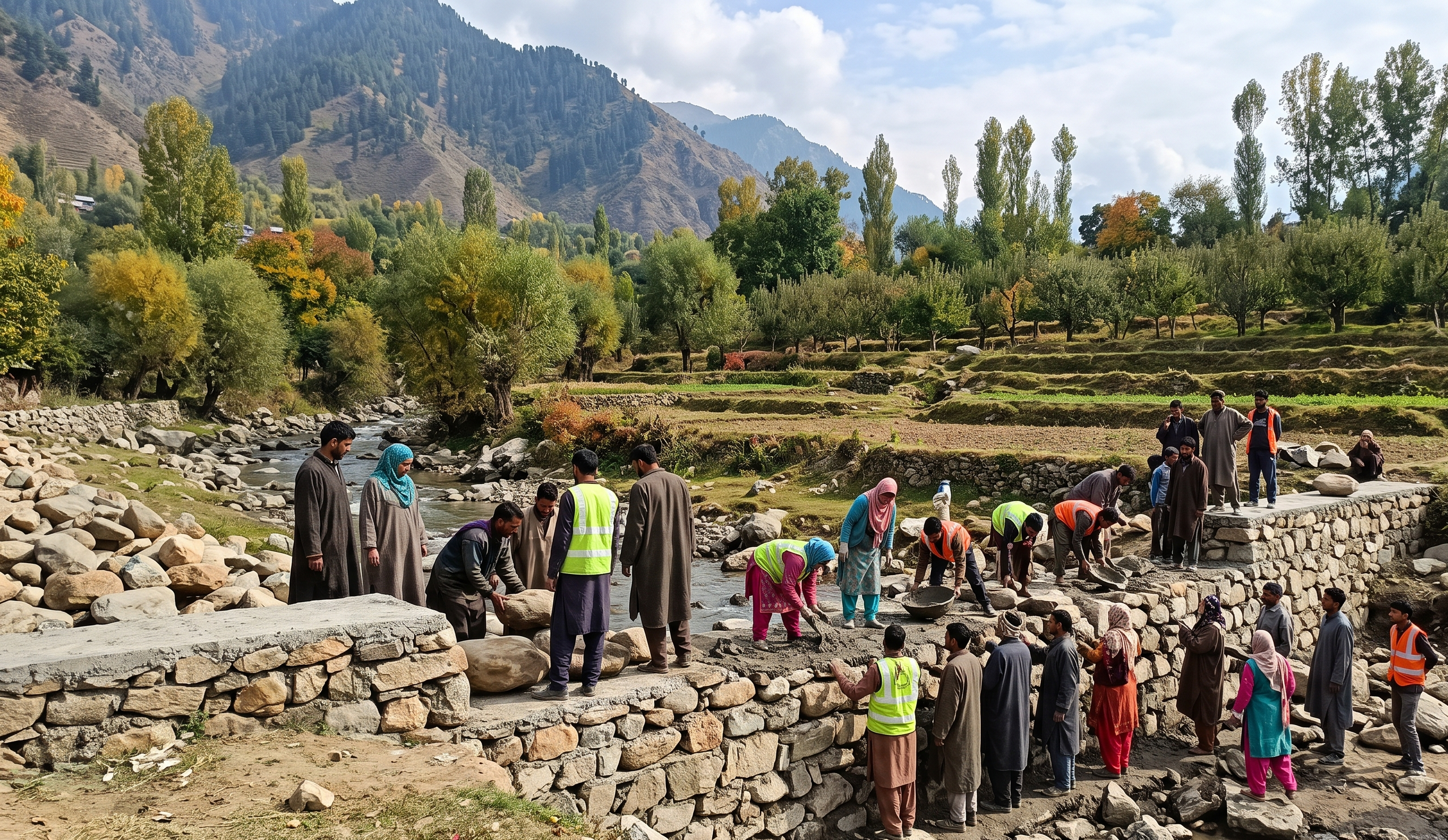
Consider Goripora Panchayat in North Kashmir, where local administration is actively implementing this shift. As the VGPP exercise unfolds, development must be evaluated through tangible, long-term utility rather than sanction orders and expenditure tallies.
When a community undertakes a water security project, such as terraced bunding, deep-pond restoration, or check-dam construction, the worker receives immediate wage support deposited directly into their account. For the village, a well-engineered structure recharges the water table, irrigates orchard land, and buffers households against seasonal precipitation deficits. Similarly, durable community assets supporting sheep farming, dairy collection, or post-harvest storage create recurrent income streams long after muster rolls are closed.
Herein lies the core thesis of VB-G RAM G: employment generation and asset building are not competing priorities. Properly planned, the dignity of rural manual labour becomes the primary engine of community capital creation.
Yet this transition brings substantial institutional responsibilities. A 125-day statutory guarantee and an emphasis on durability will fall short if execution falters. Weak technical design, poor civil engineering supervision, procurement bottlenecks, or absent post-construction maintenance can reduce even well-funded projects to disrepair. Rigorous social audits, community oversight, geo-tagging, and timely wage disbursement remain essential to safeguarding the integrity of the process.
Administrative continuity has been maintained to prevent disruption. The Union Government has clarified that existing MGNREGA job cards remain legally valid throughout the migration period until new Gramin Rozgar Guarantee Cards are distributed, and ongoing legacy works are systematically transferred into the new MIS portal to ensure completion.
Ultimately, the aspiration of Viksit Bharat@2047 will be measured by the lived condition of rural India. National advancement cannot occur by leaving the countryside behind. Stronger village infrastructure, sustainable livelihoods, and ecological resilience are not secondary byproducts of development; they are development itself.
The true benchmark of VB-G RAM G will not be found in aggregate person-day counts alone. Its lasting standard will be what standing remains after wages are cleared, worksites are cleared, and the next season begins. When public employment delivers both immediate security to a household and an enduring asset to a village, it accomplishes something far greater than temporary relief—it lays the foundation for generational self-reliance.
Disclaimer: The views expressed in this feature article are solely those of the author and do not necessarily reflect the official editorial stance or opinions of this publication.
Leave a Reply