Guarding the treacherous alpine gateways of Kashmir, these fortified stations formed an unyielding first line of defense. By leveraging rugged chokepoints, small frontier garrisons successfully turned back massive invading forces and secured the kingdom.
The mountainous geography of Kashmir has long dictated the political, military, and administrative destiny of its historic kingdoms. Encircled by the formidable bulwark of the Himalayas and connected to surrounding territories only through a precarious network of high-altitude passes, the Kashmir Valley was forced to construct an exceptionally sophisticated frontier defense apparatus. This system was designed not only to secure borders against predatory incursions, but to regulate commerce and monitor all cross-border movement with bureaucratic precision. At the heart of this ancient containment strategy stood the drangas strategic frontier watch-stations erected at the chokepoints of alpine defiles and along vital arterial corridors. Extensively chronicled in Kalhaṇa’s twelfth-century masterwork, the Rājataraṅgiṇī, and corroborated by a dense tapestry of archaeological remains, spatial geography, and surviving toponymy, these installations operated far beyond the scope of rudimentary border posts. Instead, they functioned as integrated nerve centers that blended territorial defense, customs verification, and civil governance.
Centuries later, the modern landscape preserves the memory of this institutional machinery: scattered across the vale, villages, hills, and riverbanks still bear names derived from Drung or Dranga. In the lexicon of regional historiography, classical sources deploy several interchangeable designations for these frontier stations, most prominently dranga and dvāra, the literal “gate” of the valley. Their primary mandate was absolute containment: guarding the razor-thin passes that formed the only viable corridors through which invading armies, trading caravans, ascetic pilgrims, and wanderers could breach or exit the mountainous basin. To maintain vigilance, the state did not rely on seasonal levies; the drangas were permanently garrisoned by professional troops commanded by commissioned officers titled Drangādhipa, Drangeśa, or Dvārapati. This unbroken chain of command reveals that the dranga network was no ad-hoc wartime measure, but a institutionalized frontier bureaucracy balancing military deterrence, intelligence work, and fiscal extraction directly beneath the crown’s purview.
The broader architecture of the Kashmiri military underscores just how critical these frontier garrisons were to state survival. As the historian Mohibbul Hasan documents in Kashmir Under the Sultans, provincial soldiers were systematically deployed to secure major urban markets, while secondary garrisons entrenched themselves in internal valley fortifications at locations like Nagam, Ur, Andarkot, Chiraodar, Manasbal, and Birij. Yet these internal bulwarks represented merely the second line of defense; the true outer shield rested upon the fortified drangas anchoring the mouths of the outer perimeter passes. Troop deployments fluctuated according to the strategic threat profile of each pass, but every individual dranga fell under the executive jurisdiction of an appointed military commander, a Nāyaka. This unified hierarchical chain of command ensured that frontier posts operated as interconnected regional nodes tied directly to the state’s central high command rather than as vulnerable, isolated outposts left to fend for themselves.
The operational lethalness and procedural efficiency of these watch-stations emerge with striking clarity in the pages of the Rājataraṅgiṇī. During the chaotic reign of King Sussala in the early twelfth century, the royal assassin Utpala attempted a desperate escape through the mountain passes following his treasonous strike. He made it only as far as the Dranga of Surapura. There, the alert commandant of the watch-station intercepted the fugitive, executed him on the spot, and dispatched his severed head directly to the court of King Jayasiṃha at Avantipura. The incident stands as a vivid journalistic dispatch from medieval Kashmir, underscoring the formidable reach of frontier commanders and their absolute command over movement through high-value corridors. Kalhaṇa provides further operational snapshots elsewhere, highlighting the heavily guarded route threading toward the Kishanganga Valley and the pivotal fortress-station at Varāhamūla modern Baramulla, which locked down the primary western entrance into the heart of Kashmir.
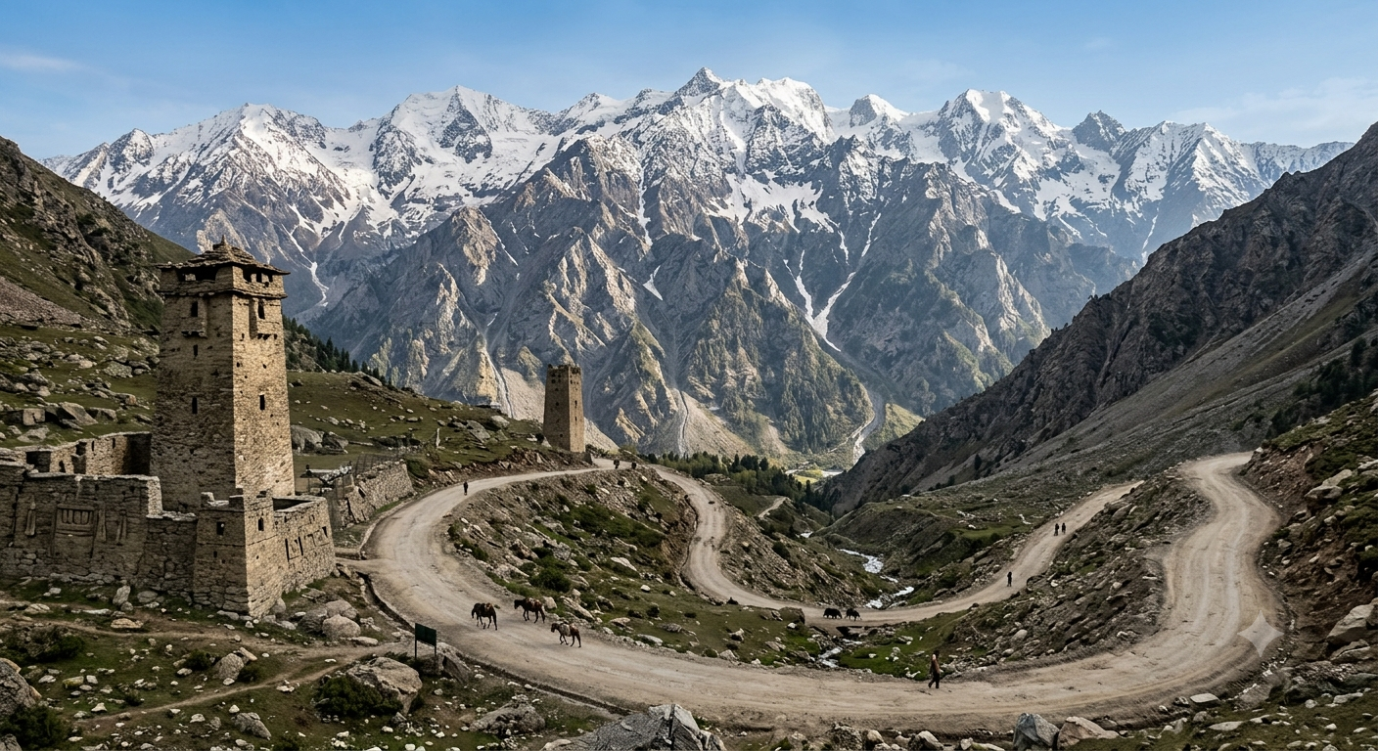
The decisive military value of the dranga system became glaringly evident during the armed insurrection mounted by the pretender Lothana against King Jayasiṃha. Recognizing that he could not destabilize the realm without paralyzing royal mobility, Lothana bypassed standard civic targets to wage a deliberate campaign of sabotage against the mārga-drangas, the strategic roadway watch-stations and their auxiliary fortifications. By specifically demolishing these installations, the insurgents severed military communications, fractured frontier integrity, and stripped the crown of its physical oversight of transport routes. The calculated destruction of the drangas demonstrated their true nature: they were the operational connective tissue holding royal authority together across broken terrain.
Crucially, the genius of the dranga framework lay in its dual mandate. While conceived in the crucible of military necessity, each post operated concurrently as a high-volume customs clearinghouse and policing depot. Scribes, inspectors, and revenue officers stationed at these gateways inspected all incoming and outgoing caravans, audited manifests, checked traveler credentials, collected state tariffs, and enforced sanitary or public order regulations along the border tracks. Through this institutional marriage of defense and revenue, the Kashmiri state transformed geographical confinement into a profitable asset, simultaneously repelling external threats, curbing illicit smuggling, and financing its treasury on the back of long-distance continental trade.
The renowned scholar and explorer Sir Aurel Stein placed this frontier architecture at the center of his historical analysis, concluding that the geopolitical sovereignty of medieval Kashmir was virtually guaranteed by its watch-stations. Because access into the valley’s fertile plains was funneled through a finite cluster of treacherous mountain defiles, compact, well-drilled garrisons at the drangas were capable of choking off massive external invasions. Small detachments holding fortified bottlenecks routinely turned back sweeping raids launched by the fierce Dard tribes of the high northern ranges and the persistent Khasa clans who dominated the southwestern highlands. The valley’s dramatic topography acted as a massive force multiplier, allowing an austere administrative network to provide comprehensive territorial defense with maximum economy of force.
This ancient blueprint of defensive governance is stamped indelibly across modern Kashmiri geography. A survey of current settlements reveals a constellation of place names preserving the archaic root: Drung Khag in Budgam, Drungbal near Pampore, another Drungbal commanding Baramulla, Dringla in Karnah, Drungnad near Shadimarg in Pulwama, and Drung near Tangmarg. Every single one of these modern hamlets clusters precisely around the mouth of a historic pass or straddles the remnants of a grand trade route. Their distribution is an open-air ledger of antiquity. Drung near Tangmarg, for instance, anchored the legendary Tosamaidan highway, the great trans-Himalayan corridor that linked the Kashmir basin with Poonch, the ancient Parnotsa. From Poonch, merchants and envoys descended into the plains of western Punjab, ultimately linking up with the grand trunk road toward Peshawar and the trade routes of Central Asia. Just along the ridge, Drung Khag occupied an interlocking tactical position controlling access to the same Tosamaidan–Poonch artery, illustrating the multi-layered depth of pass surveillance.
Far from being a collection of solitary stone bunkers, the drangas represented an integrated apparatus of border surveillance, intelligence collection, fiscal administration, and territorial defense. Through centuries of regional upheaval, this system shielded the valley from catastrophic invasion while tethering its economy to the wider Eurasian world. Today, the quiet survival of the word Drung in the everyday geography of Kashmir remains a striking monument to this medieval doctrine of frontier governance, an enduring testament to how physical geography, when governed by administrative design, can forge an impregnable mountain redoubt.
Disclaimer: The views expressed in this feature article are solely those of the author and do not necessarily reflect the official editorial stance or opinions of this publication. The author can be reached at s[email protected]
Leave a Reply