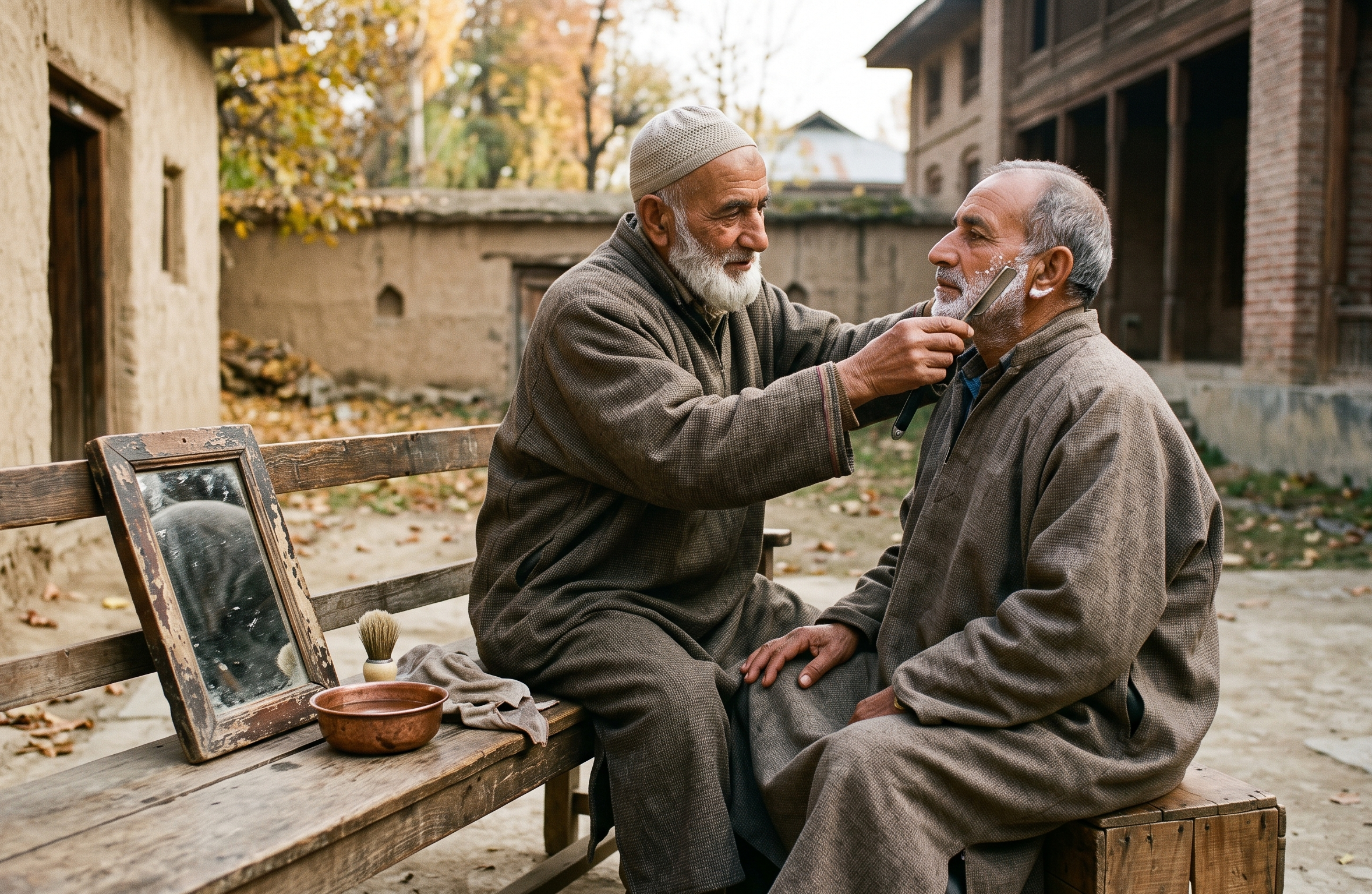
Armed with a straight razor and a chipped wooden mirror, an itinerant barber carried the living history of rural Kashmir across six decades. As modern salons replace open-air courtyards, his fading footsteps take with them an unwritten archive of generations.
By Khursheed Dar
Once, in rural Kashmir, the traditional itinerant barber known to generations simply as the Naid was an essential fixture of daily life. Long before glass-fronted salons and unisex parlours sprang up across small-town intersections, these mobile craftsmen carried their livelihood on foot. They moved from house to house with a few humble tools packed inside a worn leather pouch or canvas satchel.
Sometimes their workplace was an open courtyard (aangan), paved with sun-dried river mud. Sometimes it was beneath the dappled canopy of a walnut or chinar tree in an orchard. On long summer afternoons, it was right beside the emerald terrace of a paddy field, where farmers paused between weeding and irrigating to wait their turn. Even a dusty bend along a village road could turn into a makeshift parlour at a moment’s notice.
They shaved coarse beards. They trimmed overgrown hair. They dressed the heads of young boys preparing for Friday congregation or festival days. But beyond the simple cut of their shears, they performed a far more enduring role: they connected people. They stitched together the social fabric of neighbouring hamlets, linking village to village long before blacktop roads and telecommunication reached deep into the valley.
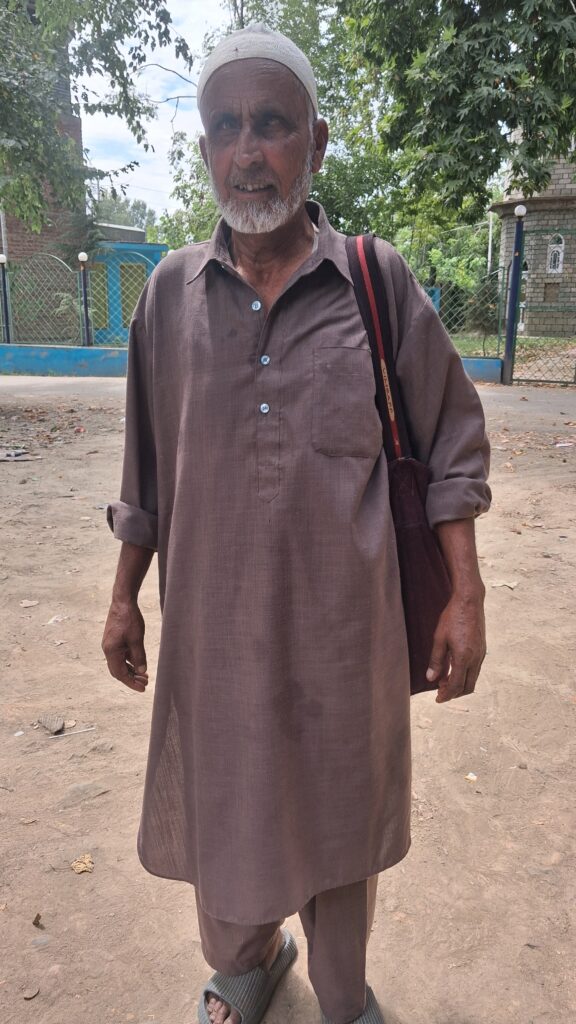
Today, while walking to offer Zohar prayers at the Jamia Masjid of our village, I met Aam Kak, our village’s traditional barber. He travels from Ganapora, a village lying a short distance away across the seasonal streams. For nearly sixty years, through political upheavals, harsh winters, and the steady churn of decades, he has walked this identical route. He was already a familiar figure in these lanes when I was not yet born.
I paused to speak with him under the cool autumn shade. What began as a casual exchange soon turned into an evocative journey through a Kashmir that survives now mostly in fading memory.
Leaning on his cane, Aam Kak spoke tenderly of the people he had shaved, the weddings he had helped prepare, and the generations whose hair he had styled and trimmed over six decades. A vast majority of those men are no longer alive. Their hearty voices have long fallen silent; their homes have been rebuilt; their sons have aged into frail elders; and their grandchildren now inhabit spaces once occupied by ancestors they know only from framed portraits.
Yet Aam Kak remembers each of them with startling clarity. He recalls their full names, their ancestral nicknames (kram), their household lineages, and the intricate, often fragile relationships that tied family to family across the pargana. He can still name elders who vanished from this valley half a century ago.
Listening to his soft, gravelly voice, it struck me that the traditional Kashmiri barber was never merely a tradesman. He was the living, unwritten register of rural Kashmir.
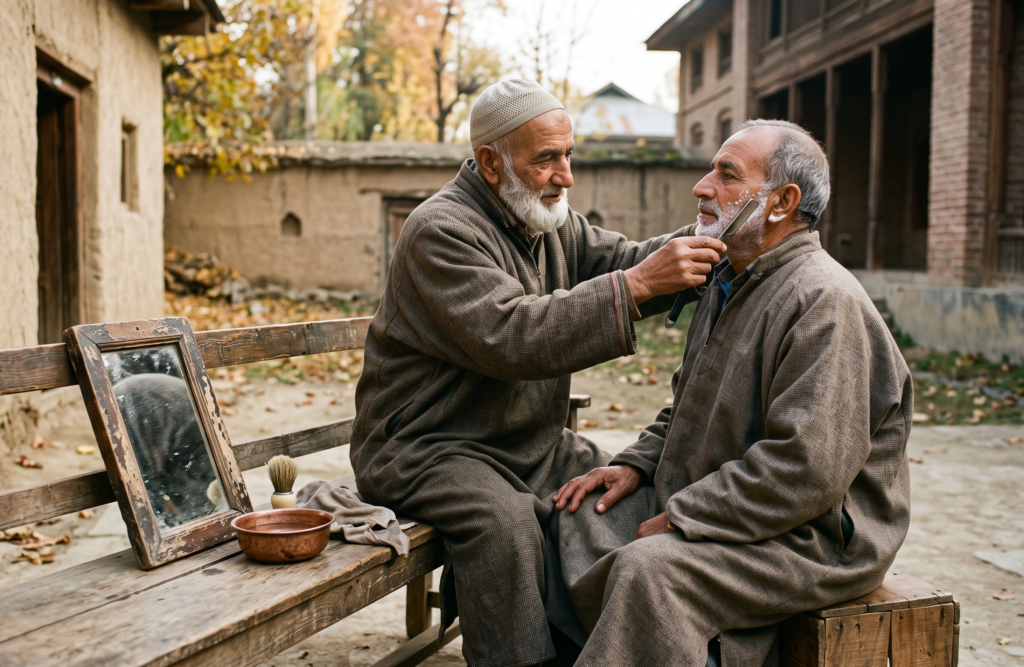
His kit was remarkably modest: a handheld mirror secured within a thick, chipped wooden frame; an imported carbon-steel straight razor (ustura); a pig-bristle brush; and a small, hammered copper bowl (kandkari cup). That was almost all he ever required. There were no electric trimmers humming against the wall, no hydraulic swivel chairs, no neon strip lights, no mirrored vanity partitions reflecting synthetic aftershaves. Just a wooden-framed mirror, a gleaming straight razor, and a little copper bowl.
The mirror caught the weathered countenance of a villager. The razor swept away the week’s stubble. The copper bowl held cold well water to soften the skin. Around these humble artefacts, effortless conversation unfolded. Men opened their hearts while seated on an overturned wooden crate or a woven grass mat (patij). The barber listened, nodded, and understood.
Because the barber traveled freely between households crossing courtyard thresholds that even close neighbours seldom entered, he possessed insights into local life that few others did. In an era without mobile networks, optical fibre, or local news sheets, information traveled by foot. The barber served as an informal herald. He carried tidings of births, bereavement, sickness, and crop yields from one end of the township to the other. Frequently, he acted as a discreet matchmaker (manzim-jor), quietly floating prospective alliances between respectable families because he knew the true temperament, domestic peace, and economic footing of every house he visited. His intimate familiarity with diverse households accorded him an indispensable standing in traditional Kashmiri society.
His craft was also intricately attuned to the agrarian rhythm of the valley. In the golden weeks of autumn, when the paddy stalks were threshed and stacked across the plains, barbers were seldom paid in cash. Instead, they collected their customary dues in grain, a measure of freshly harvested shali directly from the farmer’s barn. The farmer gathered his sustenance from the earth; the barber received a fair share for keeping the community groomed throughout the year. It was an unwritten, centuries-old social contract (faslana), embedded in mutual reliance and dignity. Money was not the sole medium of human fellowship.
Today, that agrarian social fabric has all but unraveled.
The younger generation has little reason to seek out Aam Kak. Armed with smartphones, the youth frequent modern salons equipped with revolving leather chairs, sanitised buzzers, styling gels, and imported fade blades. They will likely never know the unhurried joy of sitting under an open sky, waiting for the neighbourhood barber while hearing village gossip drift across the fields.
Yet a handful of aging men still seek out Aam Kak on market days and mosque steps. He still shaves them with a steady hand. They come not simply because they need a trim, but because his weathered palms belong to their era. When Aam Kak wields his razor, he holds an intimate fragment of a vanishing world.
When he glances into that scratched, wooden-framed mirror, he sees far more than the reflection before him. He glimpses the ghostly silhouettes of men who sat in that same light decades ago debating crop rates, winter preparations, family disputes, and communal hopes.
Modernity brings convenience, and change is relentless. Yet traditions that bound human souls together should not slip away unacknowledged. The itinerant barber was part of the invisible civic architecture of old Kashmir: a dedicated craftsman, an affectionate companion, a bearer of news, a trusted reconciler, and above all, an eyewitness to history. He watched young boys turn into fathers, and fathers into grandfathers. He smoothed the collars of men whose faces survive now only as faded monochromes on drawing-room walls.
As I parted from him to join the congregation, I understood that history is not preserved solely inside hardbound archives or state records. Often, it lingers in the quiet recollections of an elderly man resting by the roadside. It lies hidden in the bevel of a battered mirror, gleams along the honed steel of a razor, and slumbers in the cool hollow of an old copper bowl.
I promised Aam Kak that his life and craft would be documented and remembered, preserving his voice for those who will look back on this era. He listened without speaking, his gentle eyes acknowledging that some promises carry weight far beyond everyday speech. Then he offered a modest, warm smile, one carrying nearly sixty years of village memory. His razor will one day fall quiet, his mirror will lose its silvering, and his copper vessel will gather dust on a shelf. But so long as we record his journey, Aam Kak will endure as an irreplaceable custodian of our rural Kashmir.
Disclaimer: The views expressed in this feature article are solely those of the author and do not necessarily reflect the official editorial stance or opinions of this publication.
Leave a Reply