Long before Kashmir was reduced to a geopolitical battleground, it was one of Asia’s greatest engines of science, aesthetics, and philosophy. Today, that knowledge survives across the globe, while the valley and its exiled custodians have been systematically erased from the record.
By Satish Mahaldar
Kashmir is routinely reduced to a contemporary headline: security crackdowns, disputed borders, and unending geopolitical conflict. In modern discourse, it exists almost exclusively as a contested territory to be partitioned, administered, or argued over by rival nation-states. Yet beneath the noise of present-day politics lies a far older, meticulously documented truth that has been steadily buried, diluted, and denied: Kashmir was once one of the world’s foremost engines of knowledge. This is neither a nostalgic exaggeration nor an exercise in regional romanticism, but a verified civilizational reality. For centuries, the Kashmir Valley did not merely participate in intellectual currents; it generated, refined, and exported them across the Asian landmass, leaving an indelible mark on philosophy, medicine, astronomy, mathematics, and aesthetics. Yet today, a deep historical injustice endures. Even where that knowledge survives, Kashmir itself has been scrubbed from its own legacy, and more painfully, the living custodians of that tradition were violently uprooted from the soil that conceived it.
The scale of this intellectual inheritance is most immediately evident in philosophy and aesthetics. The monumental Tantrāloka, authored in the tenth century by the polymath Abhinavagupta, is not a provincial curiosity but a masterwork of human inquiry. Centuries before modern psychology and neuroscience began probing the nature of perception and consciousness, the thinkers of Kashmir Shaivism had already formulated an intricate, non-dual taxonomy of the human mind. They refused to divorce the sacred from the empirical, integrating both into a unified framework that posited consciousness not as a biological accident of matter, but as the foundational ground of all existence. From this rigorous tradition also arose the definitive formulation of rasa theory, the aesthetic doctrine detailing how literature and dramatic performance evoke transformative emotional states. Modern academia now revisits consciousness studies and cognitive aesthetics as cutting-edge frontiers, yet Kashmir mapped their foundational architecture a millennium ago. In mainstream academic narratives, however, the ideas are absorbed while the geography that birthed them is left unmentioned.
A parallel obfuscation occurred within the medical sciences. While the Aṣṭāṅga Hṛdaya of Vāgbhaṭa became a cornerstone of Ayurvedic practice across South Asia, in Kashmir it was not treated as a static relic. Kashmiri physicians tested, adapted, and expanded it to meet the harsh physiological realities of a high-altitude Himalayan climate. They developed nuanced clinical responses to acute respiratory ailments, chronic metabolic imbalances, and cold-induced disorders, integrating indigenous pharmacology such as saffron, warming alpine botanicals, and local mineral compounds. In doing so, they transformed classical theory into a responsive, environment-sensitive science, practicing a form of context-driven medicine that contemporary healthcare is only now beginning to prize. Yet as these clinical systems traveled into broader medical canons, their Kashmiri origins were slowly eclipsed, leaving behind vital techniques stripped of their geographical provenance.
Kashmir’s contributions to the exact sciences, astronomy, calendrical mathematics, and horology followed the very same trajectory. Kashmiri scholars calibrated panchāṅga systems with rigorous empirical accuracy, formulating mathematical calculations that accounted precisely for latitude, seasonal variances, and solar-lunar synchronization. Far from being dry, abstract reckonings, these calculations functioned as vital civic tools that governed agricultural planting, hydrological planning, and social organization. Kashmiri methods for predicting celestial eclipses and charting planetary motions entered extensive scientific networks that later intersected with Central Asian, Persian, and European traditions. The lines of intellectual transmission remain historically demonstrable, yet the attribution has been systematically fractured. The knowledge enriched the world, but its source receded from memory.
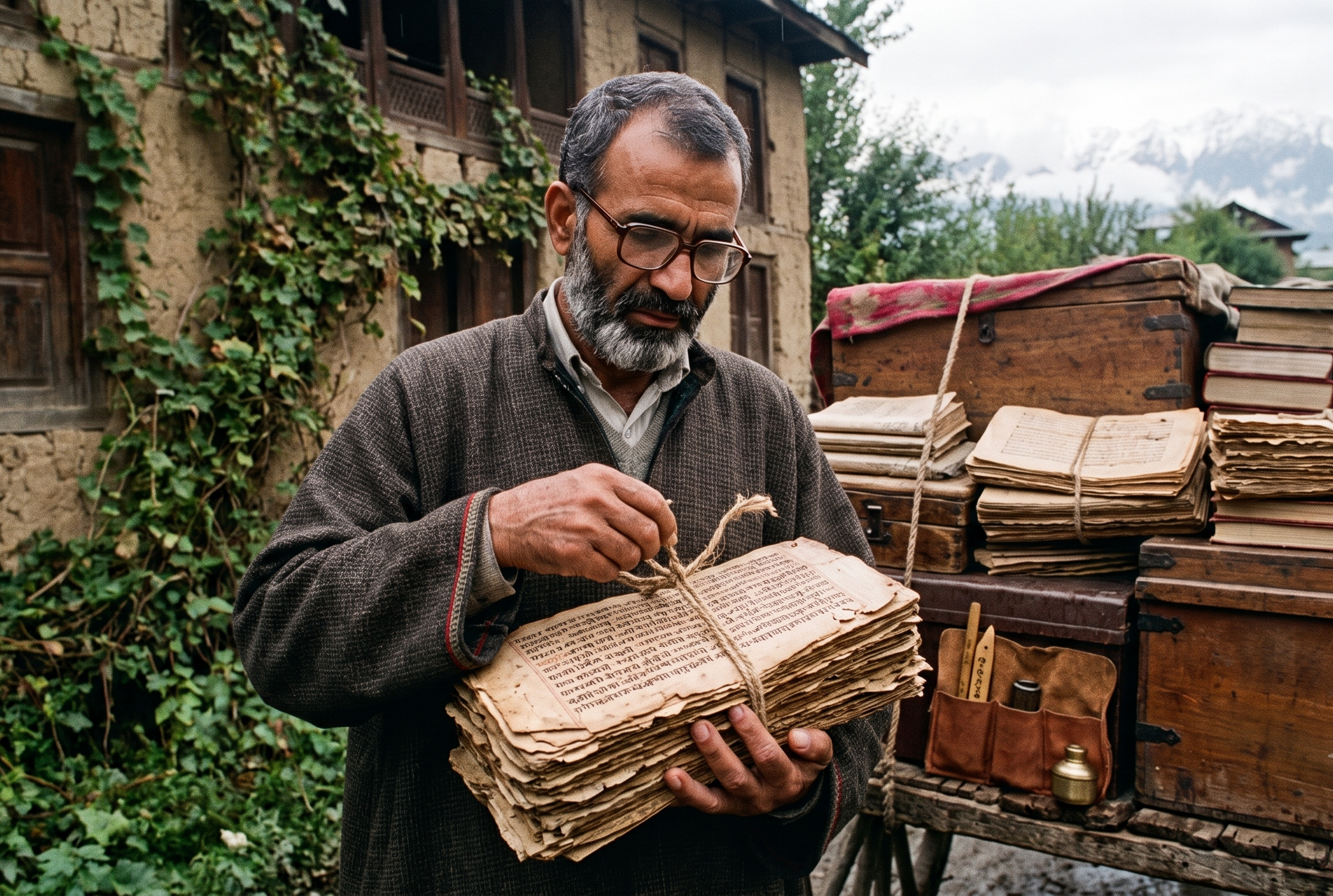
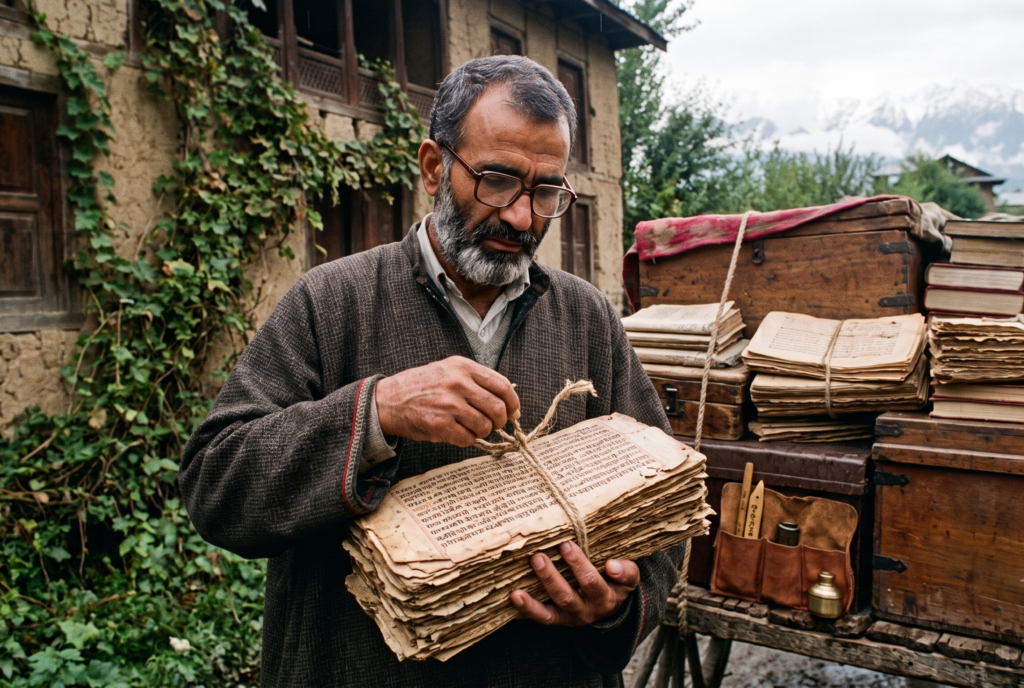
Understanding how a secluded mountain valley fostered such astonishing intellectual depth requires looking beyond physical terrain alone. Kashmir was situated at the crossroads of northern India, Central Asia, Tibet, and Persia, serving as a natural meeting ground for merchants, pilgrims, and scholars. But geography alone does not create genius; it merely enables contact. What Kashmir built was an exceptional intellectual ecosystem. It developed a disciplined manuscript culture using the indigenous Śāradā script, inking texts upon durable birch bark (bhūrjapatra) that resisted the valley’s damp cold and ensured long-term preservation. Ideas were never allowed to calcify into dogma; they were continuously copied, challenged, and refined through an intense culture of public debate and written commentary. Temple complexes and ashrams functioned as bustling academies where the guru-śiṣya paramparā safeguarded pedagogical rigor across generations, sustaining an intellectual ethos marked by daring philosophical synthesis. Kashmir engaged Vedic orthodoxies, debated Buddhist logicians at ancient seats of learning like Harwan, and integrated esoteric Tantric systems into an overarching, dynamic epistemology. It did not merely store thought; it produced entirely new ways of seeing the world.
Then came the rupture. This was not a natural, quiet fading over time, but a catastrophic structural fracture. Successive periods of institutional collapse, foreign invasions, iconoclastic zeal, and relentless political strife did not merely topple stone monuments; they shattered the human chains of transmission that kept this knowledge alive. Thousands of irreplaceable birch-bark manuscripts were burned, drowned in rivers, or left to disintegrate in abandoned homes, while others were carted away to distant private and foreign collections. Yet the most fatal loss was not textual, it was human. The custodians of this civilizational inheritance, the families of scholars, scribes, and practitioners who carried the oral keys and linguistic codes of these traditions, were forced into displacement and exile. With their flight, an unbroken continuum spanning millennia was abruptly severed from its roots, reducing living traditions to fragmented, silent artifacts.
To dismiss this collapse as an unavoidable casualty of history is to evade institutional and collective responsibility. When the primary bearers of an intellectual tradition are uprooted and their intellectual assets are scattered without state protection, it represents a catastrophic civilizational failure. The Indian state failed to safeguard this heritage, and the broader republic failed to grasp the magnitude of what was slipping away. This was not merely the local tragedy of an exiled community; it was the quiet dismantling of an indispensable organ of India’s civilizational mind. What followed was an even more insidious form of erasure, as rare Kashmiri manuscripts in global archives were catalogued under the generic label of “miscellaneous Sanskrit texts,” stripped entirely of their regional lineage. Kashmir, once revered across the subcontinent as Śāradā Pīṭha, the very seat of the goddess of learning was flattened into a militarized buffer zone, known only through the vocabulary of warfare.
Halting this civilizational amnesia requires an urgent shift from political rhetoric to deliberate institutional restitution. A concerted international effort must be launched to locate, catalogue, and digitally repatriate the vast corpus of Kashmiri manuscripts scattered across global libraries and private vaults, restoring their true Śāradā provenance. Academic bodies must fundamentally revise mainstream curricula in philosophy, linguistics, and the history of science to reflect Kashmir’s foundational contributions, dismantling the false assumption that it was ever an intellectual periphery. Most urgently, direct institutional backing must be extended to the surviving scholar-families and their descendants. A manuscript can be photographed and archived, but the specialized knowledge required to interpret its intricate commentaries and idioms lives only within the memory of its surviving practitioners. Without the revival of these custodians, any archival recovery remains dead paper.
There are moments in history when loss threatens to become irreversible, when an intellectual heritage loses its land, its people, and its living continuity all at once. That is the unresolved tragedy of Kashmir. The knowledge did not vanish from the earth, but it was orphaned, estranged from the soil that nourished it and the community that sustained it. The world continues to draw freely upon the fruits of Kashmir’s intellectual genius while remaining entirely indifferent to its origin. Until the provenance of this knowledge is restored and its displaced custodians are acknowledged, the global record of human thought will remain fundamentally distorted, and Kashmir will remain trapped as a contested geography, waiting for its civilizational soul to be remembered.
Disclaimer: The views expressed in this feature article are solely those of the author and do not necessarily reflect the official editorial stance or opinions of this publication.
Leave a Reply