
Modern education successfully trains students for global competition and economic efficiency. Unfortunately, it fails to teach the emotional intelligence required for genuine coexistence.
By Mool Raj
We live in an age of astonishing progress and disturbing contradiction. Humanity has reached extraordinary heights in science, technology, communication, and education. Never have people been so informed, so connected, and so equipped with knowledge. Classrooms preach coexistence, books speak of peace, and universities celebrate reason, dialogue, and critical thinking. Yet, outside those classrooms, the world continues to burn with hatred, suspicion, arrogance, and conflict. Nations still threaten one another, and communities still divide themselves on the basis of race, religion, language, ideology, and identity. Powerful societies still look down upon weaker ones. Even educated individuals, who have read history and studied ethics, often become participants in prejudice rather than protectors against it. This raises a painful but necessary question: if education teaches human beings to adjust, cooperate, and resolve conflict, then why do people and even nations continue to fight?
The answer lies in one of the deepest paradoxes of modern civilization: education can sharpen the mind, but it does not automatically soften the heart. Education teaches logic, but hatred is often driven by emotion. It teaches communication, but superiority is often rooted in insecurity. It explains history, but people still choose selective memory. It encourages discipline, but not always humility. In other words, education may show us how to live together, yet it does not always give us the will to do so.
One major reason is that human beings do not act only on reason. They also act on fear, ego, wounded pride, greed, and a deep attachment to their own group. A person may hold degrees and still remain trapped inside a narrow mentality. A nation may possess advanced institutions and still behave with primitive aggression. The world today shows us clearly that intellectual development and moral development do not always progress together. This is why some of the most destructive actions in history have not been committed by the ignorant alone; they have often been planned, justified, and executed by educated people. Knowledge, when separated from conscience, becomes dangerous. The same education that can produce healers can also produce propagandists. The same science that can cure disease can also build weapons. The same communication technology that can spread understanding can also spread lies at breathtaking speed.
Another reason lies in the way many education systems are structured. Much of modern education is designed to create efficiency, productivity, and national usefulness. Students are trained to compete, perform, and succeed. They are told to master subjects, but they are not always taught how to master anger. They are encouraged to speak, but not always to listen. They learn how to win arguments, but not how to understand pain. They are prepared for careers, but not necessarily for coexistence. As a result, many societies produce technically skilled individuals who are emotionally underdeveloped. The mind becomes powerful, but the spirit remains fragile. Such people can build systems, lead institutions, and influence nations, yet still be driven by superiority, prejudice, and hostility.

This imbalance is visible everywhere in the present world. We see it when nations speak the language of peace while preparing for war. We see it when political leaders exploit fear to strengthen their power. We see it when communities glorify their own suffering but refuse to acknowledge the suffering of others. We see it when patriotism turns into contempt, when faith turns into fanaticism, and when identity turns into arrogance.
At the centre of much of this lies the poisonous idea of superiority. Superiority is one of the oldest illnesses of human civilization. It is the belief that “we” are more deserving, more civilized, more moral, more chosen, or more important than “they” are. Sometimes this superiority is national, sometimes racial, sometimes religious, and sometimes cultural. But its logic is always the same: my group matters more, and therefore your dignity matters less. Once that mindset takes hold, hatred becomes easier to justify. A nation can then call domination “security.” A group can call prejudice “tradition.” A leader can call aggression “honour,” and an individual can call arrogance “confidence.”
This is how modern hatred survives even in an educated world. It does not always appear in crude form. Sometimes it wears a tie, sits in parliament, speaks fluent languages, writes polished speeches, and hides itself behind terms like strategy, civilization, interest, and order. But beneath the language, the same old instinct remains: the desire not merely to exist, but to stand above others.
That is why the present world crisis is not only political or economic; it is moral and educational. We have taught people how to compete globally, but not how to care globally. We have built institutions that reward achievement, but not enough systems that reward empathy. We have strengthened national identity, but not always human solidarity. Too often, education teaches students to become loyal to a flag before they become responsible to humanity. This does not mean national history or patriotism should be abandoned. A person can love their country deeply and still respect the rest of the world. True loyalty is not blind obedience. True loyalty means helping one’s nation become more just, more humane, and more honourable. A mature citizen does not prove love for their country by hating another country. Rather, they prove it by ensuring that their own nation does not lose its moral soul.
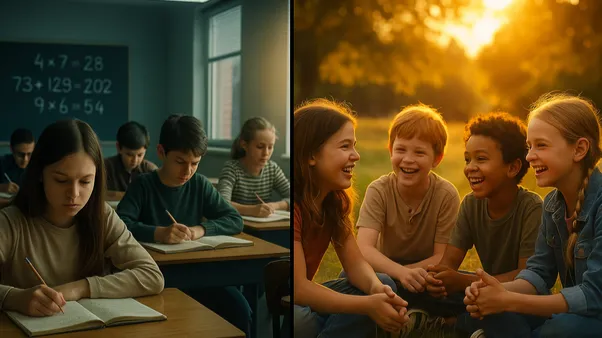
The future of peace depends on a new educational balance one that keeps knowledge but adds wisdom, keeps identity but adds humanity, and keeps excellence but removes arrogance. Students must not only learn mathematics, science, economics, and technology. They must also learn emotional intelligence, ethical reasoning, dialogue, historical empathy, and the discipline of seeing themselves in others. A child should not leave school merely knowing how to succeed; a child should leave school knowing how not to dehumanize. The world does not suffer today because there is too little information. It suffers because there is too little inner refinement. It suffers because power has outrun compassion. It suffers because many people have been trained to prove themselves, but not enough have been taught to restrain themselves.
If education remains limited to technical success, then the future may become even more dangerous: smarter machines, sharper propaganda, stronger weapons, and colder hearts. But if education begins to form character as seriously as it forms intellect, then perhaps humanity can still step back from the edge. The real test of education is not whether it produces powerful people. The real test is whether it produces people who know how to use power without hatred. Until that happens, the world will continue to live with this tragic contradiction: educated minds, but uneducated egos; advanced nations, but primitive hatreds; global connection, but moral isolation. And that is why the world still fights, not because it has learned nothing, but because it has not yet learned the most important lesson of all: no superiority can save a civilization that has forgotten how to see others as fully human.
Disclaimer: The views expressed in this feature article are solely those of the author and do not necessarily reflect the official editorial stance or opinions of this publication.
Leave a Reply