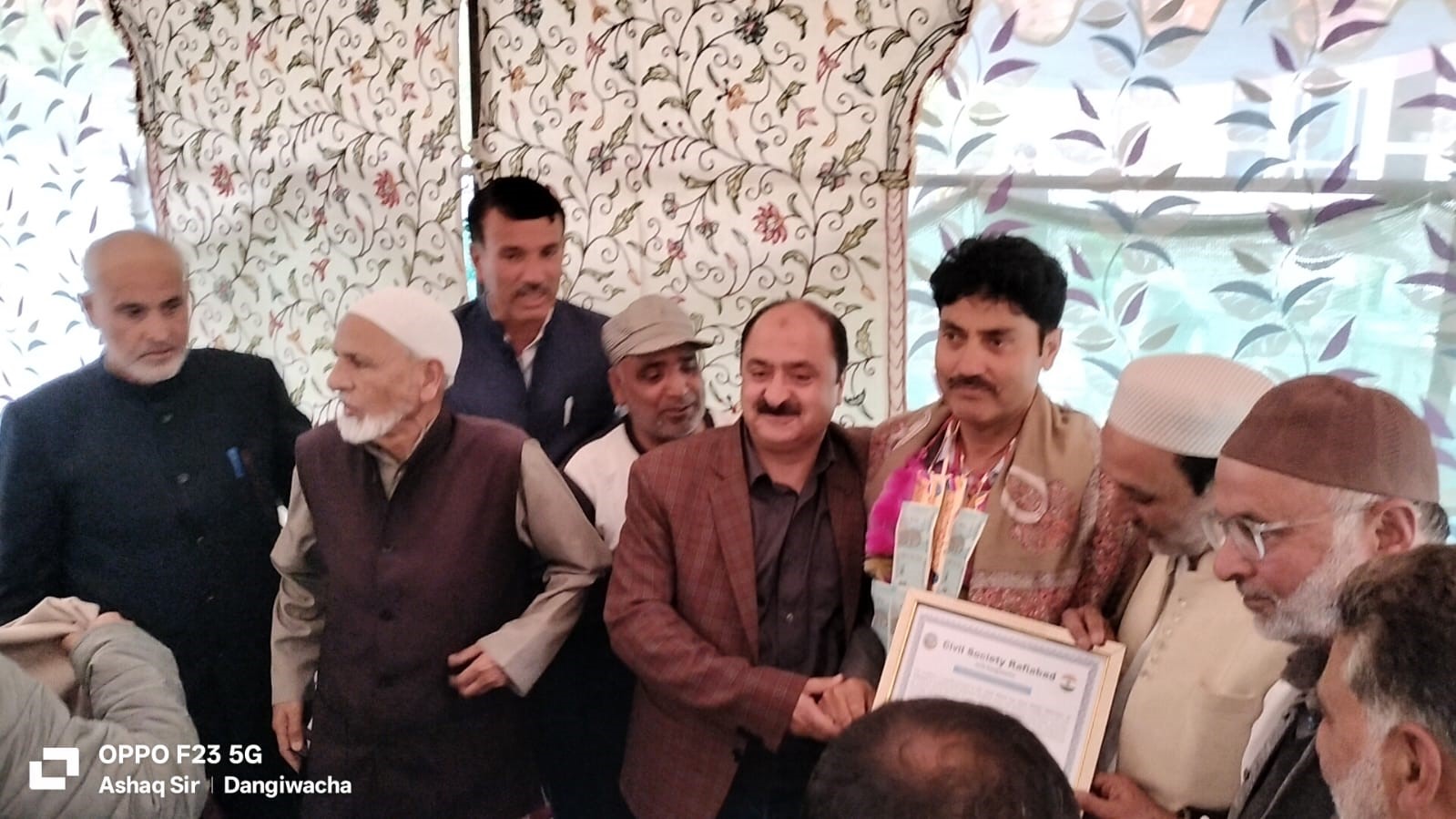
After decades of shaping minds and reflecting society, educator and columnist Naaz Sahib steps into a well-earned retirement. His story is a poignant reminder that true teaching goes far beyond the classroom walls.
By Manzoor Akash
Some teachers stay in our hearts long after they retire, and Nazir Ahmad Shah, affectionately known to everyone as Naaz sahib, is one of them. For weeks, I have planned to write about him, and today, without further delay, I want to capture the true essence of a man who was far more than just a teacher; he was a definitive role model.
His journey began on a serene morning on April 4, 1966, in a modest home situated a stone’s throw from the historic Nagraad Masjid in Dangiwacha, north Kashmir. The youngest son of the family, he was named Nazir Ahmad Shah, but to the community that would come to know and love him, he simply became Naaz, a name meaning “someone to be proud of.”
Life introduced Naaz to loss before he could fully understand its weight. He was only four years old when his father, Ghulam-ud-Din Shah, passed away. The elder Shah had been a renowned Molvi, a man of profound humility whose intellectual roots stretched to Lahore and the prestigious Hakim Ajmal Khan Tibbiya College in Amritsar. An authority on Arabic grammar, he left behind a legacy deeply etched in the community’s memory. Years later, people still spoke of his soulful Qirat, his vast knowledge, and the quiet dignity with which he carried himself. Though his father was gone early, the fragrance of this scholarly humility remained the foundation of the family home.
Naaz’s introduction to the world of letters began at the local Government Primary School, affectionately known in the neighborhood as the ‘Shabaan Sheikhun School’ because it operated out of a rented building belonging to the late Shaban Sheikh. To look back at those days is to evoke a world of sensory nostalgia. Education then was a tactile, deliberate art. Learning required a traditional wooden slate, the Takhti or Mashaqq and the Naagri qalam, a traditional reed pen dipped carefully in homemade clay ink. These simple instruments constituted the entire universe of learning for the young boy. Over the decades, Naaz would watch this universe shift dramatically, as the scratch of the reed on wood gave way to the smoothness of pen on paper, and eventually, to the silent tap of digital screens. Yet, the soul of his learning remained anchored in that early discipline.
After the fifth grade, Naaz moved to the Government High School Dangiwacha, which has since evolved into a Higher Secondary Institute. At the time, it stood as the solitary beacon of matriculate education in the entire Rafiabad region. To this day, a wave of nostalgia sweeps over him when he recalls the school’s old walls. They were adorned with the portraits of legendary figures like Mirza Ghalib, Allama Iqbal, and Sir Syed Ahmad Khan. Prominent among them was a masterpiece depicting Maulana Rumi alongside Allama Iqbal, a striking work of art created by the school’s legendary art teacher, Hashmat Ullah Hashmi. For a young, impressionable mind, these walls did not just enclose a classroom; they opened a window into the infinite sky of literature and philosophy.
Intellectual curiosity often catches fire through a spark lit by others. For Naaz, that spark came from Dr. Rafiq Masoodi, who was then pursuing his Master’s degree at Jawaharlal Nehru University in Delhi. Fascinated by the worlds existing beyond his immediate horizon, a young Naaz secretly became a subscriber to two magazines that arrived via post for Dr. Masoodi: Soviet Land and Reader’s Digest. Reading them felt like a clandestine rebellion, a quiet gathering of perspectives from opposite ends of the globe that expanded his worldview well beyond his rural surroundings.
By the tenth grade, Naaz had begun to put pen to paper. His early writings were fragmented, reflecting the chaotic thoughts of a youth searching for a voice. However, by the eleventh grade, clarity struck. He penned his first formal Urdu article, which found its way into the pages of the prestigious daily newspaper, Aftab. The literary journey had officially begun. It culminated years later, in 2004, with the publication of his booklet, Sada-i-Haq (The Voice of Truth). The work earned widespread praise from seasoned literary figures, most notably Dr. Ghulam Qadir Lone, a man whose profound mentorship became a guiding light and a primary source of inspiration in Naaz’s life.
With the passage of time, the raw, fragmented prose of his youth gave way to the deep, resonant voice of a mature columnist. Naaz became a household name for readers of the Urdu daily Uqaab, where his regular column, Sunday Kay Sunday, featured every single week without fail, serving as a weekly mirror to society and culture. Bridging his rich past with the present, his highly anticipated new book, Muhazrat-e-Hamidia, is now poised for release, a testament to a lifetime spent in devotion to the written word.
While his literary profile grew, his personal life faced severe testing. Naaz completed his Post Graduation in Economics in 1990, and for a time, life flowed with the gentle rhythm of a calm river. But 1996 arrived with a devastating fury, bringing profound grief that shook him to his core. First, he lost his beloved mother. Then, a mere forty days later, before the tears could dry, his elder brother passed away in his forties.
Grief can silence a person, or it can deepen their empathy. Naaz chose the latter, channeling his emotions into a lifelong devotion to shaping human minds. Some individuals find their calling by chance, but Naaz seemed tailored specifically for the noble profession of teaching. His contributions to education could never be contained within the four walls of a classroom. Recognizing his innate ability to connect with people, the education department utilized his talents on a grander stage. As the Zonal Cultural Coordinator for Dangiwacha from 2003 to 2012, he breathed life into the region’s youth, organizing spirited debates, seminars, and cultural festivals.
Later, as the District Cultural Coordinator, his canvas grew even larger. He became the pivotal force behind major literary events, as well as the architect of the official Independence Day and Republic Day celebrations at the district level. His meticulous execution and passion did not go unnoticed; the District Administration honored him with medals and certificates of appreciation for five consecutive years.
Recently, Naaz officially superannuated from the Department of School Education. Looking back at the boy from the vicinity of Nagraad Masjid who once practiced his alphabet on a wooden slate, one sees a life beautifully and completely lived in service of literature, culture, and education. Naaz’s story is a poignant reminder that true education is not merely about acquiring degrees or transitioning from ink to digital algorithms. It is about passion. It is about moving through the tragedies of life with grace, keeping the flame of curiosity alive, and spending a lifetime lighting candles in the dark for generations to follow. We wish you a happy, fulfilling post-retirement life, Sir.
Disclaimer: The views expressed in this feature article are solely those of the author and do not necessarily reflect the official editorial stance or opinions of this publication. The author can be reached at [email protected]
Leave a Reply