Decades after a painful separation, a tearful reunion at a North Kashmir Sufi shrine proves that old bonds cannot be erased. Behind the changing political landscape, the true spirit of the Valley lives on in the quiet embrace of old neighbours.
By Khursheed Dar
Some meetings are too sacred to be described in words; they are felt more than they are seen. A few days ago, at the revered shrine of Hazrat Zati Shah Wali (RA) in Drugmulla, North Kashmir, a Kashmiri Pandit family met its Muslim neighbours after decades of separation. There were no speeches, no formal introductions, and no rehearsed emotions. There were only tears. Long embraces. Trembling hands refusing to let go. Foreheads kissed with affection. Wrinkled faces searching for the children they had once known. For a few unforgettable moments, time stood still.
It was not merely the reunion of neighbours. It was the reunion of memories. It was Kashmir remembering itself. There was a time when such meetings were not extraordinary because separation itself was unknown. Kashmiri Pandits and Muslims did not merely live side by side; they lived as one extended family. They celebrated each other’s festivals, mourned each other’s losses, borrowed household utensils for weddings and family functions, looked after one another’s homes, and raised their children in the same lanes and orchards. Joy travelled from one doorstep to another. Grief was never confined to a single household. That was the Kashmir nurtured by its Sufi saints.
The shrines of Kashmir were never just places of worship. They were living schools of compassion. They taught generations that humanity stood above every other identity. Their doors remained open to everyone. Their courtyards never asked a visitor’s religion before offering peace. Perhaps that is why these shrines continue to witness the Valley’s most touching reunions. They still protect a bond that even decades of separation could not erase. As I watched those ageing neighbours embrace each other with tears in their eyes, one question refused to leave my heart: Kashmir, what happened to you? Who whispered poison into your ears? Who convinced brothers that they were strangers? Who planted fear where trust had flourished for centuries? Who taught you to recognise one another by religion before remembering each other’s names? The mountains did not divide us. The rivers did not divide us. The chinars did not divide us. The saints did not divide us. Then who did?
Sometimes I imagine Kashmir as a little child. A child who once laughed freely beneath the shade of chinar trees. A child who knew neither hatred nor suspicion. A child whose only language was affection. Who placed fear in that innocent heart? Who turned neighbours into strangers and called it fate? Yet children have remarkable memories. They remember kindness. They remember familiar voices. They remember the smell of home. Perhaps Kashmir remembers too.
That is why, whenever a Kashmiri Pandit family returns to its ancestral village, an old Muslim neighbour still waits with moist eyes. Someone still points towards an abandoned house and softly says, “This was your home.” Someone still recalls a childhood nickname. Someone still breaks down without embarrassment. These tears are not signs of weakness; they are witnesses. They bear testimony that love endured where hatred tried to prevail. They remind us that while history may separate people physically, it cannot erase shared memories from the human heart.
The modern reality of Kashmir, however, is a complex picture of lingering pain and cautious transition. More than three decades have passed since the mass exodus of the early 1990s, which displaced an estimated 150,000 to 300,000 Kashmiri Pandits from their ancestral homeland. Over the years, government initiatives, including the Prime Minister’s Development Package, have attempted to facilitate a return by creating thousands of transit accommodations and transit government jobs for the community. Yet, the path to a full, organic reintegration remains fraught. While several thousand Pandits have returned to the Valley to work under these specific employment packages, they often live in secure, guarded transit colonies rather than the sprawling, integrated neighbourhoods of the past. Targeted killings over recent years have occasionally heightened anxieties, serving as stark reminders of the fragile security landscape and the deep systemic fractures that still require healing.
Despite these enduring structural challenges, the grassroots social fabric of the region continues to exhibit a resilient undercurrent of communal harmony. Tourism in Kashmir has scaled unprecedented heights in recent consecutive years, drawing millions of visitors annually from across India and the globe to places like Srinagar, Gulmarg, and Pahalgam. This economic and cultural resurgence has brought increased connectivity and a visible desire for normalcy. Amidst this changing environment, the traditional socio-religious ethos of the region—popularly known as Kashmiriyat—finds its strongest anchors not in political frameworks, but in the shared cultural practices that persist at the local level. It is seen in the local Muslims who still look after abandoned Pandit temples, the joint participation in traditional festivals, and the emotional reunions that quietly unfold away from the public eye.
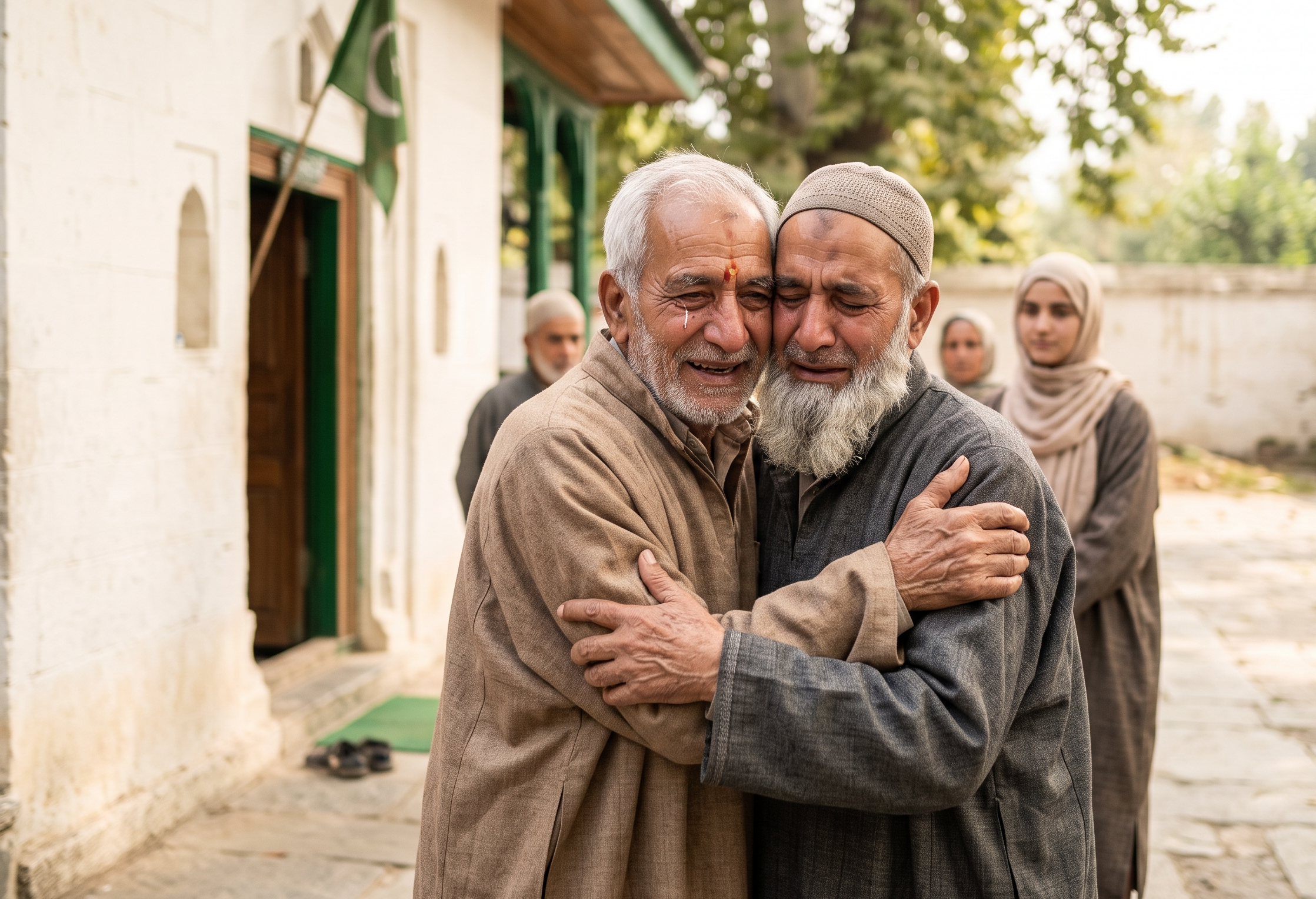
The greatest custodians of this hope remain the Sufi shrines of Kashmir. Silent yet steadfast, they continue to remind us that faith without compassion is incomplete, and that no prayer reaches heaven unless it carries love for fellow human beings. One day, perhaps, these journeys back home will no longer be rare occasions marked by tears. Perhaps children who have never met will once again play together in the same courtyards where their grandparents once shared laughter. Perhaps abandoned homes will echo with voices once more. Perhaps the fragrance of old friendships will return with the spring breeze. Until that day arrives, every tear shed at a Sufi shrine, every embrace between old neighbours, and every silent prayer for reunion will keep the spirit of Kashmiriyat alive. The bond was wounded. It was never buried. And as long as tears continue to flow from both eyes at the same embrace, hope will continue to breathe in the heart of Kashmir.
Disclaimer: The views expressed in this feature article are solely those of the author and do not necessarily reflect the official editorial stance or opinions of this publication. The author can be reached at [email protected]
Leave a Reply