From his deep proximity to three generations of the Gandhi high command to his dramatic modern exit, Azad charts a long lifetime of loyalty. However, his defense of controversial figures and eras frequently prioritizes personal relationships over rigorous historical critique.
By Mushtaq Ul Haq Ahmad Sikander
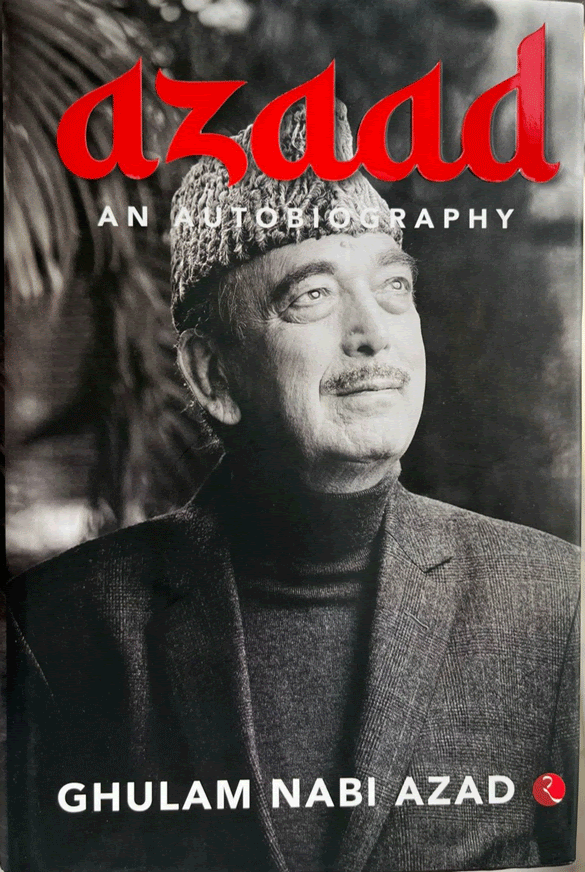
Ghulam Nabi Azad’s Azad: An Autobiography is a major political memoir standing at the complex intersection of institutional power, memory, and public self-representation. More than a chronological record of an influential career, the book operates as a deliberate narrative act. The veteran politician seeks to explain and preserve his public image at a time when the Indian National Congress has undergone deep internal strain and Azad himself has moved away from its fold to chart a new political course.
The book is an important historical document, not merely because Azad occupied the highest offices in both the party machinery and the union government, or because he worked with unparalleled proximity to three generations of the Gandhi family. Rather, its value lies in how it reveals the way a long-serving insider remembers Indian democracy from within its elite institutions. Yet, the narrative is deeply selective—remarkably candid in certain structural recollections, highly evasive in others, and frequently self-exculpatory regarding administrative failures. The text is best understood as a dual entity: its strongest feature is the rare insider’s view of national and Kashmiri politics, while its major limitation is the gap that frequently emerges between personal memory and systemic accountability.
One of the first structural characteristics that strikes the reader is the immense confidence with which Azad places himself in relation to institutional power. He writes explicitly as someone who inhabited the core of the establishment for decades, expecting his lifelong proximity to power to confer a natural authority on his recollections. The autobiography functions as an archive of institutional memory, which is inevitably shaped by personal loyalties, strategic omissions, and rhetorical goals. Azad’s narrative reflects a consistent effort to portray himself as a principled, practical organizer who was unusually tolerant of differing opinions, even across bitter ideological divides.
This self-fashioning is particularly visible in his reflections on his interactions with Prime Minister Narendra Modi during Azad’s tenure as the Leader of the Opposition in the Rajya Sabha. He notes that while he confronted the Prime Minister on the floor of the House, Modi never reacted harshly to criticism, finding him to be a great listener.
On the surface, this appears to be a gracious compliment extended to a fierce political opponent. However, within the broader strategy of the memoir, it serves a secondary purpose: it depicts Azad as a substantial parliamentary figure whose criticisms were too weighty to be ignored. Concurrently, it underlines a calculated openness toward leadership outside the Congress fold—a narrative choice that addresses contemporary detractors who accuse him of operating as a political proxy in his post-Congress career.
The defining thread running through the entire volume is Azad’s relationship with the Gandhi family. He presents himself as an unflaggingly loyal Congress worker who remained close to the high command while preserving personal independence. This extraordinary closeness grants the memoir incredible access to private meetings, but it simultaneously narrows the author’s critical distance.
His account of working under Prime Minister Indira Gandhi is telling of this tension. Azad comments that it is ironical that organizational freedom existed during her tenure considering her dictatorial reputation, noting that his personal experience was contrary to that image. This defense directly challenges the dominant historical view of Indira Gandhi as an uncompromisingly authoritarian figure. Azad does not deny her reputation; instead, he strategically relocates historical truth into the domain of personal experience, assuming that private proximity can soften broader historical judgments.
While credible as personal testimony, this defense remains analytically limited. The book avoids any serious confrontation with the structural centralization of power and the erosion of internal party democracy that historians associate with her era.
An even more intense exercise in political rehabilitation occurs in the sections dedicated to Sanjay Gandhi. In one of the most heavily debated passages, Azad attempts to counter the historical consensus surrounding the excesses of the mid-1970s Emergency. He argues that the claim that Sanjay Gandhi was anti-Muslim—targeting the community with sterilization programs and demolitions in Delhi’s Jama Masjid area—is a falsehood. Azad maintains that these drives were general cleanliness campaigns that hit both Muslim and non-Muslim slum areas alike, pointing out that Sanjay Gandhi had a large number of close Muslim friends.
The sections of the autobiography dedicated to regional politics in Jammu and Kashmir are undoubtedly among the most compelling, driven by direct regional experience and sharp political memory. Azad’s reflections on the historical rivalries between national parties and regional players are filled with tactical insights. For instance, when analyzing the historical decision to withdraw support from Sheikh Abdullah’s government in 1977, he notes that the local party unit announced the decision without Indira Gandhi’s approval, furious at the betrayal of the accord, which led to a swift electoral defeat for the Congress candidate, Mufti Mohammad Sayeed.
This passage frames the historical episode as a clear narrative of personal betrayal followed by swift electoral punishment. However, the analysis remains characteristically selective. It casts rival leaders as unilateral betrayers but fails to critically interrogate the broader, interventionist strategies of the central Congress apparatus over the decades. It is simple to condemn a specific political maneuver in retrospect; it is far more challenging to examine the institutional ecosystem that incentivized such maneuvering in the first place.
This habit of partial confession becomes even more pronounced when Azad transitions into discussing the complex dynamics of the modern Congress-PDP alliance. Here, Azad displays an unusual level of frankness regarding his tactical miscalculations. He explains how Mufti Mohammad Sayeed insisted on being the Chief Minister for the first three years, and though the central leadership was reluctant, Azad requested that they agree in the larger interest of the state. He reflects with bitterness on how the party that came third in the elections secured the top post, calling the decision a blunder and an act of excessive generosity.
Yet, despite the apparent vulnerability of the confession, the analysis remains incomplete. What this historical episode reveals is not merely a personal error in negotiation, but the structural instability inherent to coalition experiments in a fractured political landscape. The autobiography treats the entire alliance experience as a personal lesson in political prudence rather than as systemic evidence of institutional distortion.
The most serious challenge to Azad’s carefully constructed public self-presentation occurs when the narrative addresses the controversial Roshni scheme. This is the precise point where the autobiography’s claims of administrative restraint come into direct conflict with public records and legal rulings. The Roshni Act was originally envisioned as a progressive administrative mechanism aimed at vesting legal ownership rights over occupied state land to the current occupants in exchange for a calculated premium, explicitly earmarked to finance vital infrastructure and power development projects.
Over time, however, the implementation of the law became deeply mired in controversy. The act was repeatedly amended and extended, particularly during periods when Azad held immense political sway over the region. Subsequent independent scrutiny by the Comptroller and Auditor General unearthed vast irregularities, documenting instances where the act was allegedly utilized to regularize illegal encroachments by powerful elites at throwaway prices. Ultimately, in 2020, the Jammu and Kashmir High Court struck down the Act entirely, declaring it unconstitutional and void from the beginning.
Azad attempts to frame his administrative tenure as one defined by absolute vigilance, recalling an instance in March 2006 when he refused to sign a proposal to construct private houses for an officers’ colony on government land at highly concessionary rates. The passage is meticulously constructed to portray the author as a staunch protector of public property—an alert, uncompromised administrator. However, the broader public and judicial reality of the Roshni scheme complicates this neat self-image. The extensive litigation and public audits surrounding the scheme consistently demonstrated that it facilitated elite capture and provided legal cover for systemic land irregularities.
This contradiction reveals a core methodology of the political memoir: the selective separation of the author from the negative systemic consequences of policies that occurred under their watch. By presenting himself exclusively as a reformer who took large steps against illegal occupation, Azad seeks to insulate his personal legacy from a massive administrative scandal. Yet, as the text reveals, personal memoirs cannot easily erase the weight of documented public records and judicial interventions.
Beyond these primary regional and national issues, the later chapters are driven by a sharp critique of dynastic succession and the rise of a selected rather than elected internal party leadership. Azad voices immense discomfort with contemporary organizational structures where upward mobility is dictated by personal patronage rather than grassroots legitimacy. This critique gives the final chapters a distinct polemical force, particularly as he explains his dramatic exit from the Congress party and the subsequent formation of the Democratic Progressive Azad Party. He frames this transition as an act of self-respect, though the narrative remains somewhat incomplete because it fails to provide a robust response to critics who argued that his new regional formation was strategically designed to fragment the opposition vote bank.
Stylistically, the book is remarkably plain, highly functional, and easily readable. It makes no pretensions toward literary complexity, but it is undeniably effective as a fast-paced political narrative. However, this accessible style also highlights the memoir’s primary intellectual limitation: it frequently tells the reader what happened without deeply examining why it happened or investigating the deeper systemic causes behind the events.
Ultimately, Azad: An Autobiography is far more than a simple, partisan public relations exercise. It contains extraordinarily valuable, first-hand historical source material regarding the inner workings of the Congress party’s high command, the shifting dynamics of the Gandhi family’s leadership, and the volatile coalition experiments of Jammu and Kashmir. At its best, the autobiography opens a rare window into the distinct mentality of elite politics in India—its compromises, intense personal loyalties, and constant backroom bargains. At its worst, it attempts to smooth over the exact policy failures and historical controversies that make the narrative significant to historians in the first place. In the final analysis, the book remains a fascinating political self-portrait, deeply shaped by the selective discipline of memory and the immense pressure of contemporary public scrutiny.
Disclaimer: The views expressed in this feature article are solely those of the author and do not necessarily reflect the official editorial stance or opinions of this publication.
Leave a Reply