A silent chemical epidemic is rapidly shifting from the margins of Kashmiri society to its absolute center. What began as experimental use has transformed into a profound public health crisis that threatens to mute the voice of an entire generation.
By Asma Khurshid
Nowadays, Kashmir is witnessing a visible rise in campaigns, seminars, workshops, panel discussions, and youth debates centered around social awareness. Auditoriums are packed, banners are raised, and the vocabulary of “awareness” has once again found widespread currency. On the surface, it appears to be a society actively engaging with itself reflecting, questioning, and speaking out.
But beneath this visible energy lies a quieter, more uncomfortable question: What actually remains when the microphones are turned off?
For Kashmir, this is not a new phenomenon; it is a deeply familiar pattern. The louder the campaign, the quieter its aftermath. The recent history of the Valley reveals a recurring rhythm: phases of intense public engagement followed by abrupt, heavy silence. Dialogues begin, hope is briefly assembled, and narratives are carefully shaped, yet continuity frequently disappears once the immediate moment passes.
Local awareness efforts continually struggle to translate into long-term structural outcomes. Public participation becomes momentary, leaving sustained continuity as the missing element. The ultimate question, therefore, is not whether these initiatives matter, they undeniably do. The deeper issue is whether they are truly capable of producing a sustained social impact that outlives their temporary visibility.
The Gaps in the Enforcement Narrative
Official narratives frequently point toward cross-border trafficking and sophisticated global narcotics networks. These are real, well-documented forces. Yet public perception on the ground often moves in a different direction focusing instead on the widening gaps between visible enforcement and lived reality. Those discrepancies are not difficult to identify.
- Persistent Availability: Despite relentless enforcement drives and high-profile crackdowns, illicit substances remain highly accessible to vulnerable youth.
- Insufficient Rehabilitation infrastructure: The capacity of existing rehabilitation facilities remains vastly inadequate for the sheer scale of the crisis.
- Lack of Community Integration: Awareness campaigns rarely translate into deeply rooted, sustained community engagement or neighborhood support groups.
- The Data Blackout: Reliable, publicly accessible data on addiction demographics and recovery rates remains strictly limited.
What emerges from these shortcomings is a stark sense of institutional friction, uneven policy implementation, and an urgent need for stronger inter-departmental coordination and accountability. Across Kashmir, addiction is unfolding within a generation already carrying multiple layers of historical and systemic pressure. Young people are forced to navigate disrupted education systems, rigid social hierarchies, chronic unemployment, emotional isolation, and the long after-effects of political instability. The crisis is not merely chemical, it is psychological, social, and deeply existential.

Global trends heavily reflect the seriousness of this issue. According to data from the United Nations Office on Drugs and Crime (UNODC), nearly 292 million people used drugs globally in 2022, marking a steady rise over the past decade. India mirrors this broader international pattern. The Union Ministry of Social Justice and Empowerment’s National Survey on the Extent and Pattern of Substance Use explicitly identifies opioid dependence as one of the country’s most pressing healthcare concerns, with Jammu and Kashmir emerging as a critical hotspot.
Medical statistics from the Institute of Mental Health and Neurosciences (IMHANS) in Srinagar indicate that the numbers are not marginal figures, they represent an expanding public health emergency. But numbers, however large, remain fundamentally incomplete. Statistics measure scale; they do not measure despair. They cannot fully capture the quiet collapse of personal aspiration, the erosion of family stability, or the absolute loneliness that so often precedes dependency.
Classrooms Without Oxygen
There is a quieter architecture shaping this crisis, one that does not appear in police seizure reports or hospital registers. It is the architecture of the modern classroom. It represents an education system that promises personal liberation, but frequently delivers psychological compression. In this environment, learning is systematically reduced to rote performance, curiosity is replaced by intense competition, and human worth is tied directly to standardized rank.
Across India and acutely felt in regions like Kashmir, young people are raised within a rigid structure that revolves entirely around high-stakes examinations. Board results, national entrance tests, and extreme cut-off percentages divide young futures into binary categories: the “selected” and the “rejected.”
The system rarely asks what a student truly understands; it asks exclusively what they scored. Between those two questions lies an immense, crushing emotional burden. Failure is not treated as a temporary event, but as a permanent identity. Consequently, success becomes fleeting, while systemic pressure remains permanent.
Expectations often carried through families as an intense form of generational care become internalized by the youth as a suffocating burden. Slowly, a dangerous psychological equation takes root in the minds of the young:
“If I do not succeed, I do not matter.”
When that equation becomes entirely unbearable, the desire for escape rarely appears dramatic. It appears gradual, harmless, and seemingly necessary.
The Vacuum Beneath the Slogan
The state repeatedly tells the youth: “Say No to Drugs.” But if the youth could respond freely without judgment, they might ask a more difficult question: “Say yes to what?”
- Should they say yes to an education system that measures their worth in marks but offers little existential meaning?
- Should they say yes to a stagnant job market that promises dignity but consistently delivers economic uncertainty?
- Should they say yes to a conservative society where emotional distress is frequently dismissed as a personal weakness or a lack of faith?
In such a fractured landscape, anti-drug awareness campaigns begin to resemble hollow sermons delivered directly to the already wounded. Illicit substances offer something the social system often does not: immediate relief, temporary silence, and a brief pause in the relentless demand to perform.
The state response has been highly visible, active, and extensive. Surveillance systems have expanded, legal frameworks have tightened, large quantities of contraband have been seized, and arrests are made daily. On paper, this displays progress. However, seizures are statistics of interception, not of absence. While supply chains are temporarily disrupted, the underlying social demand has only deepened.
Meanwhile, inside the overcrowded wards of IMHANS Srinagar, another ledger is being written one measured not in kilograms of seized contraband, but in vulnerable human bodies. The patients are mostly young boys, many of whom have not quite grown into men, alongside an increasing number of young women. The alarmingly young age of affected individuals reflects the widening social reach of addiction across different strata of society.

Heroin has arrived, not dramatically or overnight, but persistently, like a toxic habit forming inside the very bones of a society. The pattern of addiction has shifted dangerously from the margins to the dead center: transitioning from occasional recreational use to severe physical dependency, from cannabis to cheap chemical alternatives like heroin, and from experimental usage to systemic entrapment. This is precisely where institutional responses must evolve further moving away from a purely punitive enforcement model toward long-term psychological, medical, and social interventions.
The Silence of Data
Another critical layer of this crisis lies in what remains deliberately or accidentally unseen. Reliable data regarding domestic trafficking routes, conviction rates of major distributors, long-term rehabilitation outcomes, and post-treatment relapse patterns remains severely limited or inconsistently accessible. In the absence of institutional transparency, public trust naturally weakens and speculation grows.
Data is not merely an administrative luxury, it is a democratic tool. Without it, public accountability dissolves into institutional ambiguity.
What is unfolding in Kashmir is not merely a conventional drug crisis; it is a quiet, tragic reconfiguration of youth itself. A generation that once filled libraries and community spaces now increasingly fills rehabilitation wards. A generation that once debated political and social futures now negotiates severe physical withdrawals. A generation once defined by its vibrant voice is increasingly defined by its enforced muteness. The real tragedy is not found in the escalating numbers alone. It is found in the slow, agonizing transformation of youth aspiration into chemical escape.
THE SPECTRUM OF THE YOUTH CRISIS
Systemic Pressure ———> Emotional Vacuum ——> Chemical Escape
(High-Stakes Exams) (Stigma & Silence) (Heroin/Opioids)
In this context, drugs are not merely illicit substances. They are functional responses to structural absence, deep future uncertainty, and unaddressed emotional pain. If the cycles of public engagement continue to fade into apathy, the responsibility for change cannot rest solely on formal institutions. Society especially its youth leadership must find a way to sustain momentum far beyond official, state-sponsored platforms. This critical transition requires a multi-pronged approach:
- Building Independent Knowledge Networks: Establishing localized research and documentation initiatives to track the true spread of addiction independent of state data.
- Demanding Data Transparency: Actively utilizing legal, civic, and journalistic tools to demand clear public reporting on rehabilitation success and relapse rates.
- Destigmatizing Treatment: Strengthening community-based, non-punitive rehabilitation centers to reduce the social shame that prevents families from seeking early medical help.
- Shifting to Sustained Movements: Moving away from isolated, single-day seminar events toward continuous, institutionalized community support systems.
- Developing Policy Literacy: Training youth advocates to engage with public health governance and policy design meaningfully rather than rhetorically.
A Generation Holding Its Breath
These are not quick, superficial solutions; they are difficult, necessary continuities. Beyond structural reforms, there must be a profound, honest social acknowledgment: addiction is not merely an individual moral failure, it is, in many ways, a predictable systemic outcome. Until that core truth is confronted with collective clarity and courage, the cycle will inevitably persist. Without sustained, multi-layered intervention, illicit trafficking, deep-seated addiction, and broader social harm will continue to deepen. Vulnerable youth will keep slipping through the institutional cracks.
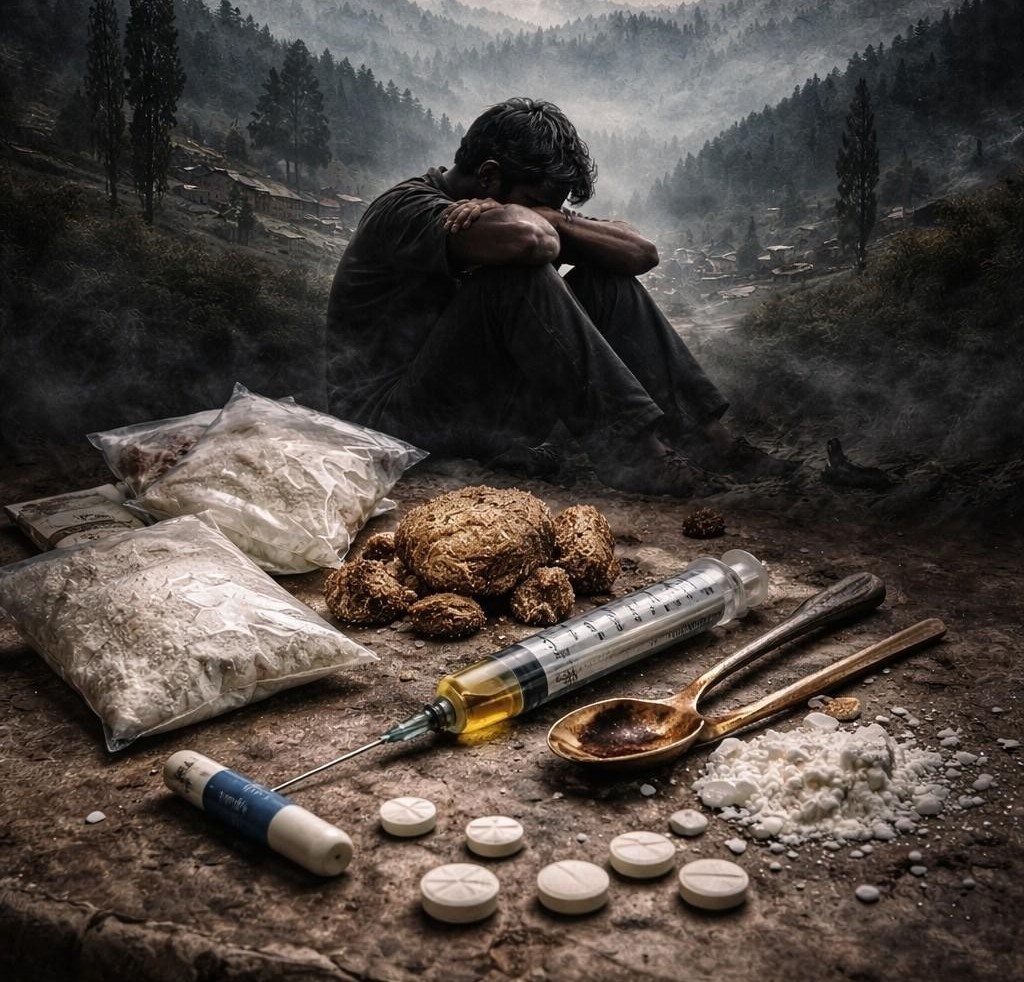
The tragedy of Kashmir’s drug crisis lies in this stark contradiction: the state apparatus is highly active, but the underlying problem is evolving far faster than the institutional response.
What happens to a society when its youth is subdued, not by physical chains, but by debilitating chemicals? Perhaps this specific quietness is where the danger becomes most acute. Normalization allows for silent expansion, and unchecked expansion ensures that what was once a shocking social exception eventually becomes the daily rule.
Kashmir has long been described through romanticized or tragic metaphors: a paradise, a paradise lost, or a paradise under siege. Perhaps it is time to discard these poetic labels for something far more grounded and fragile. Kashmir is not a paradise; it is a pulse. Today, that pulse is distinctly uneven, interrupted by substances that promise temporary silence but deliver absolute dependence. The ultimate question for the Valley is whether it will collectively listen to the true rhythm of that pulse before it fades entirely into numbness.
Disclaimer: The views expressed in this feature article are solely those of the author and do not necessarily reflect the official editorial stance or opinions of this publication. Data has been compiled from multiple sources, and figures may vary. Readers are encouraged to verify the data independently.
Leave a Reply