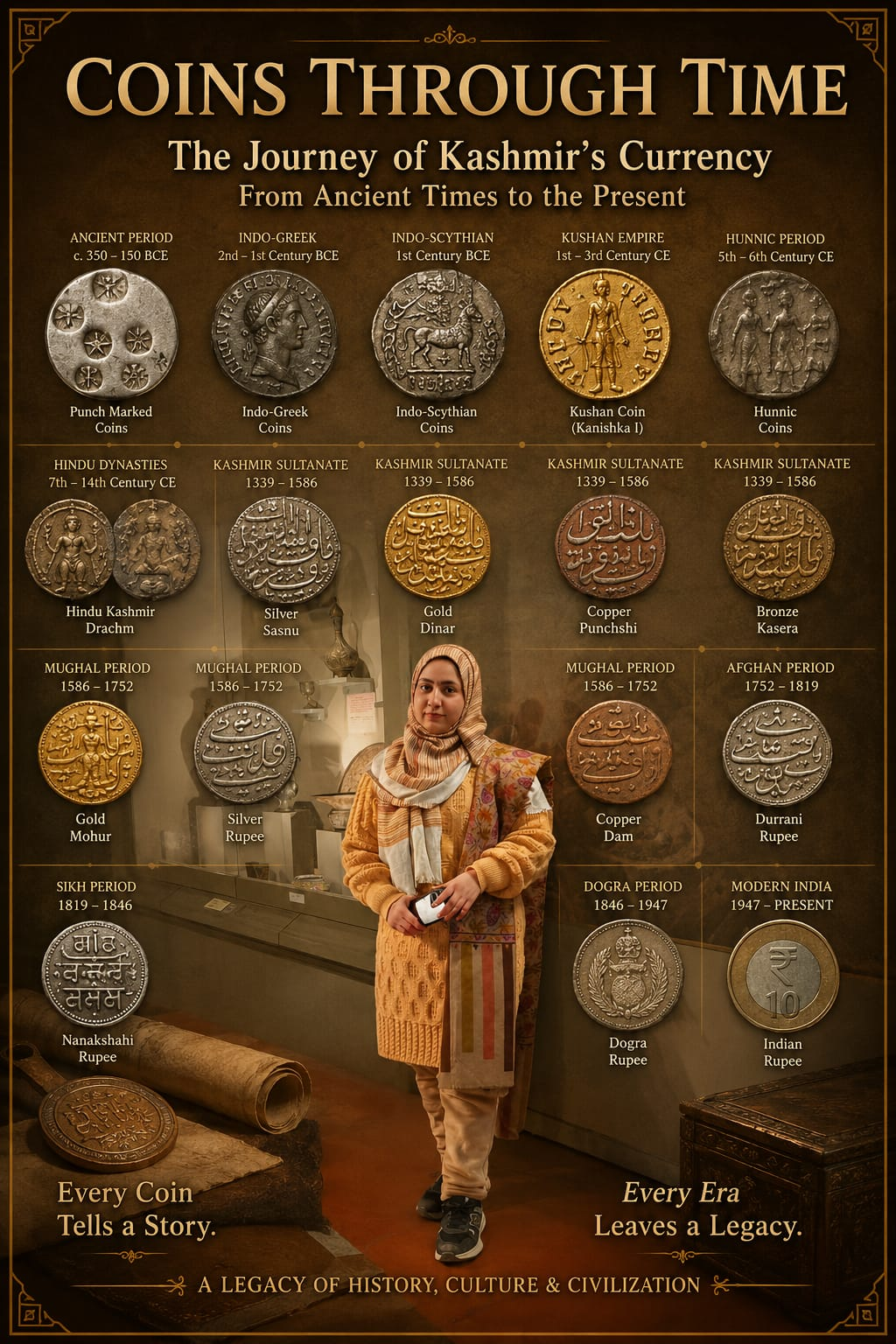
Every dynasty that ruled Kashmir left its unique mark stamped onto the currency of the day. By looking closely at these surviving artifacts, we can trace the political and economic evolution of a vital historic crossroads.
By Afreen Jan
Long before digital payments and paper money became part of everyday life, the people of Kashmir relied on coins that carried far more than monetary value. These small pieces of metal bore the symbols of kingdoms, the names of rulers, the influence of changing religions, and the marks of cultures that flourished across centuries. Every coin that once passed through Kashmiri hands is a silent witness to a remarkable history, offering us a tangible way to touch the past.
The story of Kashmir’s currency began over two thousand years ago with simple punch-marked silver and copper pieces. Stamped with small symbols rather than the faces of kings, these early coins were among the first organized forms of money used in the region. By helping to replace the old barter system, they encouraged local trade and laid the foundation for a growing economy.
As time moved on, Kashmir welcomed new rulers and fresh ideas from distant lands. The Indo-Greeks introduced beautifully crafted coins featuring realistic portraits and Greek writing, while the Kushan rulers later transformed regional coinage into true works of art. Under the famous Emperor Kanishka I, Kushan coins displayed images of kings alongside gods and goddesses from various religious traditions. This reflected the deep cultural and spiritual diversity of the time. These coins also serve as a reminder that Kashmir was once an important crossroads connecting South Asia, Central Asia, and the silk routes beyond.
Following the Kushans, the local Hindu dynasties created one of the most enduring coin designs in South Asian history. For centuries, their money commonly featured a standing king on one side and a seated goddess on the other. This remarkable consistency reflected not only a shared artistic tradition but also the political continuity that defined medieval Kashmir. Traders and citizens across generations used these familiar images, which provided economic stability through centuries of change.
A completely new chapter opened in 1339 with the establishment of the Kashmir Sultanate. Persian inscriptions replaced the older designs, and coins became beautiful expressions of Islamic art and calligraphy. Different denominations like Gold Dinars, Silver Sasnus, Copper Punchshis, and Bronze Kaseras circulated widely across the valley. These pieces supported regional trade while symbolizing the unique authority and independence of the local Sultans.
The arrival of the Mughals in 1586 connected Kashmir to one of the largest and wealthiest empires in the world. The Mughals introduced standardized Gold Mohurs, Silver Rupees, and Copper Dams. This standard system made commerce far more efficient, directly linking Kashmiri markets with major imperial cities like Lahore, Delhi, Agra, and Kabul. During this era, coins became powerful symbols of economic integration, making Kashmir an active participant in global trade networks.
Later on, Afghan, Sikh, and Dogra rulers each left their own distinct imprint on Kashmir’s monetary timeline. Each shift in power brought changes to the language, imagery, and weight of the currency. During the nineteenth century under Dogra rule, the region reached a major milestone with the introduction of the first paper currency notes. This crucial shift marked the beginning of the transition away from a purely metallic economy toward the modern financial systems we use today.
In the modern era, the Indian Rupee is the official currency used across Jammu and Kashmir. The banking system is highly advanced, with digital apps, instant electronic transfers, and automated teller machines replacing the need for physical cash in many daily transactions. Yet, the ancient coins preserved in museums, archaeological collections, and private holdings continue to speak across generations. They remind us that history is not just found in textbooks or large stone monuments, it can also be held in the palm of a hand.
For historians, archaeologists, and collectors, these old coins are priceless records of Kashmir’s political shifts, artistic achievements, and economic evolution. For ordinary readers, they offer something equally valuable: a chance to connect with a shared heritage that stretches back more than two millennia. In a fast-paced age when money is increasingly digital and invisible, the old coins of Kashmir invite us to pause. They show us that currency has always been more than just a medium of exchange. It is a living reflection of identity, culture, and human endurance. Every single coin carries its own unique story, and together, they tell the extraordinary, unfolding story of Kashmir itself.
Disclaimer: The views and historical interpretations expressed in this feature article are solely those of the author and do not necessarily reflect the official editorial stance or opinions of this publication.
Leave a Reply