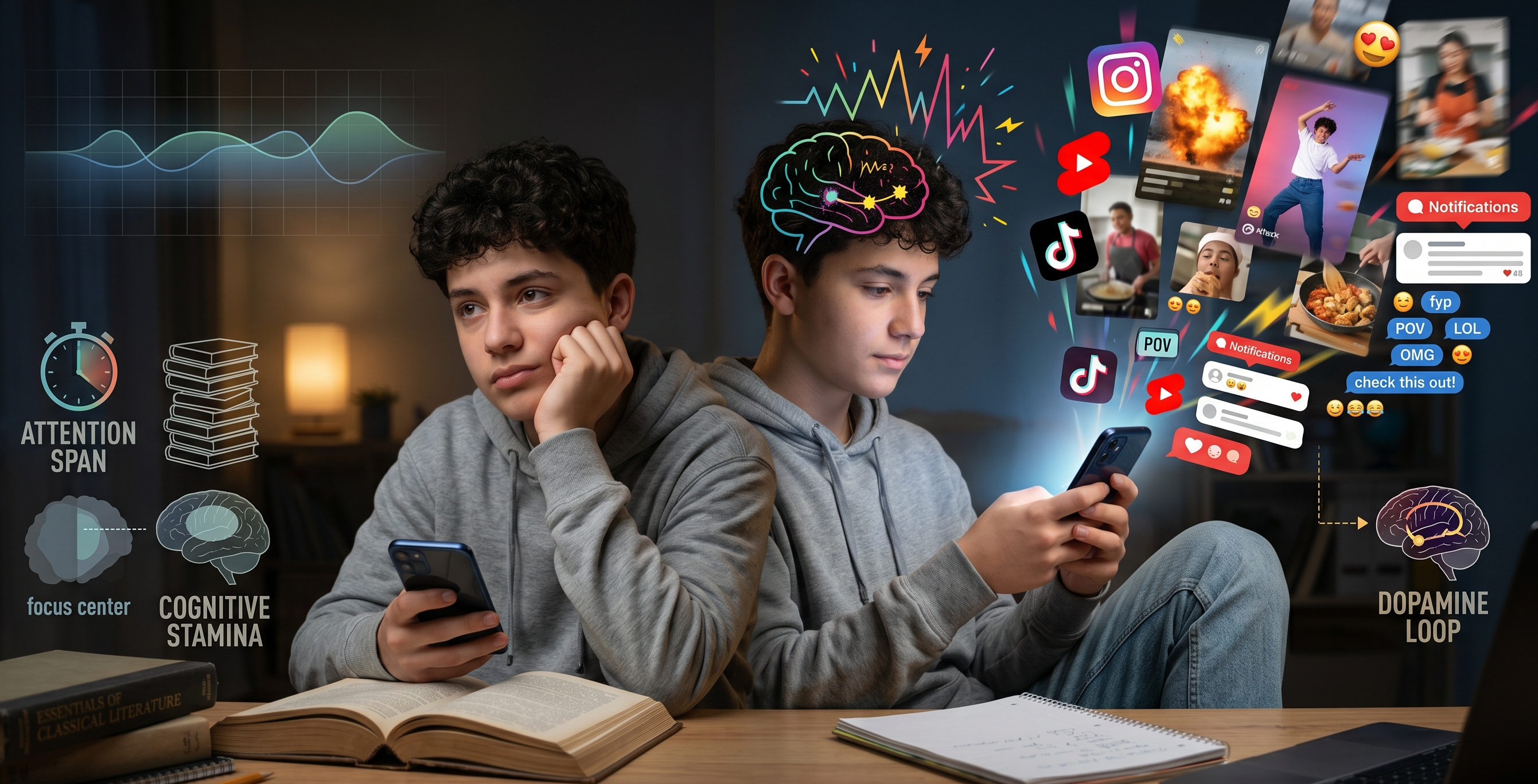
Sustained engagement with dense, complex texts is being replaced by a preference for bullet points and captions. This shift is noticeably weakening critical reading comprehension and compromising formal writing proficiency.
By Dr Aqib
The digital landscape for the modern student is no longer defined by the occasional Google search or a casual scroll through social media; it is dictated by a relentless, algorithmically engineered stream of micro-content. Platforms like Instagram Reels, YouTube Shorts, and TikTok have fundamentally transformed the cognitive architecture of the classroom. Between demanding academic schedules and extracurricular commitments, the average teenager now navigates an ecosystem where information, entertainment, and social validation are delivered in explosive, sub-60-second bursts. Recent digital consumption data highlights a staggering shift: teenagers globally now average upwards of four hours a day purely on short-form video platforms. While these ultra-fast clips appear to be harmless bite-sized entertainment, neuroscientists, cognitive psychologists, and educators are raising an urgent question: How is this constant exposure to high-velocity media reshaping a generation’s capacity to learn, retain, and think critically?
The response from the educational frontlines is increasingly uniform and deeply concerning. Across schools and universities, instructors report a profound shift in classroom dynamics, characterized by unprecedented levels of student restlessness and an acute intolerance for pedagogical pacing that cannot compete with a smartphone screen. The historic challenges of classroom management, whispering, passing notes, or simple daydreaming have been entirely eclipsed by the pull of the pocket-sized supercomputer. Even when devices remain unseen, the psychological phenomenon of “phantom vibration syndrome” and the persistent cognitive load of anticipating notifications create a state of continuous partial attention. Students are physically present but mentally fragmented, struggling to endure a standard lecture without experiencing a compulsion to check for digital updates.
This behavioral evolution does not indicate a decline in baseline intelligence or latent capability. Rather, it demonstrates the terrifying plasticity of the human brain, which is actively adapting to an environment optimized for rapid gratification and infinite novelty. Neurobiological research reveals that short-form videos act as highly efficient delivery systems for dopamine, the neurotransmitter associated with reward and anticipation. Each swipe introduces a completely novel stimulus, a comedy sketch, a dance trend, a cooking hack triggering a micro-dose of dopamine. When the developing brain is habituated to this intense, self-directed reward loop, traditional educational models, which rely inherently on sustained attention, linear progression, and delayed gratification, begin to feel painfully under-stimulating.
This creates an acute structural mismatch between the contemporary student’s neural wiring and the traditional academic environment. Deep learning requires cognitive stamina, the ability to sit with a complex algebraic formula, parse a dense historical text, or follow a nuanced scientific argument without seeking immediate distraction. Short-form media trains the brain to do the exact opposite: to abandon a stimulus the moment it loses absolute novelty. Consequently, educators note a sharp decline in working memory capacity and information retention. When students attempt to multitask by switching between studying and scrolling, they incur a severe “task-switching penalty.” The brain cannot seamlessly toggle between high-level cognitive processing and mindless consumption; instead, information is processed superficially, failing to consolidate from short-term working memory into long-term cognitive frameworks.
This superficiality extends heavily into literacy and language acquisition. Long-form reading, whether navigating a classic novel, analyzing an editorial, or digesting a textbook chapter is a foundational exercise that builds vocabulary, structural comprehension, and analytical stamina. However, the omnipresence of short-form culture has given rise to a generation of hyper-skimmers. Accustomed to captions, bullet points, and text overlays, students increasingly view dense, multi-page texts with anxiety and exhaustion. Standardized testing data and reading comprehension metrics reflect this shift, showing a decline in the ability of students to track complex, extended narratives or identify subtle thematic nuances.
Simultaneously, the linguistic shorthand of the digital world, slang, fragments, memes, and emoji-driven communication is bleeding into formal academic output. High school and college instructors frequently report that student writing is becoming progressively fragmented. The ability to construct a cohesive, persuasive, multi-paragraph essay using varied syntax and formal vocabulary is being replaced by brief, declarative sentences that mirror social media captions. While this does not inherently destroy basic language skills, it severely limits a student’s proficiency in formal, professional, and academic discourses, which are vital for success in higher education and the modern corporate workforce.
The impact on creativity is equally paradoxical. Proponents of short-form platforms argue that they democratize creativity, turning passive consumers into active creators who learn digital video editing, audio synchronization, concise visual storytelling, and basic media literacy. Millions of young people are undeniably learning to express themselves with high technical proficiency. However, cognitive scientists warn that this represents a highly commodified, algorithmic form of creativity. True, profound creative thought requires an essential cognitive catalyst that short-form media actively eliminates: boredom. Historically, periods of uninterrupted quiet and boredom forced the mind inward, sparking daydreaming, deep reflection, and original synthesis. When every spare micro-moment—waiting for a bus, walking between classes, or sitting in a quiet room—is instantly filled by scrolling, the mind is never permitted to enter the default mode network, the neural network responsible for creative insight and self-referential thought.
Beyond cognition and creativity, the hyper-engagement of short-form content exacts a heavy toll on student wellbeing, most notably through sleep deprivation. Because these algorithms are explicitly designed to maximize watch time, users routinely fall into “revenge bedtime procrastination,” scrolling late into the night. The blue light emitted by screens suppresses melatonin production, while the high-arousal content delays the onset of REM sleep. The resulting chronic sleep deficit directly compromises the prefrontal cortex, compounding deficits in attention, emotional regulation, and memory consolidation the following school day. Furthermore, the curated, idealized realities presented in these brief clips foster an environment of toxic social comparison, driving up rates of adolescent anxiety and depression, which present further psychological barriers to effective academic engagement.
Yet, a complete rejection of short-form media is neither realistic nor entirely warranted. When intentionally decoupled from addictive algorithms, the format holds undeniable pedagogical utility. Innovative educators and scientists are successfully hijacking the short-form medium to deliver highly effective “micro-learning” modules. A 60-second video demonstrating a physics concept with high-production visuals, breaking down a complex historical timeline, or offering a mnemonic device for foreign vocabulary can capture the interest of a visual learner far more effectively than a standard lecture. These bite-sized educational assets serve as excellent entry points, sparking a curiosity that teachers can subsequently leverage into deeper, long-form classroom exploration.
The ultimate reality of the short-form revolution is that the technology is here to stay, and its architectural grip on human attention is only intensifying. The challenge ahead does not belong to the students, whose brains are simply adapting to the world they inherited, but to an educational ecosystem and parental network that must explicitly teach digital discipline. Mitigating this cognitive crisis requires a deliberate effort to cultivate “cognitive ambidexterity” ensuring that while students can navigate the rapid-fire digital world, they preserve the sacred, irreplaceable capacity for deep focus, slow reading, and sustained intellectual endurance.
Disclaimer: The views and historical interpretations expressed in this feature article are solely those of the author and do not necessarily reflect the official editorial stance or opinions of this publication.
Leave a Reply