Prime Minister Narendra Modi’s recent ‘Nation First Appeal’ isn’t just about saving dollars, it is a masterclass in leveraging a billion-strong population to shield the economy from a volatile world.
The air crackles with geopolitical tension. Half a world away from India’s shores, the Strait of Hormuz, the vital maritime artery of global energy is caught in a relentless deadlock. As the West Asia crisis escalates in this sweltering May of 2026, Brent crude oil has violently surged past the psychological threshold of $100, occasionally touching a blistering 52-week high of $126 per barrel. For an economy that imports 85% of its crude oil requirements, the math is as brutal as it is simple: higher oil prices mean a bloated import bill, soaring domestic demand for US dollars, and immense pressure on the foreign exchange reserves.
Recently, the Indian Rupee touched a record intraday low of 95.43 against the dollar, prompting global analysts and armchair economists to label the situation a “currency crisis.” Yet, to view this moment solely through the lens of a depreciating fiat currency is to entirely miss the broader, far more inspiring narrative. India is not buckling; it is bracing. And the strategy isn’t relying solely on the Reserve Bank of India’s formidable forex reserves, it is actively tapping into the ultimate sovereign asset: the collective willpower of 1.4 billion citizens.
The ‘Nation First’ Appeal
On May 10, 2026, standing before a massive public rally in Hyderabad, Prime Minister Narendra Modi delivered an address that will likely be remembered as a historical masterstroke of mass economic mobilization. Avoiding complex macroeconomic jargon, the Prime Minister laid out a pragmatic, seven-point “Nation First Appeal” aimed directly at the Indian consumer. His underlying message was crystal clear: economic sovereignty in an interconnected, volatile world begins at home, in our daily choices.
Recognizing that fuel consumption is the primary driver of the dollar drain, the Prime Minister urged an immediate behavioral shift. “Use metros wherever available, adopt carpooling and rely more on railways for transporting goods,” Modi implored the crowd, his voice carrying the urgency of the moment. “All these measures will reduce dependence on petrol and diesel and cut the use of foreign currency.”
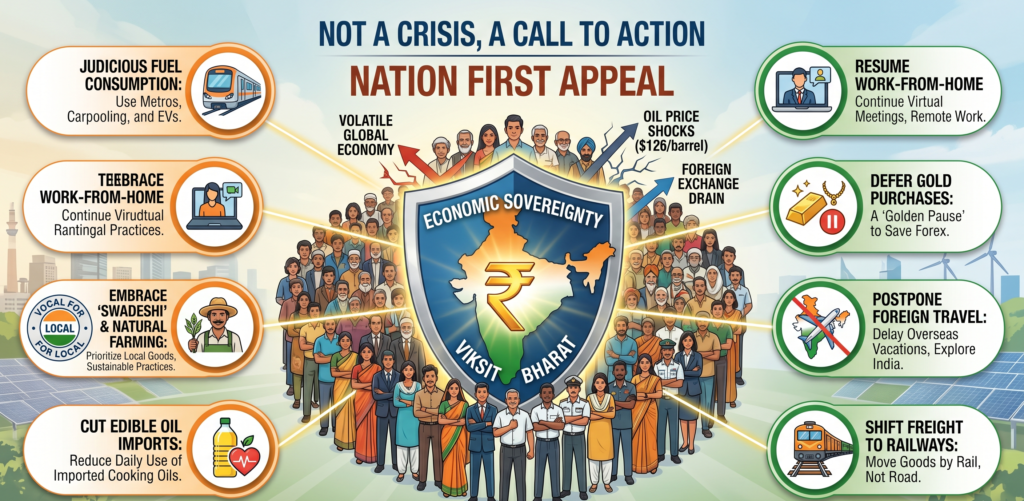
What makes this approach uniquely effective is the leadership’s ability to reframe macroeconomic defense mechanisms as acts of everyday patriotism. Modi reminded the nation of its recent history of spectacular resilience, drawing direct parallels to the COVID-19 pandemic’s adaptability. “We developed work-from-home and virtual meeting systems during corona. We got used to it. The need of the hour is to resume those methods,” he noted. By advocating for a return to virtual workflows, he wasn’t merely suggesting a lifestyle shift; he was proposing a direct, citizen-led cut to the nation’s fuel import bill without stifling productivity.
The Golden Pause
Perhaps the most audacious of the Prime Minister’s appeals was directed at one of India’s deepest cultural and emotional inclinations: the absolute reverence for gold. India, historically the world’s second-largest consumer of the precious metal, was projected to consume between 600 and 700 tonnes of gold in 2026. With global gold prices hovering near a staggering $4,700 per ounce, every gram imported acts as a severe drain on the precious foreign exchange desperately needed to secure vital energy and food supplies.
-
Judicious Fuel Consumption: Shift toward electric vehicles (EVs), utilize metro rail services where available, and adopt carpooling to significantly reduce petrol and diesel usage.
-
Resume Work-From-Home (WFH): Re-adopt COVID-era practices like remote working, virtual meetings, and video conferencing to minimize daily commuting and fuel dependence.
-
Defer Gold Purchases: Postpone buying gold for at least one year to prevent the massive outflow of foreign exchange required to import the precious metal.
-
Postpone Foreign Travel: Avoid overseas vacations and non-essential international travel for the next year to keep foreign currency within the domestic economy.
-
Shift Freight to Railways: Utilize the railway network instead of road transport for sending parcels and moving goods to save on commercial fuel costs.
-
Cut Edible Oil Imports: Consciously reduce the daily consumption of imported edible cooking oils.
-
Embrace ‘Swadeshi’ and Natural Farming: Prioritize locally manufactured goods, lower the reliance on imported chemical fertilizers, and actively promote natural farming methods to build a self-reliant supply chain.
Modi asked citizens to take a bold step: halt gold purchases for festivals and weddings for at least one year. It is a monumental ask, disrupting centuries of tradition where gold is synonymous with auspiciousness, status, and wealth security. Yet, framed as a shield for the Rupee, this “patriotic gold buying freeze” has struck a profound chord across the nation.
This appeal is not an attack on wealth creation; it is a temporary, strategic reallocation of national priorities. India accounts for roughly 22% of global gold jewellery demand. By simply pausing this immense influx of gold, the country can offset billions of dollars in foreign exchange outflow. This grants the central bank the critical breathing room required to stabilize the Rupee, proving that the citizens themselves can act as the ultimate hedge against imported inflation.
Restructuring Daily Habits
The Prime Minister’s appeal extended seamlessly into Indian kitchens and travel itineraries. He urged citizens to reduce their consumption of imported edible cooking oil by 10%, a precise, actionable metric that achieves the dual purpose of cutting agricultural import bills while simultaneously promoting better cardiovascular health outcomes for the populace.
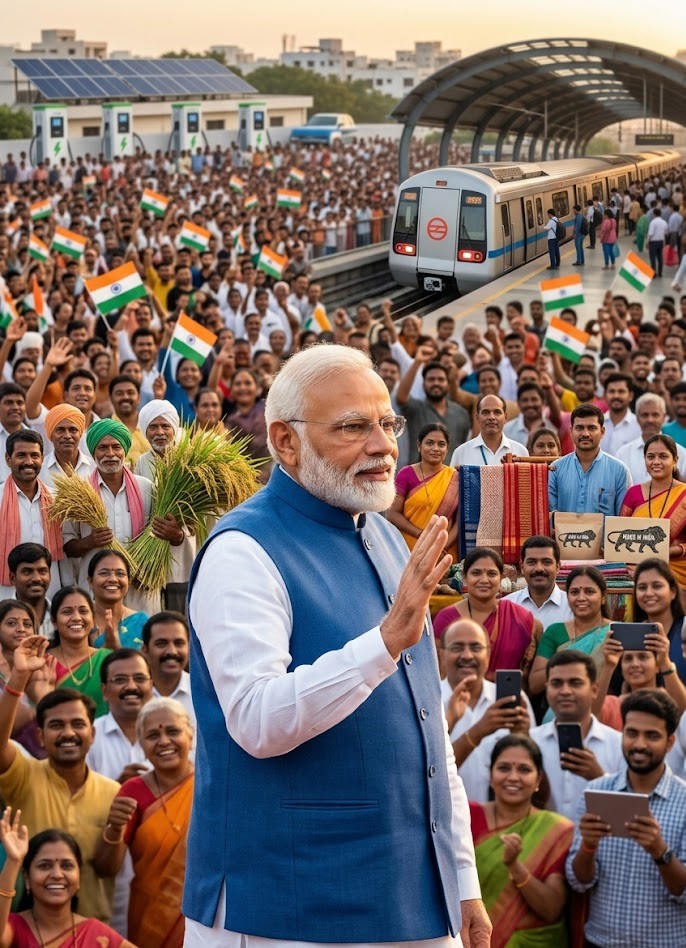
Furthermore, he called for a strict moratorium on non-essential foreign travel, overseas vacations, and lavish international destination weddings for the next twelve months. In a booming economy where international travel has rapidly become a status symbol for the rising middle class, this is a sobering call to ground our aspirations in national necessity. Why spend dollars abroad when the diverse landscapes of India offer unparalleled domestic tourism opportunities?
Reigniting the highly successful “Vocal for Local” campaign, Modi struck a mature, balanced tone. He did not demand a chaotic, overnight embargo on foreign products, but rather a conscious, deliberate transition. “This does not mean throwing away foreign goods immediately, but we must work towards self-reliance as soon as possible,” he emphasized. It is an approach that asks consumers to read the labels on their daily goods and deliberately champion India-made alternatives, fostering a robust domestic manufacturing ecosystem.
The Macroeconomic Reality
Naysayers and foreign critics might instinctively argue that asking consumers to cut back is a sign of underlying economic fragility. However, a closer look at India’s macroeconomic fundamentals tells a story of formidable, undeniable strength. According to the State Bank of India (SBI) Research Report released this May, the Indian economy remains a global beacon of stability. Despite global uncertainties and the raging Middle East conflict, the report projects a highly resilient GDP growth rate of 6.6% for the financial year 2026-27, maintaining momentum from a solid 7.5% growth in the previous fiscal year.
The SBI report explicitly states that “India continues to demonstrate resilience despite global uncertainties and regional conflicts.” Domestic consumption remains a powerful, driving engine. Furthermore, the near-term food supply often the Achilles’ heel of developing nations during crises looks highly secure thanks to robust rabi crop yields. Credit growth continues to expand robustly, reflecting deep underlying business confidence and a healthy banking sector.
The currency pressure India faces today is entirely an imported crisis fueled by geopolitical theatrics far beyond its borders. By actively curbing dollar outflows through behavioral economics, India is effectively neutralizing the external shock.
Future-Proofing
While the public tackles the immediate consumption side of the equation, the institutional machinery is gearing up to address the structural elements of the Balance of Payments. The SBI report correctly highlights the need for a comprehensive package, including the potential calibration of a resurgent “Indian Diaspora Bond.” By leveraging the wealth and patriotism of Non-Resident Indians (NRIs) with tax-friendly yields, India can effortlessly bolster its forex reserves.
Moreover, the nation is not losing sight of the future. The same economic reports emphasize that Artificial Intelligence (AI) added roughly 0.1% to 0.5% to GDP levels annually in advanced economies recently. India is already rededicating itself toward AI-led productivity gains, semiconductor manufacturing, and green hydrogen, ensuring that the economy is future-proofed against the next global shock.
A Unified March
As India navigates this volatile geopolitical chapter of 2026, the overarching narrative is not one of despair or decline, but of a mature nation coming of age. The current currency friction is merely a stress test for a system that has repeatedly proven its boundless capacity to adapt. The long-term vision, Viksit Bharat (Developed India) remains entirely unwavering.
Prime Minister Narendra Modi’s recent appeals are a testament to a unique brand of democratic leadership that treats citizens not merely as passive subjects of economic policy, but as active, essential stakeholders in the nation’s fiscal destiny. By transforming the simple acts of carpooling, delaying a jewelry purchase, or choosing a local brand into profound acts of patriotism, India is actively rewriting the global playbook on how a massive democracy weathers a storm.
The Rupee may be temporarily tested by the turbulent tides of the Strait of Hormuz, but the true resilience of the Indian economy is firmly anchored in the unyielding resolve of its people. And that is an intrinsic asset that no global crisis, and no fluctuating market, can ever devalue.
Leave a Reply