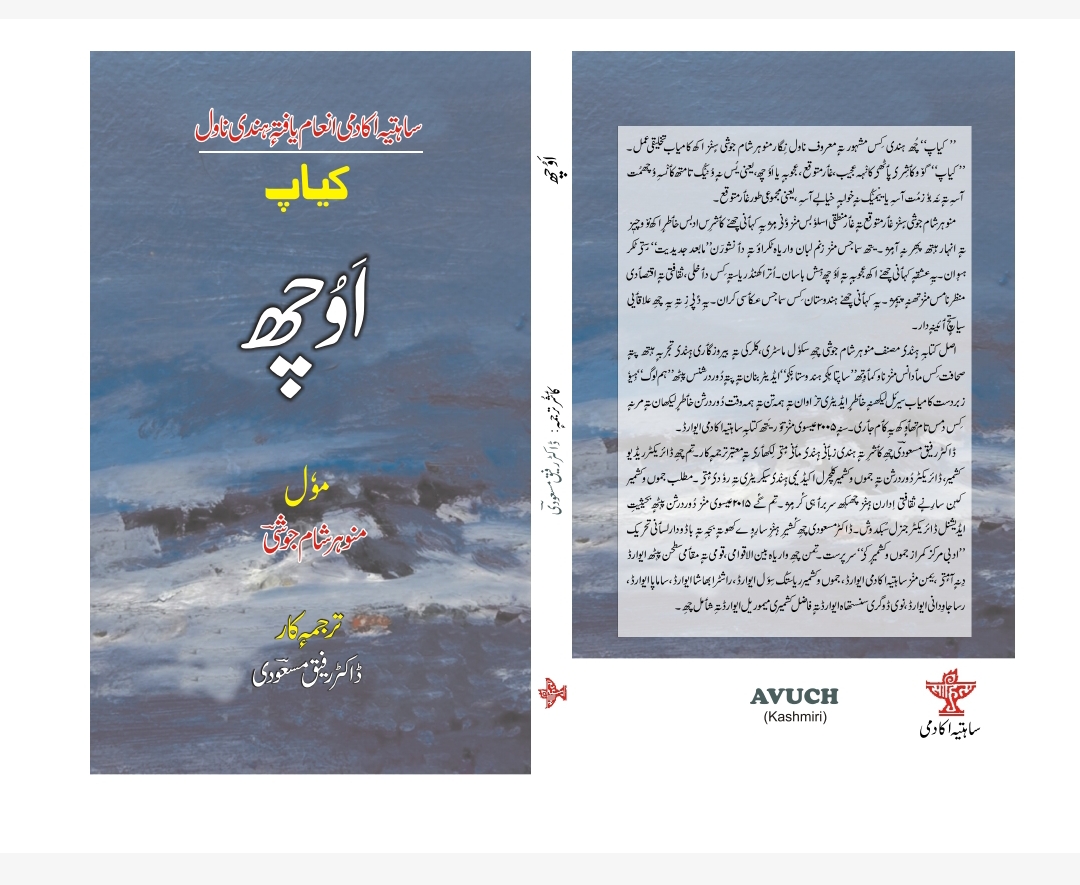
Manohar Shyam Joshi’s ‘Kyap’ Finds a New Voice in Kashmiri
By Rayees Ahmad Kumar
Manohar Shyam Joshi was a titan of Hindi letters whose influence stretched from the rugged hills of Almora to the living rooms of millions across India. Born into the family of a distinguished educationist and musicologist, Joshi carried forward a legacy of intellectual rigor and cultural depth that defined his career as a novelist, screenwriter, and commentator. When he passed away in 2006, the then Prime Minister Dr. Manmohan Singh aptly characterized him as one of the most influential writers and commentators in Hindi in recent times. For the general public, he was the architect of India’s most iconic television sagas—Hum Log, Buniyaad, and Kakaji Kahin, works that did more than entertain; they chronicled the aspirations and anxieties of a nation in flux. Yet, beneath the populist success of his teleplays lay the soul of a master novelist. Among his celebrated literary contributions, Kasap and Kyap stand as pillars of modern fiction. It was for Kyap that Joshi received the Sahitya Akademi Award in 2005, a testament to his ability to weave complex social critiques into the fabric of compelling prose.
The resonance of such a masterpiece transcends linguistic boundaries, and the recent translation of Kyap into Kashmiri by Dr. Rafiq Masoodi—published under the title Avuch, represents a landmark moment for regional literature. Dr. Masoodi, a prominent literary figure in the Valley and chief patron of Adbi Markaz Kamraz, has bridged a significant cultural gap. This 159-page translation, published by the Sahitya Akademi, New Delhi, is not merely a linguistic transfer; it is an act of cultural preservation. By rendering Joshi’s intricate prose into the native Kashmiri tongue, Masoodi has made a thought-provoking text accessible to a new audience, adding a valuable regional dimension to an already prestigious work. This translation follows in the successful footsteps of Masoodi’s previous works, Bey Pie Talash and Panun Doud Panin Dag, and it is expected to be received with similar accolades, enriching the Kashmiri literary landscape with its stylistic texture and emotional weight.
To encounter Kyap is to experience an “unbearable disturbance.” It is not an ordinary story, nor does it rely on overt drama or rhetorical excess to move its audience. Instead, Joshi employs a silent, playful narration that lulls the reader into a sense of security before unveiling an unsettling tragedy. The work is artfully gentle, revealing its depth slowly and almost clandestinely. On the surface, the prose flows effortlessly, presented with a casual ease, humor, and irony that often provoke a smile. The narrative tone is disarming and conversational, resembling a piece of gossip shared between friends. This deliberate stylistic choice creates a feeling of familiarity and comfort. However, this simplicity is a mask. The “gossiping” rhythm of the book is a narrative trap; it creates a long-lasting comfort only to make the eventual realization of the story’s gravity more profound.
At its core, Kyap is a powerful exploration of a society caught between different worlds. Through its pages, we see a cultural and emotional landscape shaped by the friction of a half-realized modernity clashing with an uncritical postmodern mindset. In this world, traditional customs and rituals have lost their anchor, yet modern ideals have not been fully accommodated or understood. The result is a moral vacuum where human emotions are marginalized. Sincerity, selflessness, and pure intentions are viewed with suspicion, and emotional vulnerability is treated as a liability. It is a world where being “clever” has superseded being “wise,” and being “educated” has not necessarily led to being “humane.”
While Kyap can be categorized as a love story, it shuns the conventions of idealized romance. The love depicted here is fragile, unprotected, and constantly threatened by societal expectations. It frequently collides head-on with social hypocrisy, intellectual vanity, and moral confusion. The characters do not suffer because they lack feelings; they suffer because feelings have no legitimate space in a society obsessed with appearances, progress, and borrowed ideas. Their connections are not destroyed by dramatic betrayals or overt cruelty, but by the slow erosion of neglect, hesitation, and the inability of the collective to grant legitimacy to the heart’s true desires. In this world dominated by intellectual frameworks and status, love becomes expendable, something to be set aside rather than defended.
One of the most striking features of the narrative is its devastating critique of intellectual pretension. Joshi targets a specific brand of pseudo-intellectualism that is detached, ironic, and emotionally evasive. Through his characters, he exposes how sophisticated posturing and high-minded debates can become a form of moral irresponsibility. The narrative suggests that when the intellect separates itself from empathy and responsibility, it ceases to be an enlightening force and instead becomes complicit in emotional harm. These characters engage in ideas but fail to acknowledge the human consequences of their choices, leading to a tragedy that arrives noiselessly, mirroring real life, where dreams often fade without a loud, dramatic collapse.
The brilliance of Kyap, and by extension Masoodi’s translation, lies in this subtlety. The reader is not confronted with a spectacle of sorrow but with a creeping realization that something precious has been lost. The emotional climax of the book is not a plot twist but a sudden inner response within the reader. It is a moment where the irony collapses and the truth is laid bare. The reader who has been smiling throughout the playful prose suddenly halts, startled by an unexpected heaviness. This is encapsulated in the quiet, haunting question: “Why are tears rolling down my face, why have my eyelids grown moist?” This moment reveals the true impact of the story, transforming what previously appeared humorous into something deeply personal and tragic.
Ultimately, Kyap remains a deeply relevant work for contemporary times. As societies continue to negotiate the murky waters of identity, progress, and tradition, Joshi’s insights offer a mirror to our own emotional displacement. The book does not offer easy solutions; instead, it provides an honest portrayal of individuals navigating intellectually ambitious but emotionally undernourished environments. It is a work of quiet intensity a “small work with a long echo.” It demands introspection rather than attention, proving that in literature, a whisper is often more powerful than a shout. Dr. Rafiq Masoodi’s rendering preserves this spirit and cultural nuance, ensuring that Manohar Shyam Joshi’s voice continues to resonate, providing a meaningful bridge between languages and a massive addition to the treasury of Kashmiri literature.
The views expressed in this article are solely those of the author and do not necessarily reflect the opinions or views of this Magazine.
Leave a Reply