An In-Depth Investigative Account of the Women’s Self-Defence Corps (WSDC)
By Ajaz Rashid
In late October 1947, as tribal raiders breached the Jhelum Valley and Srinagar’s Dogra administration fled overnight, Kashmir faced imminent collapse. With the city plunged into darkness and panic spreading from the sacking of Baramulla, ordinary women refused the role of passive victims. Shedding traditional seclusion, school teachers, students, and homemakers mobilized into the Women’s Self-Defence Corps. Armed with heavy .303 Lee-Enfields and driven by secular resolve, they drilled in snowdrifts, guarded urban sectors, and ran emergency field hospitals. This is the forgotten history of the women who took up arms to defend the Valley’s survival and future.
The Crisis of October 1947
In the closing days of October 1947, the geopolitical equilibrium of the Indian subcontinent disintegrated along the pir panjal and the river gorges of the Jhelum. Following the partition of British India into two independent dominions, Maharaja Hari Singh’s princely state of Jammu and Kashmir hung in political suspension under a contested Standstill Agreement. The political vacuum collapsed abruptly on October 22, when an armada of motorized trucks carrying thousands of armed Pashtun Afridi, Mahsud, and Wazir tribesmen, bolstered by regular Pakistani military personnel on leave (Operation Gulmarg), breached the border at Muzaffarabad.
The onslaught devastated border garrisons. Within seventy-two hours, Uri, Garhi, and the frontier trading hubs were reduced to burning ruins. By October 26, the irregulars stormed Baramulla, the strategic gateway just thirty-four miles northwest of Srinagar.
What followed in Baramulla transformed the political crisis into an existential humanitarian shockwave:
- St. Joseph’s Catholic Mission, church, and hospital were sacked, resulting in the killings of European and Anglo-Indian nuns, patients, and local civilians.
- Thousands of rural and semi-urban women across the Jhelum Valley became the prime targets of mass sexual violence, abduction, and pillage.
| Frontline Dynamics (Late October 1947):
Muzaffarabad (Fell Oct 22) ➔ Uri (Fell Oct 24) ➔ Baramulla (Fell Oct 26) ➔ Advance halted at Shalateng (Nov 7) │ Srinagar Panic & Power Cut │ Formation of Salamati Fauj & WSDC
|
In Srinagar, the Dogra administrative apparatus evaporated overnight. Maharaja Hari Singh and his court fled the winter capital by convoy in the pre-dawn hours of October 26, heading for the southern sanctuary of Jammu. He left behind a city stripped of police, regular army units, and civil administration.
The vacuum was seized by the Jammu & Kashmir National Conference, led by Sheikh Mohammad Abdullah. Rather than succumbing to anarchy, the party organized a provisional administration from the Srinagar Tourist Reception Centre and Palladium Cinema, setting up the Salamati Fauj (Peace Brigade) and the National Militia.
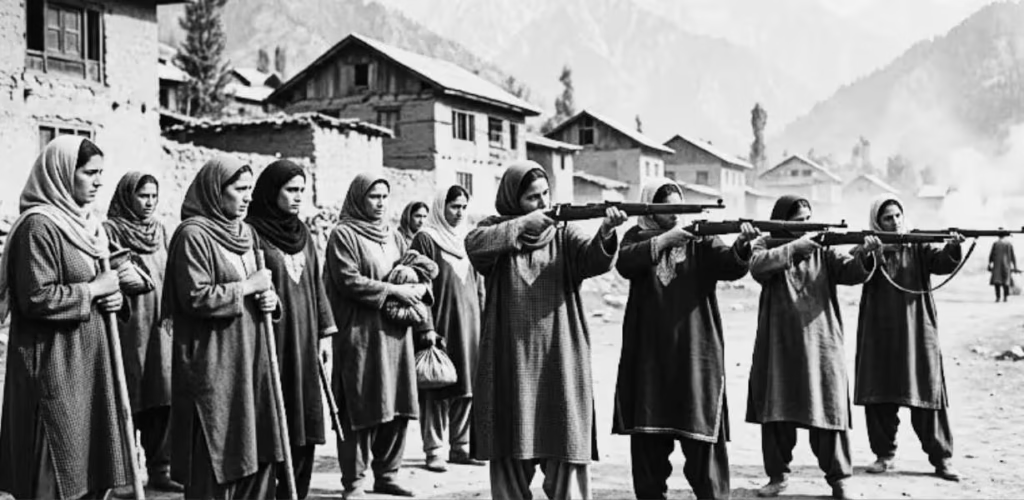
Parallel to this civil mobilization arose the most singular paramilitary formation of the post-partition era: the Women’s Self-Defence Corps (WSDC). Confronting the prospect of mass rape and subjugation, Kashmiri women, spanning elite salon intellectuals, schoolteachers, and working-class peasants rejected the traditional paradigm of passive victimhood. They took up military drill, loaded surplus bolt-action rifles, and mounted urban defenses.
Genesis of the WSDC
The sudden emergence of female rifle companies on the streets of Srinagar was not a spontaneous anomaly; it was rooted in the socio-political mobilization of the 1930s and 1940s. The National Conference had laid ideological groundwork through its radical 1944 manifesto, Naya Kashmir (New Kashmir), authored under the intellectual influence of left-leaning nationalists and progressive internationalists like B.P.L. and Freda Bedi. Naya Kashmir featured a dedicated Women’s Charter that promised:
- Universal adult franchise regardless of gender,
- Equal economic and inheritance rights,
- The elimination of domestic seclusion (purdah),
- Comprehensive civic education for girls.
When the 1946 Quit Kashmir agitations erupted against autocratic Dogra rule, women stepped into street protests, evading state police and running clandestine courier lines while the male leadership was imprisoned.
By November 1947, this political consciousness was redirected toward military defense. The foundational leadership brought together experienced political organizers, secular educators, and communist-aligned cultural figures:
- Zenab Begum (President): Sister of veteran leftist politician Ghulam Mohammad Sadiq. A veteran street agitator of the 1946 Quit Kashmir campaign, she possessed the charisma to mobilize both conservative veiled women from Old Srinagar and progressive university graduates.
- Freda Bedi: Born Freda Houlston in Derbyshire, England; Oxford graduate, wife of Marxist intellectual B.P.L. Bedi, and future Buddhist nun (Gelongma Karma Kechog Palmo). Her internationalist perspective and radical egalitarian vision made her a vital strategist on the Corps’ Executive Committee.
- Begum Akbar Jehan Abdullah: Wife of Sheikh Abdullah, known popularly as Madr-i-Meharban (Mother of Kindness). She mobilized women’s welfare units, directed the Red Cross relief depots, and coordinated supply logistics between civilian volunteer bases and frontline camps.
- The Educator Cadre: Miss Mahmud, Principal of the Government Girls’ High School; Miss Uma Razdan, leader of student networks; Mrs. Mehraj Qureshi, Inspectress of Schools; and Mrs. Sumitra Inder Mohan.
These women bypassed religious, caste, and social boundaries. Kashmiri Panditanis, Sunni and Shia Muslims, and local Sikhs drilled in shoulder-to-shoulder formations at Pratap Park and the polo grounds—an unprecedented sight in a traditional society.
Command Structure and Key Figures
The Corps functioned under a unified command structure that interfaced civilian political mobilization with regular military training:
| Category / Role | Leader / Key Figure | Primary Responsibilities & Strategic Contribution |
| Corps President | Zenab Begum | Overall executive direction; recruitment across Srinagar mahallas; civic outreach and liaison with the Emergency Administration. |
| Strategic Advisor & Committee Member | Freda Bedi | Ideological training; media relations; coordination of civil defense, internationalist political education, and refugee documentation. |
| Relief & Medical Patron | Begum Akbar Jehan Abdullah | Heading emergency medical logistics, blood donation drives, field clinics, and hospital relief coordination. |
| Educators & Organizers | Miss Mahmud, Miss Uma Razdan, Mrs. Mehraj Qureshi, Mrs. Sumitra Inder Mohan | Institutional mobilization; translating urban anxiety into regimented drill; mobilizing female students and teachers for service. |
| Military Instruction | Colonel Sher Jung | Former officer of the Indian National Army (INA); chief drill master of the National Militia and Home Guards; tactical small-arms trainer. |
| Decorated Marks-women | Shakti Bhatia & Sajda Begum | Elite marks-women; winners of the Cariappa Cup and Lakhindar Singh Cup, respectively; instructors for new recruits. |
| Humanitarian Chiefs | Mrs. Atri, Mrs. Lakhwara, Sajda Begum | Managing inpatient care in military and civilian hospitals; field rations, sanitation, and refugee relief distribution. |
Military Training and Tactical Drill
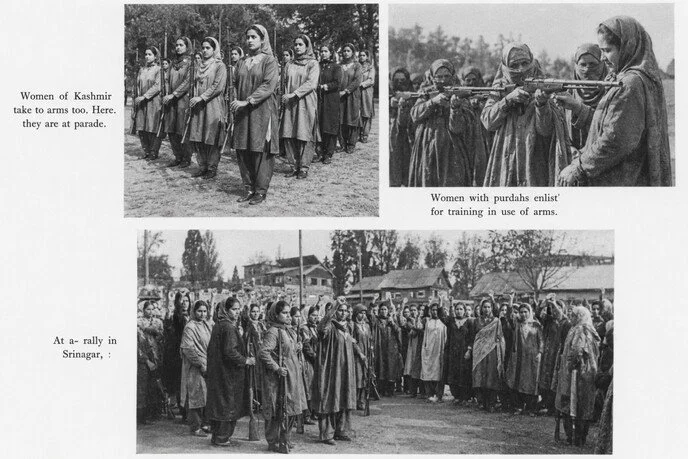
The military education of the WSDC was neither symbolic nor theatrical. It was run with rigorous field discipline directed by Colonel Sher Jung, a veteran of Subhas Chandra Bose’s Indian National Army (INA). Drawing upon the INA’s precedent of the Rani of Jhansi Regiment, Sher Jung instituted a systematic training regimen designed to transform middle-class girls and rural homemakers into a capable rear-guard territorial force.
| Training Progression:
Phase I: Marching, Physical Conditioning, Disciplinary Drill │ Phase II: Marksmanship & Maintenance (Lee-Enfield .303 Bolt-Action) │ Phase III: Close-Quarters Weapons (Sten Mk II Submachine Guns, Hand Grenades) │ Phase IV: Heavy Defensive Arms (Bren Light Machine Guns, Fixed-Position Firing)
|
The Arms of the Corps
Instruction began with physical conditioning, formation marching, and bayonet drill. Recruits were then introduced to the primary infantry rifle of the Commonwealth: the Lee-Enfield .303 SMLE.
- Weight and Recoil: Weighing over 8.8 pounds empty and generating significant shoulder recoil, the rifle posed an intense physical challenge for younger girls and older women unaccustomed to heavy physical exertion.
- Mechanical Mastery: Recruits were trained to strip, clean, clear jams, load five-round charger clips, and fire from prone, kneeling, and standing stances.
- Advanced Weapons: Advanced trainees moved to automatic and squad-level support weapons:
- The 9mm Sten Mk II submachine gun, prized for urban defense and close-quarters corner fighting.
- The .303 Bren Light Machine Gun (LMG), taught for fixed-position defense of vital infrastructure like bridges and transmission points.
- Live-fuse handling and throwing of the Mills No. 36 Fragmentation Grenade.
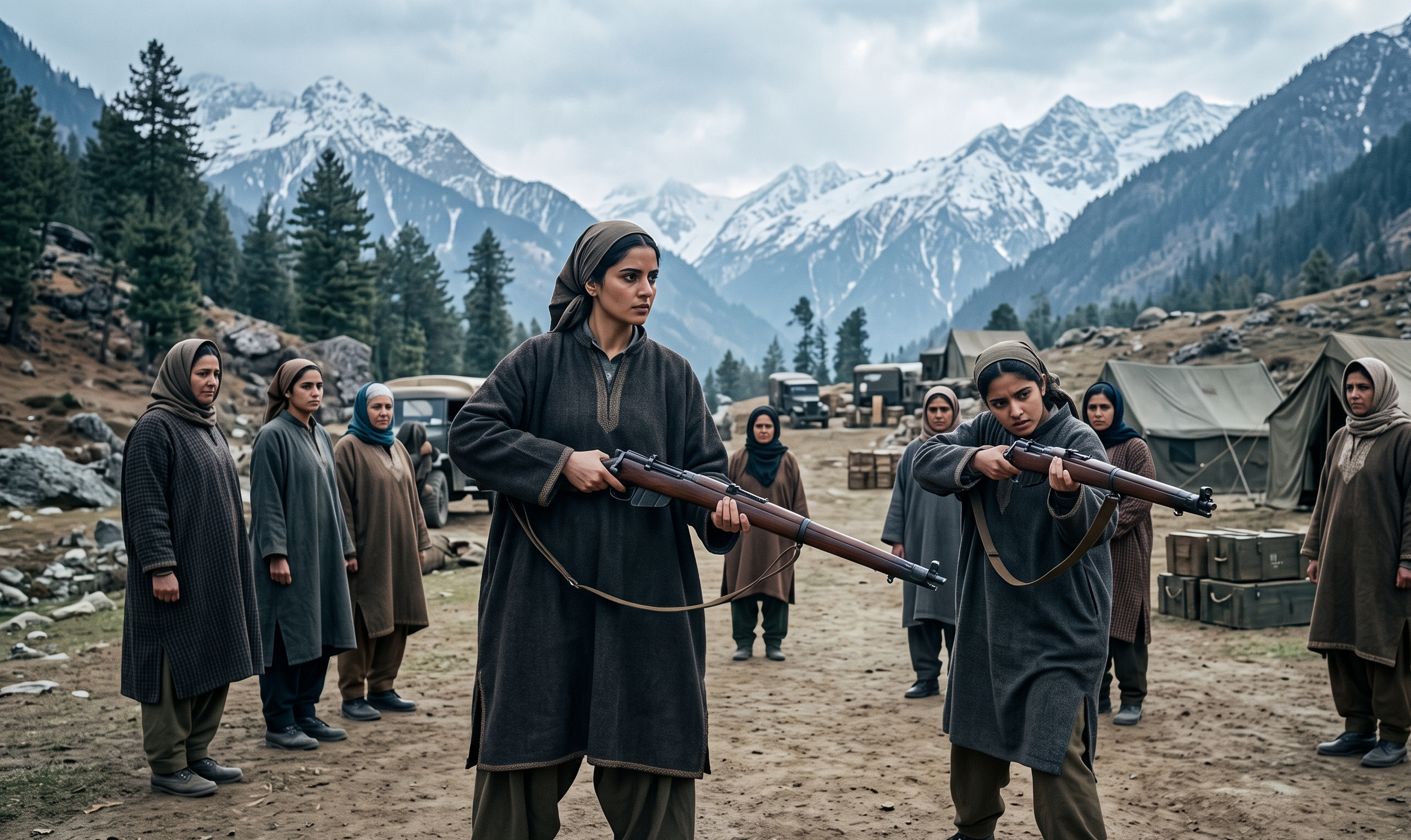
The logistical hurdles were aggravated by the onset of one of the harshest Himalayan winters on record. With the Banihal Cart Road choked by snow and air supplies throttled by limited Dakotas operating off an unpaved Srinagar airstrip, the recruits faced acute shortages of standard uniforms, boots, and warm gear. Undeterred, the women cleared deep snowdrifts from the Pratap Park and Eidgah parade grounds themselves with wooden shovels, training in their traditional pherans and shalwar kameez with fabric tucked up for mobility.
The standard of their marksmanship was corroborated in live-fire competitions observed by senior Indian military commanders who arrived following the accession. In a high-profile marksmanship trial evaluated by Lieutenant General K. M. Cariappa (later the first Indian Commander-in-Chief of the Army):
- Shakti Bhatia won the Cariappa Cup, scoring an exceptional 17 out of 20 bullseyes at range.
- Sajda Begum secured the Lakhindar Singh Cup for rapid rifle manipulation and accuracy.
The Triple Mandate
| ┌───────────────────────────────┐
│ WSDC TRIPLE MANDATE │ └──────────────┬────────────────┘ ┌───────────────────────┼───────────────────────┐ ▼ ▼ ▼ ARMED DEFENSE POLITICAL EDUCATION HUMANITARIAN RELIEF • .303 Lee-Enfields • Secular Democracy • SMHS Field Hospital • Sten Guns & Bren LMGs • Progressive Socialism • Refugee Rations • Guerrilla Defense • Anti-Communal Rallies • Civil-Military Morale
|
The leadership of the WSDC recognized that military arms were useless without an ideological spine and a resilient civilian rearguard. They operated on a tripartite model:
- Political Education & Ideological Mobilization
Daily drill sessions were coupled with open-air political seminars. National Conference leaders and progressive intellectuals addressed the ranks on:
- The socio-economic implications of the Naya Kashmir program.
- The menace of sectarian polarization, at a time when Punjab and Jammu were consumed by retaliatory communal massacres.
- Women’s structural equality, divorce rights, labor guarantees, and protection from forced marriage.
The Corps revived anti-feudal and patriotic poetry. Marching squads traversed Srinagar singing Kashmiri anthems written by nationalist poets like Ghulam Ahmad Mahjoor and Abdul Ahad Azad:
“Walo ha baagvano, navbaharuk shaan paada kar…”
(Come, gardener! Create the glory of a new spring…)
The corps’ cultural squads carried these themes into volatile urban wards, organizing neighborhood watch committees and quelling communal panic.
- Humanitarian Logistics and Emergency Medicine
As the wounded poured into Srinagar from the frontlines at Pattan, Baramulla, and Shalateng, the Corps mobilized as a volunteer nursing and auxiliary corps. At Sri Maharaja Hari Singh (SMHS) Hospital and makeshift casualty clearing stations:
- Members led by Mrs. Atri, Mrs. Lakhwara, and Sajda Begum cleaned trauma wards, dressed complex shrapnel wounds, and set up blood donation drives.
- Volunteers prepared and distributed hot rations, fresh eggs, fruit, and warm garments to both regular Indian Army troops and local militiamen recovering from frostbite and combat trauma.
- The Corps set up relief camps for thousands of destitute Hindu, Sikh, and Muslim refugees escaping the raiding parties, documenting missing family members and arranging emergency shelters.
This civic presence built a vital bridge between the civilian populace and the frontline defense forces, maintaining urban morale through the darkest weeks of November 1947.
Socio-Political Legacies
The critical intervention of the Indian Army at the Battle of Shalateng on November 7, 1947, turned the tactical tide. The tribal irregulars and Pakistani regulars were routed from the outskirts of Srinagar and pushed back down the Jhelum gorge past Baramulla and Uri.
As conventional military formations consolidated their lines across what became the Ceasefire Line (the Line of Control), the urgent operational necessity for an armed, civilian female defense militia faded. In March 1948, the Jammu and Kashmir Emergency Administration transitioned into a formal cabinet headed by Sheikh Abdullah as Prime Minister of the state.
The demobilization of the WSDC was swift:
- Disarmament: The rifles, submachine guns, and field gear were retrieved and re-inventoried by the state militia and police arsenals.
- Re-channeling into Civil Infrastructure: The core leadership leveraged their mobilization to permanently alter women’s institutional presence in the Valley:
- Begum Akbar Jehan channeled the energy into social welfare boards, refugee rehabilitation programs, and the All Jammu and Kashmir Women’s Conference.
- Educators like Miss Mahmud and Uma Razdan laid the foundations of the first public Government College for Women (M.A. Road, Srinagar) in 1950, securing tuition-free higher education for women in Jammu and Kashmir.
- Zenab Begum continued her political trajectory, winning election to the Jammu and Kashmir Legislative Assembly in the 1972 and championing state-level progressive labor and marriage reforms.
- Freda Bedi turned her attention to refugee relief, publishing on the Kashmiri struggle, before moving deeper into Buddhist philosophy, eventually taking vows as a nun in the Kagyu tradition.
Historiographical Assessment
Despite their foundational role in preventing the fall of Srinagar, the women of the WSDC were largely sidelined in conventional postcolonial military histories. Mainstream national historiographies in both India and Pakistan reduced the 1947–1948 war to conventional troop deployments, the politics of the Instrument of Accession, and elite diplomatic maneuvering at the United Nations.
Modern feminist historiography and subaltern studies have worked to recover these narratives. Scholars such as Urvashi Butalia, Ritu Menon, and Mridu Rai have demonstrated that the partition of the subcontinent cannot be comprehended solely through high-table constitutional diplomacy. The Women’s Self-Defence Corps demonstrated that Kashmiri women were not merely casualties in a geopolitical contest between rival nation-states; they were armed political actors who organized, defended, and shaped the civic space of their homeland during its most precarious historical crossroads.
Historical Documentation & Sources
- Government of Jammu and Kashmir, Through Blood, Sweat & Tears: A Record of the Defence of Kashmir, (Jammu: Ranbir Government Press, 1948).
- Abdullah, Sheikh Mohammad. Atish-e-Chinar (Flames of the Chinar: An Autobiography), (Srinagar, 1986).
- Bedi, Freda. Behind the Bamboo Curtain: Social and Political Glimpses of a Transforming Region, (Contemporary Writings and Archive Notes, 1947–1951).
- Rai, Mridu. Hindu Rulers, Muslim Subjects: Islam, Rights, and the History of Kashmir, (Princeton University Press, 2004).
- Whitehead, Andrew. A Mission in Kashmir, (Viking/Penguin India, 2007).
- Field notes and archival compilations by Dr. Zahid Iqbal Sheikh, Faculty, Department of History, Govt. College VKB, Hyderabad.
Leave a Reply