Bashir Aarif delivers a masterclass in the Kashmiri afsana tradition through eleven tightly crafted stories. The collection captures the quiet grief of displacement, communal memory, and the fractures of modern society.
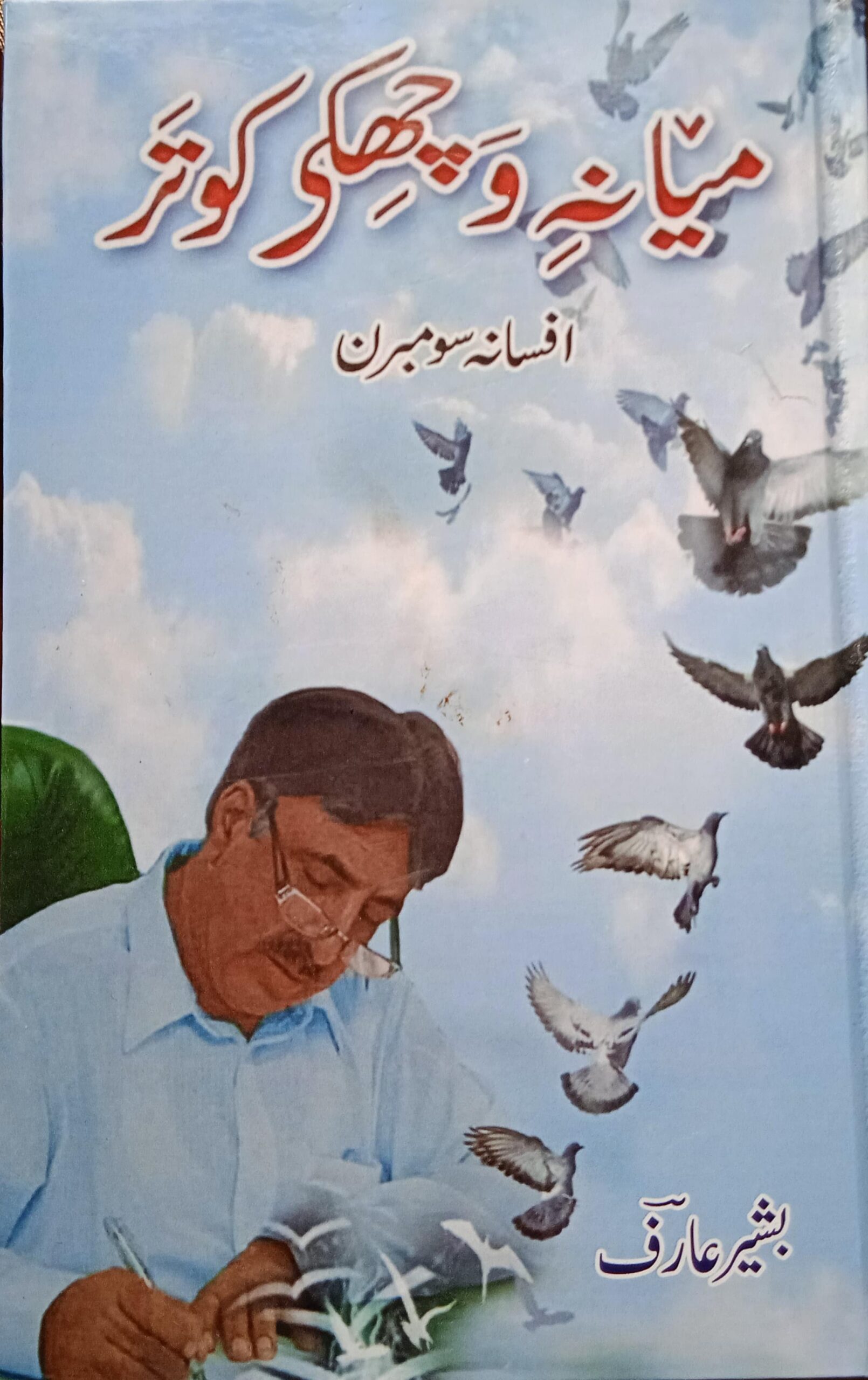
Some short stories are meant to be read and forgotten; others must be slowly chewed and digested. Bashir Aarif’s Kashmiri short story collection, Myani Vachik Kotar, decisively belongs to the latter category. Published by Meezan Publishers, Srinagar, and dedicated by the author to his wife and three daughters, this volume offers a deeply felt, socially conscious narrative suite. It reflects the seasoned voice of a writer who has observed life across its many dimensions. Aarif writes with precision and compassion, transforming delicate, fleeting details into expansive, poignant literary vignettes. His work is far from art for art’s sake; it is an authentic archive of Kashmiri life, rooted in the soil, its folk traditions, and its ancestral vocations.
Spanning eleven short stories across 110 pages, this afsana collection unfolds as a sustained exploration of human interiority. Rather than merely recounting linear tales, the volume presents a mosaic of Kashmiri society. While the stories are anchored in the everyday rhythm of Srinagar and the wider Valley, their emotional architecture remains universal. Through finely etched characters, Aarif explores survival through adversity. In an era dominated by voluminous tomes that often gather dust, the author opts for economy and impact. The collection remains deliberate and concise, drawing the reader through a sequence of tightly structured narratives that sustain tension until the final sentence.
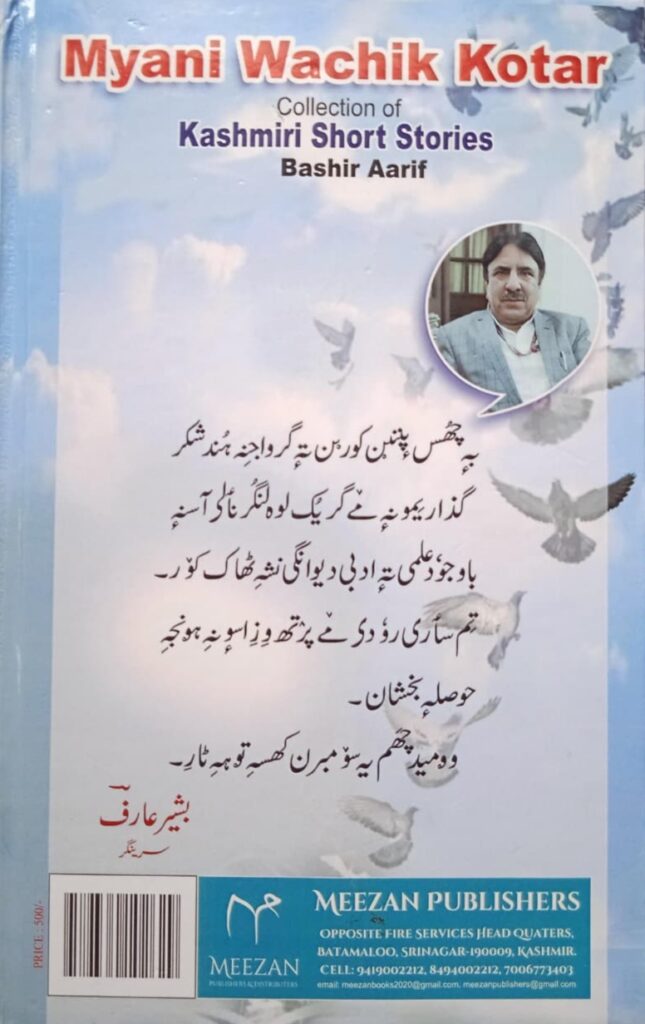
Aarif brings formidable literary and cultural pedigree to this project. A towering figure in regional broadcasting, he is a seasoned intellectual, writer, poet, and scriptwriter who served as Deputy Director General of Radio Kashmir (now All India Radio). For decades, he helped shape regional cultural discourse over the airwaves, earning widespread acclaim for the intellectual depth of his programming. In addition to his celebrated na’ats, renowned for their devotional lyricism, he created the landmark radio show Zoon-e-Dab, a cultural fixture throughout Jammu and Kashmir.
Myani Vachik Kotar emerges as an essential contribution to his wider body of work in Kashmiri, offering narratives drawn straight from regional realities. The stories are neither derivative nor purely speculative; they serve as a lucid social ledger of contemporary life. The characters carry an immediate familiarity, bearing names and traits that evoke traditional trades, shared histories, and the close-knit bonds of neighborhood life. Through them, the collection preserves a vital link to local memory while forcing readers to confront the rapid cultural and moral shifts reshaping their environment.
Though the slim volume suggests a quick read, the narrative weight of each entry demands a deliberate, reflective pace. Aarif captures complex lives within concise frames. His Kashmiri prose, clear and unadorned on the surface, conceals layered subtexts that reward close reading. In carefully executed pieces such as Tuel-Kul, Brasht, Shooch, Atur, Gopa, Aav Ha Aav Ha, Kanz, Sakh Dod Chum, Yeth Makanas Manz, Manz Saraai, and the title piece Myani Vachik Kotar, Aarif recalls an earlier era in the Valley, a period prior to deep communal ruptures, when walls had not yet been erected inside human hearts.
The enduring trauma of the Kashmiri Pandit exodus forms a central emotional current in the text, emerging prominently in stories like Yeth Makanas Manz and Brasht. Drawing upon decades of observation, Aarif depicts the disorientation of lost hearths, exile, and the quiet grief of feeling estranged from one’s native home. He captures the psychological toll of displacement with restraint, eschewing melodrama in favor of quiet human truths.
Beyond historical memory, Myani Vachik Kotar operates as a sharp critique of societal hypocrisies. The characters are not flat symbols; they function as kotar (pigeons) sheltered within the vachik (the inner chamber of the chest), animated by personal desires, frailties, and an enduring need for affection. In Tuel-Kul, Aarif explores how late-life emotional longing is met by public cynicism and gossip, contrasting human vulnerability against a judgmental social backdrop. In Brasht, this theme deepens through the portrait of a 70-year-old Pandit who dedicates himself entirely to his household, only to be reflexively condemned and ostracized by an unforgiving neighborhood, underscoring how swiftly a community can turn toward prejudice.
Aarif frequently revisits the historical bonds that once unified Muslims and Pandits across religious lines. In Atur, he sketches a striking portrait of solidarity forged amid crisis. When two young lovers, Farooq and Anjali, elope to Gulmarg and are detained by law enforcement, Anjali’s father, Mohan Ji, intervenes to shield Farooq from severe legal retribution by claiming the young man is his own son. Though Mohan Ji later takes his own life under the crushing weight of public stigma, the act itself highlights the deep, paradoxical kinship that historically held the community together.
The moral compromises of modern life are examined with equal sharpness in Shooch. Here, a stray puppy is left to die because it is regarded as ritually impure, yet the very individuals who reject the animal readily pocket the money allocated for its care. Through this stark vignette, Aarif strips away the veneer of public righteousness, exposing the ethical lapses disguised as religious rectitude.
The title story, Myani Vachik Kotar, anchors the overarching collection. The metaphorical pigeons emerge as the collective human experiences, forgotten figures, and quiet tragedies the author has observed and sheltered in his consciousness across decades. They are living memories given flight through the printed page. Ultimately, the collection stands as a formidable entry in the Kashmiri afsana tradition, balancing reverence for cultural heritage with an unsparing look at contemporary human conduct.
Disclaimer: The views expressed in this feature article are solely those of the author and do not necessarily reflect the official editorial stance or opinions of this publication. The author can be reached at [email protected]
Leave a Reply