Addressing events in New Delhi and Srinagar, top leaders emphasized that remembering past trauma is vital for national harmony. They urged the youth to reject divisive forces and work toward an inclusive future.
By Ajaz Rashid
As India prepared to celebrate its Independence Day, the country paused on August 14, 2026, to observe Partition Horrors Remembrance Day. From national seminars in the capital to solemn gatherings in Srinagar, political leaders, scholars, and citizens reflected on the catastrophic human cost of the 1947 division of the subcontinent. Across multiple addresses, the central message remained resolute: remembering the trauma of Partition is not intended to reopen historical wounds with bitterness, but rather to honor the resilience of millions of displaced survivors, draw vital lessons on national security, and reinforce the enduring values of peace, brotherhood, and civilisational unity.
In New Delhi, Vice-President C. P. Radhakrishnan addressed a National Seminar organized by the Centre for Independence and Partition Studies, University of Delhi, in association with the Indian Council of Historical Research (ICHR). The seminar, themed ‘The Partition of India – A Saga of Displacement, Separation and Resettlement’, focused on the historical realities of the 1947 tragedy. Paying tribute to the survivors present, the Vice-President characterized the event as a reflection on “one of the most tragic and dehumanising chapters” in Indian history.
Vice-President Radhakrishnan underscored that while Independence brought long-awaited freedom from colonial rule, it came paired with unprecedented devastation and one of the largest mass migrations in human history. He observed that the sheer scale of the event serves as an enduring warning against the destructive consequences of hatred and communal division. Clarifying the broader purpose of the observance, he noted that the objective is not to harbor animosity, but to foster unity and harmony across modern India.
Emphasizing historical education, Radhakrishnan praised the University of Delhi for establishing the Centre for Independence and Partition Studies in 2023. He noted that the Centre has already recorded the oral testimonies of over a hundred survivors while actively engaging students through archives, public events, and lectures.
“Our children deserve to know the truth of Partition,” Radhakrishnan said, adding that an event of such vast magnitude cannot be reduced to a few lines in a textbook. He warned that those who fail to remember the past risk repeating its tragedies.
Turning to geopolitics and governance, the Vice-President explained that the hurried redrawing of boundaries left deep territorial fractures that still affect India’s defence policy, national security, and regional diplomacy. Reflecting on crisis leadership, he remarked that the will and determination of political leadership are crucial when taking difficult decisions in the national interest. He stressed the necessity of advance notice and preparedness in major policy decisions affecting public safety, noting that the security of citizens must always remain paramount.
Radhakrishnan also reflected on the cultural and civilisational loss wrought by Partition. The event was not merely a political division, he said, but the disruption of a civilisational landscape interconnected for millennia. He pointed to lost or complicated access to iconic cultural, spiritual, and historical sites, including the Sindhu river, Kartarpur Sahib, Nankana Sahib, ancient Shaktipeeths, and the archaeological heritage of Harappa, Mohenjodaro, and Takshashila. Urging citizens to prioritize national identity over sectarian fault lines, he emphasized that no caste, language, or region surpasses the nation.
During the seminar attended by DU Vice-Chancellor Prof. Yogesh Singh, ICHR Chairman Prof. Raghuvendra Tanwar, Dean of Colleges Prof. Balram Pani, Registrar Dr. Vikas Gupta, and numerous scholars, the Vice-President felicitated 15 Partition survivors, toured a commemorative photo exhibition, and administered a ‘No Drugs’ pledge to the participating youth. Concluding his address, he noted that the day serves as a reminder that freedom is precious, unity is essential, and peace can never be taken for granted.
Prime Minister
Joining the nationwide remembrance, Prime Minister Narendra Modi paid tribute to the countless victims and survivors, highlighting how ordinary citizens overcame catastrophic losses to build modern India.
The Prime Minister noted that Partition was a dark historical juncture that uprooted entire communities, severed families, and inflicted profound suffering. Yet, out of that destruction emerged stories of unprecedented perseverance. Modi commended those who rebuilt their lives from scratch, transforming personal tragedy into national achievement.
Sharing a Sanskrit Subhashitam on the virtue of enterprise and hard work, the Prime Minister noted that human endeavor—not passive reliance on fate—shapes destiny, fostering innovation, science, craftsmanship, and prosperity.
In a statement shared on X, Prime Minister Modi wrote:
“Today we mark #PartitionHorrorsRemembranceDay. We recall the courage of all those who were impacted by Partition. It was a moment in history that tore apart several lives families were uprooted, loved ones were lost and immense suffering was endured.
At the same time, overcoming this, people rebuilt their lives from nothing, turned adversity into achievement and contributed immensely to our nation’s progress. Their life journeys remind us of the strength of the human spirit.
May this day deepen our resolve to preserve harmony and brotherhood in our nation and collectively work towards building a Viksit Bharat.”
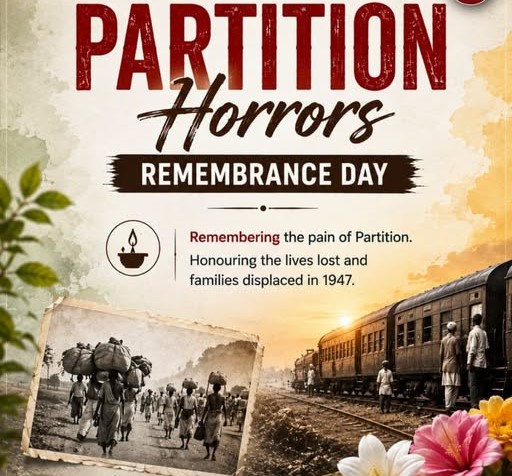
Modi reiterated that the courage shown by Partition survivors should serve as a collective blueprint for achieving national goals and preserving solidarity across the country.
Lt Governor Manoj Sinha
In Srinagar, Lieutenant Governor Manoj Sinha led the observance at Tagore Hall, where attendees observed a two-minute silence for the victims and viewed a photo exhibition alongside a theatrical performance illustrating the trauma of displacement.
Addressing the gathering, Sinha described Partition as an enduring wound in the national psyche:
“Decades after the partition, their sacrifice reminds us that the wound remains unhealed, lingering as a generational pain in India’s collective soul. On Partition Horrors Remembrance Day, we are not merely recalling the past but we are giving voice to those millions whose voices were taken away from them. I wish to reiterate with firm resolve that we will not allow their pain to be buried in the dust of history. Remembering them is fulfilling our duty towards humanity. We will preserve their memories. Remembering them with complete truthfulness, honesty, and utmost sensitivity is the most sacred tribute. I believe that their stories are an indelible chapter of our national consciousness, and their sacrifice will forever remain alive in the soul of Mother India,” the Lieutenant Governor said.
Sinha noted that the local historical context of Jammu and Kashmir was deeply entwined with the tragedy of 1947. He highlighted the displacement of families from Pakistan-occupied Jammu Kashmir and Chhamb, recalling their long struggle for equal rights, which he credited Prime Minister Modi with resolving through the abrogation of discriminatory provisions. He also paid homage to the victims of the tribal invasions that took place in the months following Partition.
“Within a few months of partition, enemies of the nation carried out terror attack under the cover of tribal invasions. Indian army and people fought bravely. The struggle and sacrifice of countless families are an integral part of the collective memory of Jammu Kashmir. Today, I humbly pay tribute to the patience, hard work, and unbroken patriotism of all those families,” Sinha stated.
Focusing on the path forward, Sinha called upon the youth of the Union Territory to reject communal discord and embrace their role in nation-building:
“The youth of Jammu Kashmir must ensure that the mistakes of the past are never repeated in the future. Where walls were once raised, you must build bridges of trust and construct a Viksit Bharat that is inclusive,” he said.
Together, the nationwide observances reaffirmed a collective resolve: to keep historical memory alive with sensitivity, honor the resilience of those who survived, and safeguard the foundational unity of the nation.
Leave a Reply