We like to believe we are the absolute authors of our own destiny. Yet modern science suggests our brains make decisions long before our minds ever register them.
By Aman Ashraf
Humans have always thought of themselves as the authors of their own choices. Each decision, each desire, each act of love or regret feels deeply personal, driven by an invisible “self” inside us that consciously shapes reality. Yet, modern neuroscience and physics are beginning to challenge this certainty. If the brain is finalizing choices before we are even consciously aware of them, the very concept of free will begins to fracture. But if consciousness is simply the byproduct of electrical signals and chemical reactions, why does existence feel aware of itself at all? Perhaps the greatest mystery is not that the universe exists, but that it is capable of questioning its own existence through us.
For centuries, humanity took free will for granted. Choice appeared inseparable from consciousness itself. Modern science, however, has increasingly questioned this assumption. In groundbreaking experiments, neuroscientists discovered brain activity associated with decisions a few moments before participants experienced making them. For many, this opened up a disturbing possibility: consciousness might not be the initiator of our choices, but rather a spectator—the awareness of a decision after the fact. This echoes the long-held views of classical physics, which described the universe as a completely deterministic system, a cosmic mechanism functioning according to the absolute laws of cause and effect. If all particles adhere strictly to these physical laws, then human thought itself may be nothing more than the inevitable consequence of a chain of previous events leading back to the beginning of the universe.
However, this deterministic understanding of reality began to collapse when a revolutionary branch of physics emerged in the early twentieth century. While classical physics viewed the cosmos as entirely predictable, quantum mechanics revealed a microscopic world governed by uncertainty and probability. At the quantum level, subatomic particles behaved in ways that flatly contradicted conventional human intuition. A photon, for example, could exhibit the properties of both a wave and a particle simultaneously. Furthermore, Heisenberg’s uncertainty principle demonstrated that the exact position and momentum of a particle could never be known at the same time with complete exactness. This led to a radical shift in how we view the nature of reality. The universe was no longer seen as an orderly machine operating with complete certainty, but as something far more enigmatic and unpredictable underneath.
Another profound notion that feeds into humanity’s uncertainty about existence is entropy—the fundamental tendency of physical systems to progress from order to chaos over time. The universe seems to be steadily sliding into disorder, visible in everything from dead stars to lost memories. Some physicists even suggest that our very perception of time is intimately connected to this relentless increase in entropy. Yet, despite living in a universe that appears headed for chaos, conscious beings still search for meaning, purpose, morality, and even the divine. This presents a remarkable paradox: why should a universe dominated by decay produce minds that crave truth, coherence, and understanding? Stars burn out and structures inevitably decay, but the human mind remains fueled by questions that extend far beyond immediate survival. We are driven to find out not only how the universe works, but why it exists at all.
This brings us to perhaps the deepest mystery in both science and philosophy: consciousness. Despite stunning advances in neuroscience, no theory has fully accounted for how subjective experience emerges from physical matter. The human brain contains billions of neurons that communicate with each other through a complex network of electrical and chemical signals. Yet, from these physical interactions emerges an inner world of thoughts, feelings, memories, and self-awareness. Describing a biological process is not the same as explaining the experience itself. Science can explain how neurons fire, but it has not figured out why those interactions should result in the subjective experience of watching a sunset, falling in love, or contemplating one’s own existence.
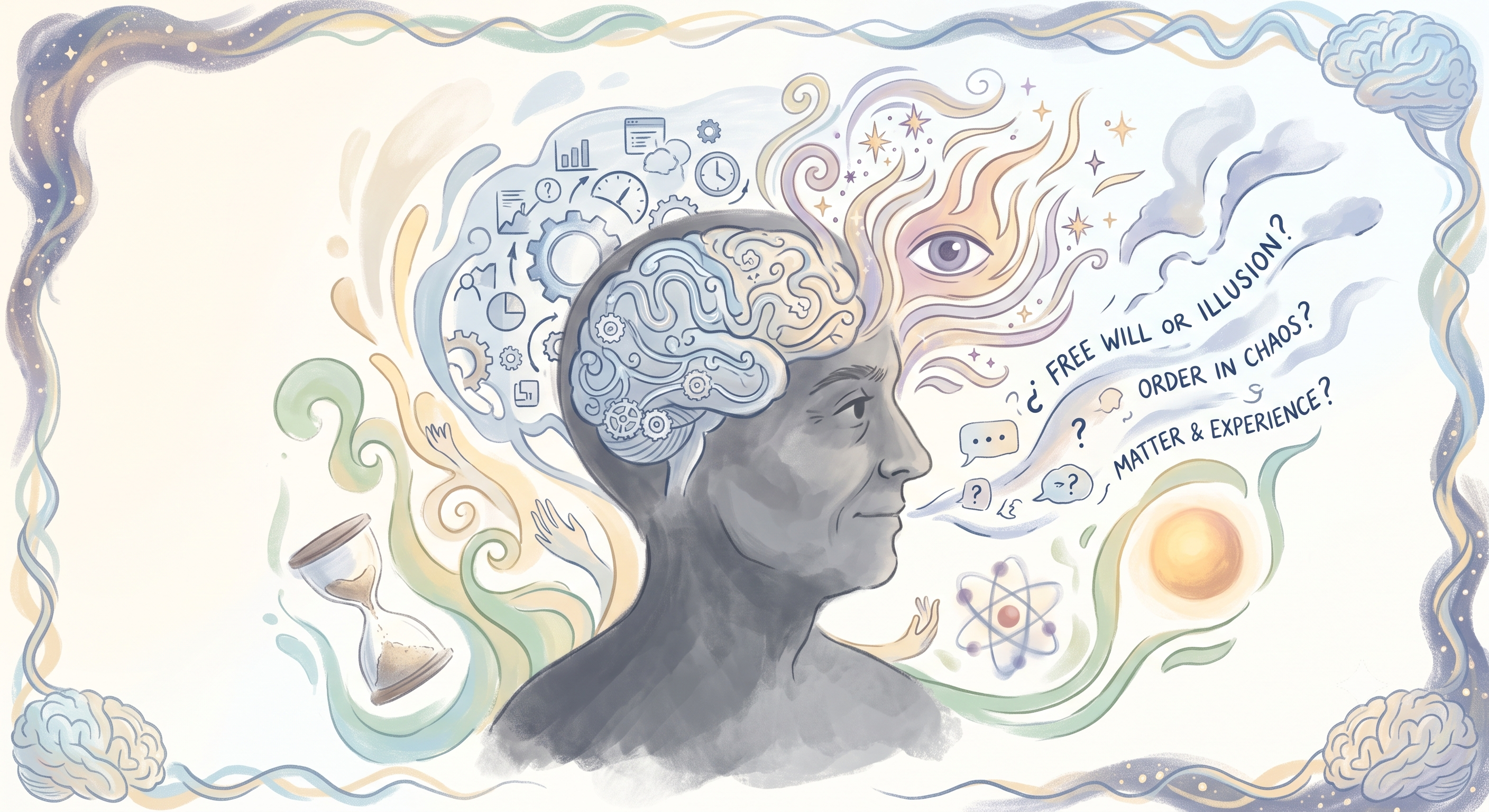
This profound gap between physical processes and subjective experience is known as the “hard problem” of consciousness. The hard problem is not merely a neuroscience puzzle; it is a fundamental philosophical dilemma. If subjective experience cannot be fully accounted for by physical matter, then consciousness may be far more fundamental to the fabric of reality than we ever realized. This possibility has compelled thinkers to ask whether reality is truly limited to matter and energy, or if there is a deeper dimension to existence that science has not yet fully grasped.
Reality has become progressively more mysterious the deeper we explore it. Determinism challenged free will, quantum mechanics challenged determinism, our understanding of time was challenged by entropy, and our understanding of matter itself was challenged by consciousness. In answering old questions, every major scientific discovery has laid bare even deeper questions beneath. The more we learn about the universe, the more mysterious it seems, not less.
Perhaps the greatest discovery of science is not that the universe is governed by laws, but that through us, it has become aware of those laws. We are made of atoms, thinking about atoms. We are temporary beings questioning eternity, pieces of the universe trying to understand the whole. Yet, after centuries of philosophy and science, the most profound questions remain unanswered. Is consciousness something fundamental to the cosmos, or are we just matter watching itself? Is free will an illusion, or is it precisely what makes us human? The mystery of existence is not solved, but waiting until these questions are answered.
Disclaimer: The views expressed in this feature article are solely those of the author and do not necessarily reflect the official editorial stance or opinions of this publication.
Leave a Reply