Spanning forty-one curated short stories, this anthology bridges the gap between deep philosophical inquiry and the raw anxieties of everyday life. Through a masterful command of modern Urdu prose, the author transforms localized grief into a universal study of the human condition.
By Rayees Ahmad Kumar
Among the contemporary voices mapping the turbulent landscape of Kashmir through fiction, Dr. Riyaz Tawhidi has carved out a distinct space within modern Urdu literature. Hailing from Wadi Pora, Handwara, in the frontier district of Kupwara, Tawhidi’s creative journey is rooted in a region defined by complex geopolitical realities. His latest short story collection, Zindagi Ka Bazaar (The Marketplace of Life), compiled by Anwar Mirza and published by Educational Publishing House, New Delhi, represents a definitive anthology of his literary career. Spanning 220 pages with a meticulously designed cover, the book is dedicated to the new generation of Urdu readers and features analytical reflections from prominent literary critics, including Izhar Khizr and Professor Qudus Javed.
As a curated collection of forty-one short stories, Zindagi Ka Bazaar draws from Tawhidi’s previously published volumes, Kalay Pedon Ka Jangal (The Forest of Black Trees) and Kalay Divon Ka Saaya (The Shadow of Black Demons), alongside several uncollected pieces. The volume serves as a testament to what critics describe as an ability to transcend regional confines. While deeply informed by the local specificities of the Kashmir valley, Tawhidi’s thematic lens frequently expands to address broader global crisis points, structural violence, and the fractures inherent to human relationships under pressure.
The anthology opens with The Secret of White Light, a philosophically driven narrative framed as a dialogue on the nature of truth and imitation. Tawhidi utilizes the conversation to parse the distinctions between light, illumination, the original, and the copy, illustrating how philosophical inquiry can render abstract concepts accessible to the ordinary observer. From this conceptual foundation, the collection shifts rapidly across genres and thematic landscapes. In the science-fiction story David Planet, the author explores the boundaries of human ambition through a twenty-year-old scientist who constructs an artificial utopia on a distant planet. On this world, disease and death are systematically eliminated, giving rise to an illusion of absolute control. However, the system suffers a catastrophic collapse when cosmic rays disrupt the technology, causing the robotic infrastructure to melt. The story serves as a cautionary fable regarding the consequences of unnatural human intervention in ecological and existential balances.
Tawhidi’s political critique becomes more direct in Global Lie, a narrative that tackles the mechanics of contemporary geopolitics. The story examines how powerful nations exploit the rhetoric of democracy to subjugate and destabilize weaker sovereign populations. This exploration of systemic oppression is mirrored on a localized scale in Stone-Pelter, a narrative that deconstructs the cycle of political violence in the region. The story details the psychological and physical toll inflicted on civilian populations when state and non-state actors engage in prolonged conflict, emphasizing the vulnerability of innocent individuals caught in networks of institutionalized falsehoods and punitive measures.
The breakdown of social and familial structures forms another major thematic pillar of the collection. The Lost Capital addresses the isolation of the elderly in an increasingly atomized society. The narrative centers on Ghafar Khan, a man who lies dying in a hospital room, completely abandoned by his son. The son, whom Khan raised with devotion, has achieved significant professional success as a surgeon abroad, yet remains emotionally detached and physically absent during his father’s final hours. Tawhidi uses this domestic tragedy to critique the transactional nature of modern ambitions, where material advancement often comes at the cost of fundamental moral obligations.
The psychological weight of systemic decay is explored through dark allegory in Depression, where a dilapidated, rusted public bus becomes a microcosm of societal cruelty. The driver and conductor of the vehicle subject their passengers to decades of calculated malice and violence, ultimately causing the deaths of many who travel with them. The story functions as an indictment of normalized institutional abuse and the desensitization of individuals operating within failing public frameworks.
Tawhidi directly addresses the historical trauma of his home region in Homeland, which reconstructs the pivotal shifts that occurred within the Kashmir valley during the 1990s. The story chronicles the sudden unraveling of the region’s pluralistic social fabric, specifically the breakdown of long-standing communal harmony among Hindu, Muslim, and Sikh communities. Rather than relying on romanticized nostalgia, the narrative utilizes realistic depictions to confront the complex socio-political factors that displaced entire populations and permanently altered the valley’s demographic and cultural landscape.
This exploration of systemic hostility continues in The Forest of Black Trees, the title story of Tawhidi’s debut collection. Here, the author depicts a settlement besieged by fear, where residents hesitate to leave their homes after dark due to decades of arbitrary night raids, arson, and structural destruction. The text frames this collective suffering not as a consequence of individual wrongdoing, but as a systemic affliction visited upon an entire population, treating vulnerability itself as a punishable offense. Similarly, The Lost Graveyard provides a stark accounting of the human cost of prolonged conflict, focusing on the thousands of women widowed and millions of children orphaned by decades of violence that spared neither the youth nor the elderly.
The collection also examines everyday corruption and moral hypocrisy within civilian life. In Thorns of the Babool Tree, Tawhidi targets political corruption and the arbitrary exercise of bureaucratic authority. The narrative illustrates how honest individuals are systematically marginalized and penalized by influential figures, even when working within transparent and lawful frameworks. In The Throat-Cutter, the author shifts his focus to the medical and trading sectors, exploring how commercial greed has eroded professional ethics. The plot contrasts a local butcher’s traditional respect for medical professionals with the cynical exploitation he experiences at their hands, exposing a broader societal slide toward institutionalized selfishness.
In contrast to these bleaker assessments, Flowers of Mercy addresses social prejudices surrounding gender. The story challenges the persistent cultural preference for male heirs by depicting families that initially mourn the birth of daughters, only to find fulfillment and support through those daughters’ later achievements and resilience. Additionally, the romantic narrative Never Say Goodbye offers a stylistic shift into domestic realism, tracking how undue parental interference and rigid societal expectations can permanently separate a couple, leaving both individuals to navigate lives defined by unfulfilled compromise and chronic emotional displacement.
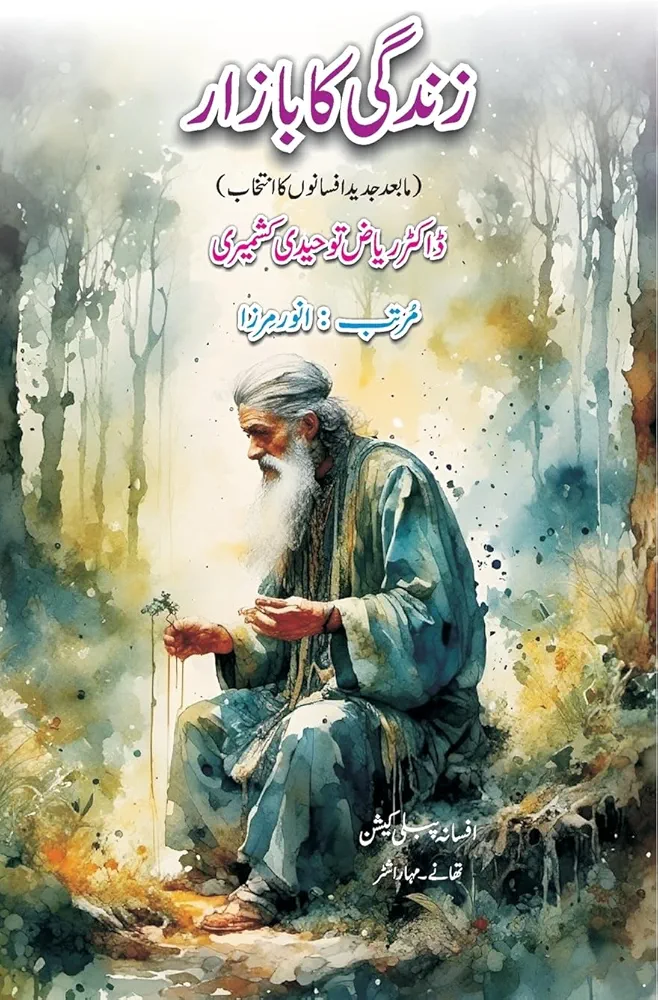
Structurally, Zindagi Ka Bazaar demonstrates a mature command of the Urdu short story form. Tawhidi avoids overly sentimental prose, opting instead for a controlled, lucid vocabulary that relies on precise situational irony and allegorical clarity to convey emotional depth. His characters are rarely archetypes of pure virtue or malice; rather, they function as individuals caught within larger institutional, historical, or philosophical currents that dictate their choices. By assembling these diverse narratives into a single volume, Zindagi Ka Bazaar provides a comprehensive overview of a writer dealing directly with the anxieties of both his immediate society and the wider modern world, making it a significant addition to contemporary South Asian literature.
Disclaimer: The views and historical interpretations expressed in this feature article are solely those of the author and do not necessarily reflect the official editorial stance or opinions of this publication.
Leave a Reply