While official medieval chroniclers remained silent under the constraints of royal patronage, the oral traditions of Kalaroos kept the memory of the seven mystics alive. Their quiet contemplation stands as a timeless testament to cultural resilience against enforced orthodoxy.
By Khursheed Dar
Among the half-buried testimonies of Kashmir’s layered past stands a curious structure in the village of Kalaroos, nestled in the northern reaches of Kupwara district. Famous for Satbaran literally “seven doors” this site consists of seven arched niches carved meticulously into a single limestone rock face. Though not referenced in the canonical chronicles of Kashmir’s medieval history, Satbaran remains etched in the collective memory of the local populace. Their interpretations, passed through oral tradition, demand a historically responsible inquiry.
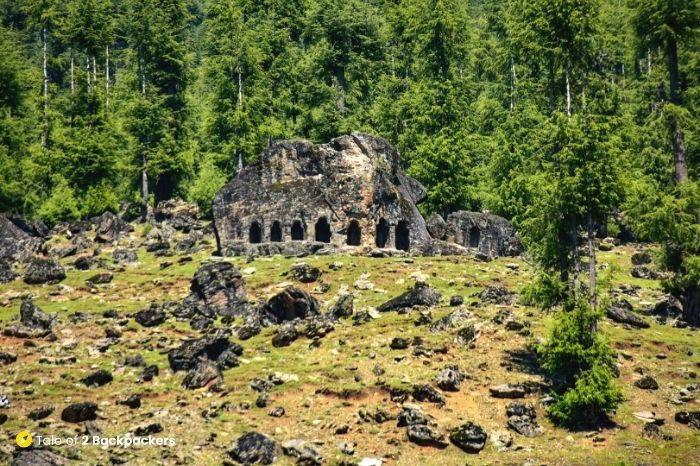
My own investigations into the site have been manifold. I undertook several field visits, made efforts to document local lore, and searched for textual sources that could authenticate, or at the very least, correlate with the narrative preserved by the people of Kalaroos. For long, such sources eluded me, until I came across a literary work entitled Sultana Kota Rani by Khawaja Farooq Renzu Shah. In this narrative, the author makes a striking claim: that the seven doorways once hosted seven ascetic mystics engaged in deep meditation, who were ultimately executed beheaded during the reign of Sultan Sikandar (1389–1413). The etymology proposed is equally compelling: Kala, meaning head; Roos, meaning without. Kalaroos, then, implies a place “without heads”, a linguistic testament to the martyrdom of its saints.
Let us attempt a cautious reconstruction. Sultan Sikandar’s reign is often characterized in later Persian and Sanskrit sources as one of intensified orthodoxy and centralization. Influenced deeply by missionary zeal, Sultan Sikandar’s administration pursued what it termed the “purification” of public religious life effectively marginalizing syncretic practices that had defined Kashmir’s religious and artistic landscape for centuries. The destruction of the Martand Sun Temple, the neglect and eventual ruin of numerous wooden shrines, and the transformation of multi-faith institutions into mono-religious ones are part of this legacy.
Yet, such events cannot be assessed solely through theological lenses. One must also recognize the undercurrents of statecraft. Sultan Sikandar’s policies were as much about consolidating power as they were about religious reform. In medieval polities, faith was often employed as a tool to galvanize political authority. Hence, acts now perceived as iconoclasm could well have had political motivations cloaked in religious language. The mystics of Satbaran, if they existed as described by the author of Sultana Kota Rani, may have symbolized the older, inclusive spiritual order—rendering them incompatible with the emerging doctrinal orthodoxy.
The official historiography of the period, preserved by chroniclers like Jonaraja and Śrīvāra, remains cautious. These scholars, though perceptive, operated under royal patronage and within intellectual constraints. Their reluctance to delve into the full scope of spiritual and artistic erasure speaks to the silences that power can impose upon history. In this historiographical vacuum, the oral traditions surrounding Satbaran become invaluable. They offer us a culturally authenticated memory of resistance—resistance not through arms, but through quietude, contemplation, and ultimate sacrifice.
It is unfortunate that during the Cold War era, this culturally significant site was drawn into the realm of absurd speculation. Folklore emerged that the cave of Satbaran led to Russia, giving the site a strategic dimension it never possessed. In the process, the mystics of oral tradition were replaced with an imagined espionage route. Such distortions exemplify how sacred geography can be hijacked by political anxieties, resulting in a historical misreading of silence not as spiritual meditation, but as covert concealment.
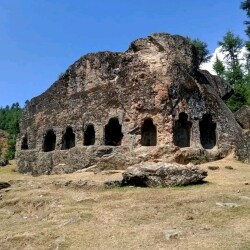
Presently, Satbaran lies outside formal heritage protection. Despite growing appeals from heritage enthusiasts and local tourism advocates for the Archaeological Survey of India (ASI) or the Jammu & Kashmir Directorate of Archives, Archaeology, and Museums to intervene, there are still no physical barriers to protect it from environmental erosion or human interference. Yet, within the domestic spaces of Kalaroos its kitchens, its elderly storytellers Satbaran lives on. It exists not merely as a site, but as an idea—a memory-space transmitted orally across generations.
Let it be clear: this column does not aim to vilify Sultan Sikandar. It is a well-acknowledged principle of historical analysis that events must be situated within their contemporary contexts. The Sultan’s policies, while deeply transformative, also reflected the broader Islamic revivalism of the 14th century that swept across Central and South Asia. However, this does not absolve the cultural and spiritual losses incurred during his reign. A balanced historiography must account for both statecraft and its consequences upon the lived experiences of ordinary people.
To sum up, Satbaran represents an absence that speaks a void carved into stone that refuses erasure. It is not grand in architecture nor officially commemorated, but it is monumental in memory. The seven saints of Satbaran, if legend holds true, remind us that history is not only written in ink and stone, but also whispered in wind and remembered in silence. Their stillness was a form of dissent. Their beheading, a price paid for fidelity to a way of being. In revisiting Satbaran, we do not merely uncover the story of seven mystics, we recover the very principle that history must serve truth, even when it comes veiled in myth, memory, or silence.
Disclaimer: The views and historical interpretations expressed in this feature article are solely those of the author and do not necessarily reflect the official editorial stance or opinions of this publication. The author can be reached at [email protected]
Leave a Reply