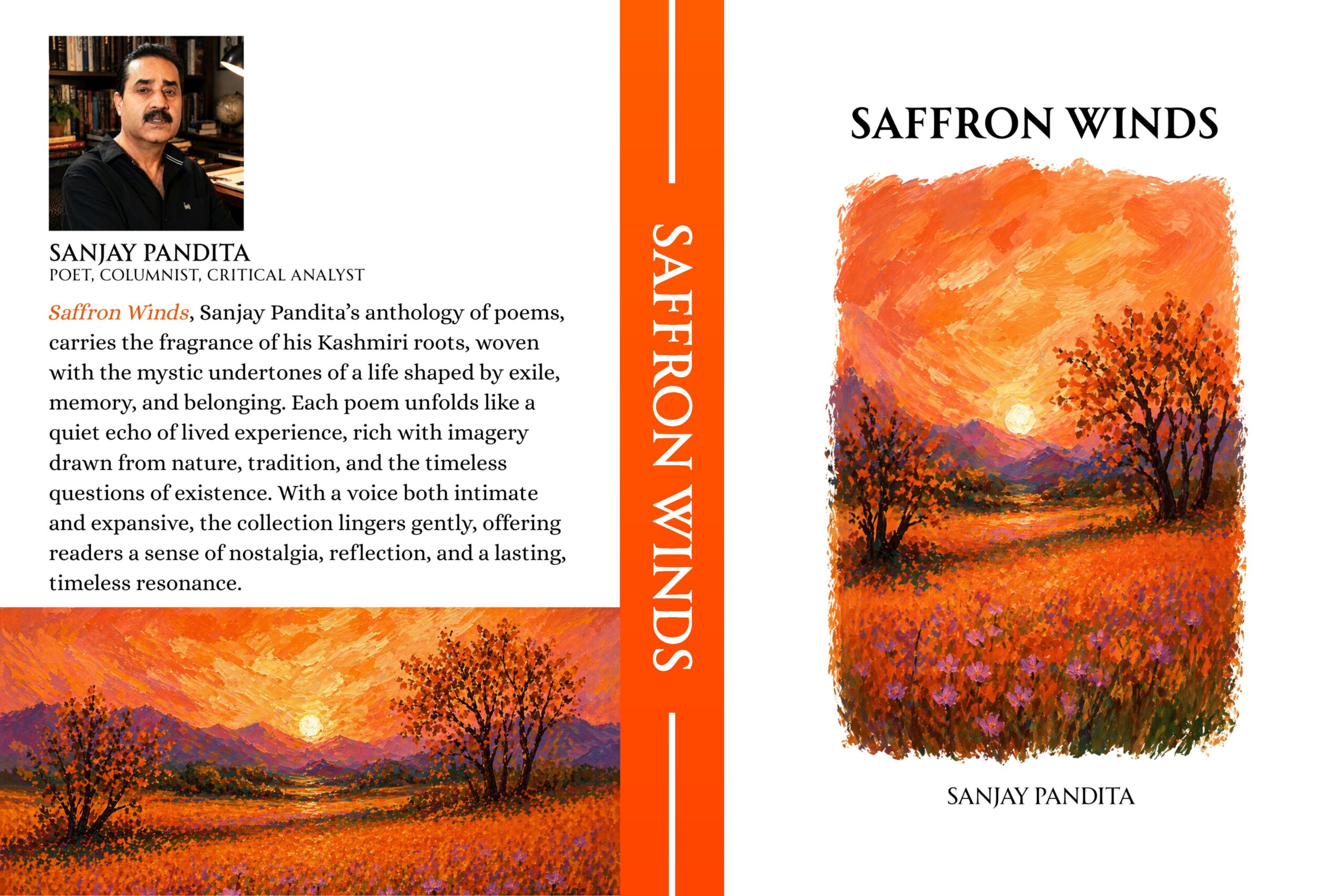
Sanjay Pandita’s debut anthology transforms the vivid landscapes of Kashmir into an emotional bridge between a remembered past and the lived present. Through 125 deeply personal poems, the collection captures a displaced soul finding timeless sanctuary in the geography of home.
By Manzoor Akash
Poetry succeeds when it transforms personal experience into universal emotion, a delicate literary feat that Sanjay Pandita accomplishes with remarkable grace in his debut anthology, Saffron Winds. Comprising 125 poems, this collection offers a rich, immersive journey into landscapes both external and internal. It arrives as a significant contribution to contemporary Indian English poetry, an impression validated by three illuminating forewords from distinguished literary figures: Dr. Santosh Bakaya, Lily Swarn, and Prof. Kul Bhushan Razdan. Together, these voices affirm the collection’s artistic merit and thematic richness.
The title itself, Saffron Winds, immediately evokes Kashmir, the land of legendary saffron fields, snow-clad peaks, whispering rivers, and timeless memories. Yet, the currents blowing through these pages are not merely geographical. They are emotional and psychological tides carrying fragments of a deeply personal past. Pandita writes as a cultural émigré who has carried Kashmir within his heart long after leaving its physical boundaries. Consequently, his poetry functions as a bridge connecting a vividly remembered past with a complex, lived present.
Central to this collection is an intimate, almost animistic relationship with nature. Throughout the anthology, the natural world is never treated as a static backdrop; instead, it operates as a living, breathing participant. Rivers speak, mountains meditate, snow possesses a memory, and ancient trees stand as silent witnesses to the passage of time. Pandita’s treatment of the Lidder River, a recurring motif, exemplifies this spiritual engagement. The river transcends its physical geography to become a companion and a source of revelation. In the poet’s own phrasing, it is transformed from a body of water into “not a river, but revelation.”
The physical topography of the valley dominates the sensory canvas of the book. Majestic Chinar trees spread cathedral-like shade across multiple poems, while snowfall serves as a multi-layered metaphor for silence, purity, and internal transformation. Mist, rain, and shifting seasons become the very vocabulary through which deeper existential truths are excavated. Pandita’s imagery remains vivid yet unpretentious, choosing clarity over obscurity so that readers can effortlessly see, hear, and feel the world he inhabits.
While the influence of romantic and mystical traditions runs deep recalling Wordsworth’s reverence for nature, Kahlil Gibran’s philosophical lyricism, and the raw spiritual intensity of Sufi poetry, Pandita’s voice remains distinctly independent. His lines emerge from lived experience rather than mere literary imitation. The language is clean, accessible, and inherently musical, allowing profound philosophical insights to surface naturally from ordinary, everyday observations.
Nostalgia acts as the primary emotional anchor of Saffron Winds. The poet frequently returns to the sanctuaries of childhood, family, and homeland, but these recollections never degenerate into cheap sentimentality. Instead, they serve as rigorous reflections on identity, displacement, and the relentless passage of time. Pieces like Echoes of Childhood effectively transport the reader into a world where a mother’s voice, a plate of saffron milk, and the quiet, domestic rituals of home are elevated to sacred repositories of human memory.
Among the most resonant pieces are those dedicated to the poet’s parents. These works celebrate the quiet sacrifices, dignity, and unconditional love that anchor a human life. The father figures as a symbol of silent endurance and selflessness, while the mother embodies nurturing strength and boundless affection. By focusing on these intimate portraits, Pandita achieves a universality that easily transcends cultural and geographical boundaries, striking a chord with readers anywhere who have known parental devotion.
Equally significant is the anthology’s spiritual dimension. Pandita’s work ventures past the visible, material world to explore questions of mortality, gratitude, and self-realization. There is a persistent, quiet search for truth beneath the surface of appearances. The poetry suggests that wisdom does not arrive in grand, dramatic revelations, but accumulates in quiet moments of deliberate awareness. Nature acts as the ultimate pedagogue here; rivers, trees, and sunlight are the teachers guiding the poet toward internal peace.
Gratitude emerges as the central philosophical thread binding these 125 poems together. Pandita celebrates small acts of human kindness, fleeting moments of natural beauty, and the profound interconnectedness of human existence. He effectively reminds an often-distracted audience that life’s most meaningful experiences reveal themselves in ordinary encounters and simple, unvarnished gestures.
This philosophy is delivered through a remarkable command of imagery and metaphor. Snow is beautifully captured as “a weaving of white stillness,” while icicles are sharply envisioned as “daggers of frozen time.” Chinar trees are cast as the loyal guardians of memory. Such metaphors enrich the lyricism of the poems without overwhelming their structural economy; they arise organically from the poet’s genuine engagement with his environment.
Love also finds expression in these pages, though it manifests in subtle, contemplative forms. Rather than focusing on romantic fulfillment or melodrama, the poet explores the spaces left by longing, absence, and remembrance. In poems like Rainspell, love becomes entirely inseparable from memory and spiritual yearning, creating an atmosphere of quiet, moving introspection.
Perhaps the anthology’s greatest triumph is its absolute sincerity. There is no stylistic posturing or attempt to impress through intellectual complexity. The poems speak directly from the heart, deriving their power from absolute authenticity. Readers encounter a writer entirely willing to reveal vulnerability, uncertainty, wonder, and hope without a shred of pretension.
The three included forewords provide crucial critical frameworks for understanding this debut. Dr. Santosh Bakaya highlights Pandita’s deep connection with human values, Lily Swarn emphasizes the inherent musicality and emotional depth of the verse, and Prof. Kul Bhushan Razdan explores the postmodern and philosophical dimensions of the collection, properly situating it within the broader landscape of Indian English literature.
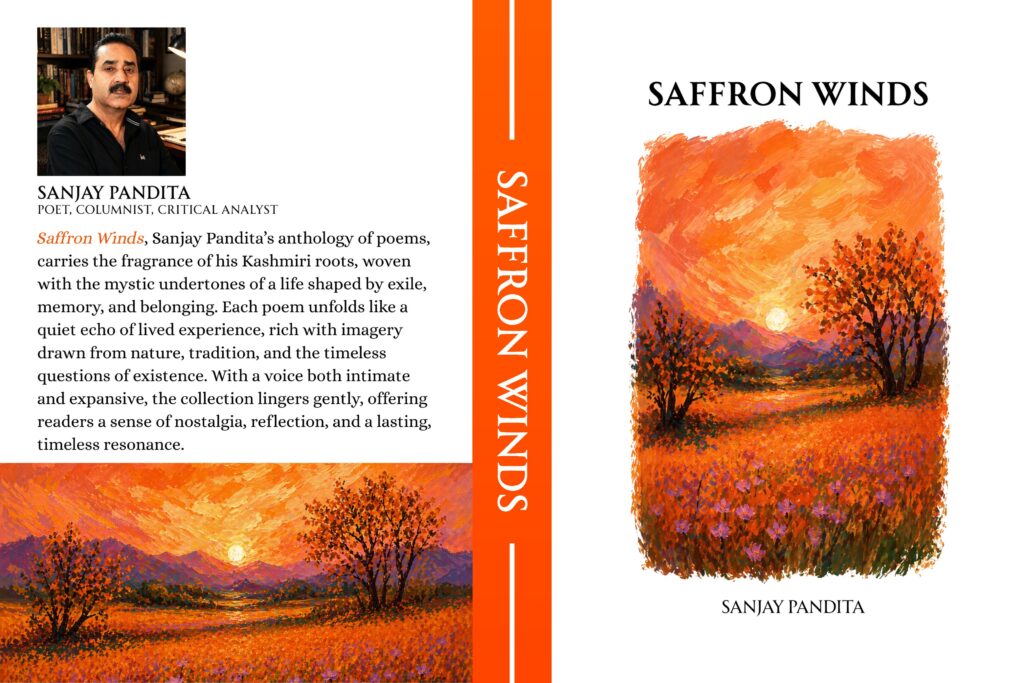
For a debut collection, Saffron Winds is remarkably assured. It reflects the maturity of an author who has spent years observing the world, reflecting upon its quiet mysteries, and carefully translating those insights into verse. The anthology does not content itself with merely describing external scenery; it invites readers to pause, lower their defenses, and reconnect with their own inner landscapes.
In an age characterized by haste, digital noise, and social fragmentation, Saffron Winds offers something increasingly rare: stillness. It invites us to listen to the rivers, converse with the trees, walk forgotten paths, and rediscover the quiet wisdom that resides just beneath the surface of daily life. The poems remind us that beauty still exists in simplicity, that memory can be converted into a source of psychological strength, and that the human spirit continues to seek its ultimate meaning through art.
Saffron Winds is therefore far more than a simple collection of poems. It is a sustained meditation on belonging, an elegant celebration of nature, a moving tribute to family, and a spiritual exploration of life’s enduring questions. With this anthology, Sanjay Pandita establishes himself as a sensitive, deeply thoughtful poetic voice whose words linger long after the final page is turned. Like the fragrance of saffron drifting across Kashmir’s autumn fields, these poems leave behind an enduring impression that is gentle, evocative, and unforgettable.
Disclaimer: The views and historical interpretations expressed in this feature article are solely those of the author and do not necessarily reflect the official editorial stance or opinions of this publication. The author can be reached at [email protected]
Leave a Reply