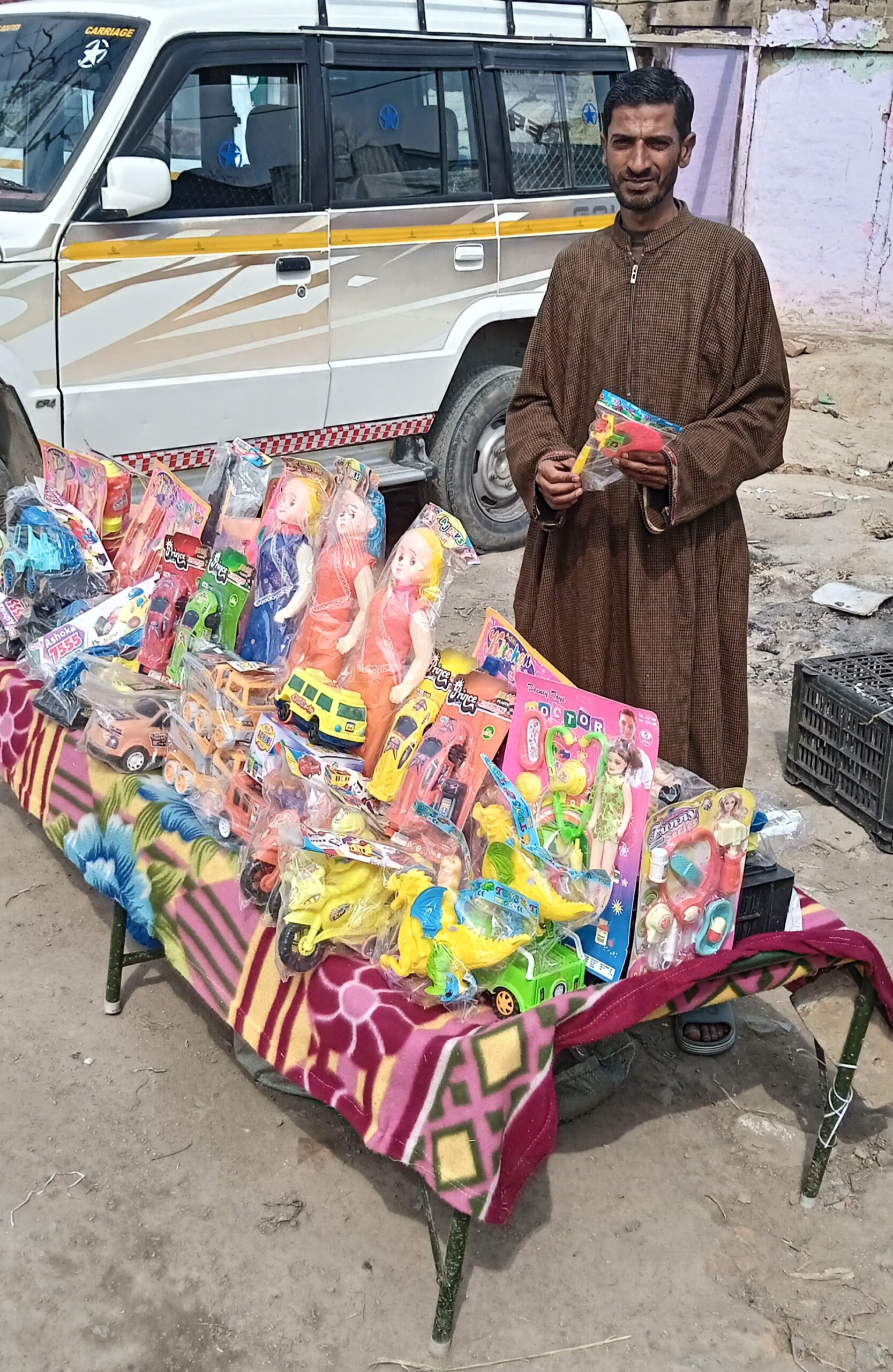
Born into a world of silence, Mohammad Sultan Mir has refused to let his speech and hearing impairments dictate his destiny. Through freezing winters and scorching summers, his seasonal hustle in Rafiabad stands as a powerful testament to the dignity of honest labor.
By Manzoor Akash
Colin Powell once observed that a dream does not become reality through magic; it takes sweat, determination, and hard work. In the quiet corners of Rafiabad, Kashmir, Mohammad Sultan Mir lives this truth every single day. Known affectionately by locals as “Koll”—a Kashmiri word for a person who cannot speak or hear—Mir has transformed his silence into a profound narrative of resilience. He is not merely a street vendor navigating the economic margins of a conflict-weary region; he is a father of two, a cornerstone of his community, and a living testament to human dignity. At a time when economic desperation drives many toward modern shortcuts or illicit trades, Mir’s life stands as a masterclass in honest labor.
A journalist looking at the tapestry of rural Kashmir often finds stories of grand political shifts or systemic struggles. Yet, the true heartbeat of the valley resides in individuals like Mir, whose daily existence is an unyielding battle against hardship. Hailing from the village of Gund Karim Khan, his life is a continuous cycle of adaptation. Because he lacks the ability to communicate through speech, the market dynamics between the towns of Dangiwacha and Watergam could easily have isolated him. Instead, Mir has mastered the art of survival by aligning his livelihood with the changing seasons, proving the old adage that when you cannot change the direction of the wind, you must adjust your sails.
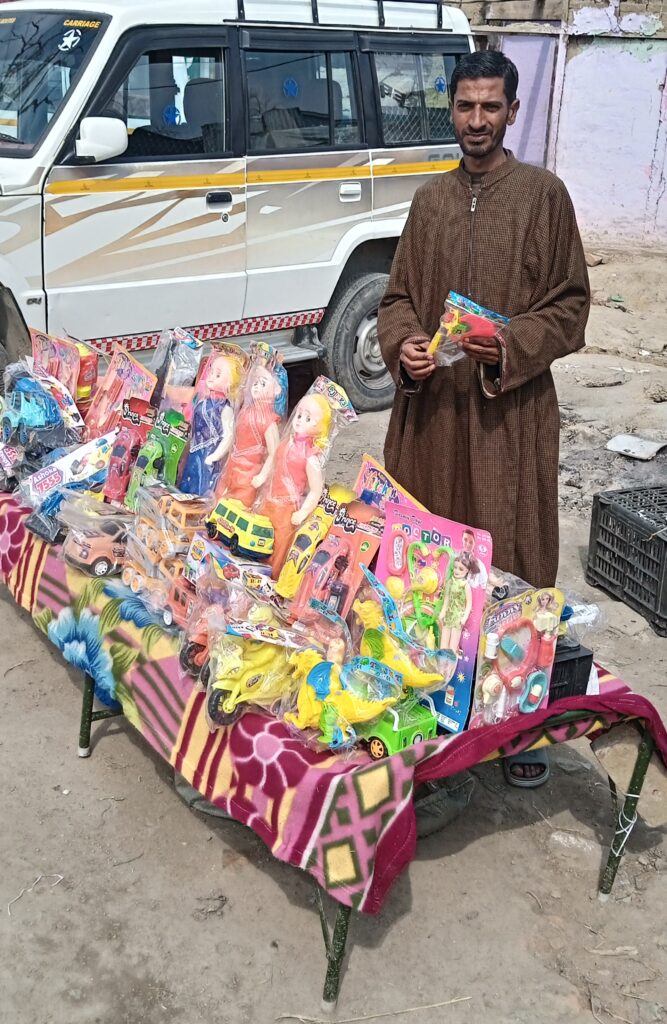
Before the biting Kashmiri winter sets in, Mir can be found in the main market of Watergam, his presence announced not by words, but by the meticulous arrangement of toys displayed on a simple wooden cot. As the temperature plummets and the valley is blanketed in snow, the toy cart undergoes a metamorphosis. Recognizing the shifting needs of his clientele, Mir pivots to selling hot, fresh omelettes from a modest stall in the same market square. This seasonal agility ensures that even during the harshest months, when economic activity in the region slows to a crawl, his family does not go hungry.
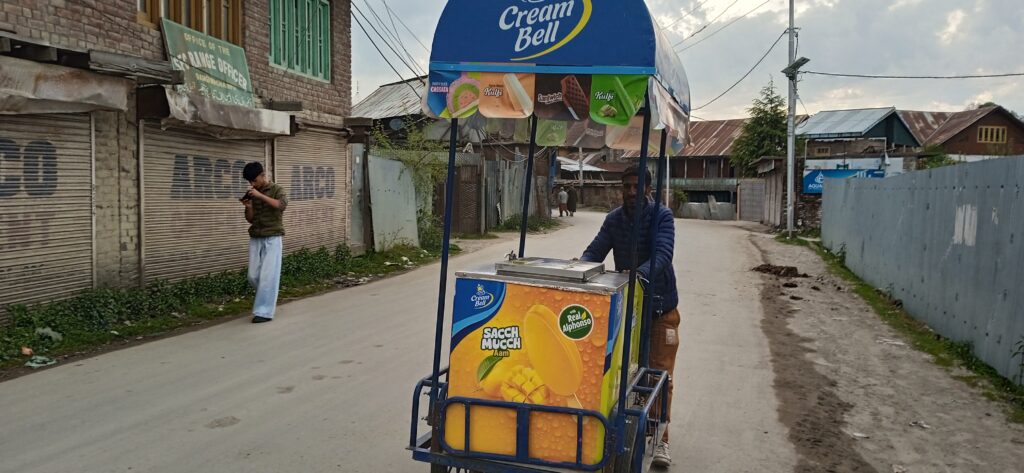
When winter finally relents and the valley warms, Mir transitions to what has become his most profitable and iconic venture: selling ice cream. This summer hustle has earned him the local moniker “Koll Ice-cream Woel.” Pushing a heavy wooden cart through dusty village roads under a scorching sun, Mir uses a small trumpet to bridge the gap left by his silence. The sharp, nostalgic note of the horn acts as a universal language. Upon hearing it, children burst from their homes, racing toward the man they affectionately call “Koll Maam”—the uncle who cannot speak, but who brings sweetness to their afternoons.
The physical toll of this life is immense. Mir walks many kilometers each day, his body strained by the weight of the cart and the heat of the season. Yet, the climax of his daily journey offers a poetic glimpse into his character. As evening approaches, he routinely pauses on the banks of the Hamal, a local stream located about a kilometer from his home. Sitting by the cool, rushing water, he can often be seen quietly counting the day’s earnings. It is a moment of profound solitude and triumph—a silent ledger of a day’s honest toil written in crumpled rupee notes.
“The best thing about him is that he earns an honest living,” says Firdous Ahmad, a resident of Rafiabad who has watched Mir’s journey for years. Ahmad’s perspective reflects a deeper community consensus. In an era where socioeconomic pressures tempt many into illegal enterprises, Mir represents an alternative path. He is viewed not with pity, but with a deep, abiding respect. Local observers note that whether he is flipping omelettes in the freezing cold or pushing an ice cream cart in the summer heat, the quality of his character remains consistent. He does not beg; he does not exploit. He simply works.
This narrative carries a particular urgency today. The entire Kashmir Valley is currently engaged in a critical 100-Day Drug Awareness Campaign, aiming to combat a rising tide of substance abuse and illicit trade that threatens the region’s youth. Within this socio-political context, Mir’s story transcends standard human-interest reporting; it becomes a vital counter-narrative. He provides the youth of Kashmir with a blueprint for survival that rejects despair. His life proves that no matter how steep the structural barriers or personal limitations may be, dignity can still be carved out through sheer willpower. Mohammad Sultan Mir reminds us that an honest life is a choice, and it is a story worth telling with pride.
Disclaimer: The views and historical interpretations expressed in this feature article are solely those of the author and do not necessarily reflect the official editorial stance or opinions of this publication. The author can be reached at [email protected]
Leave a Reply