Deep in the Pir Panjal range, a modest granite temple stands guard over the River Jhelum. Once a vital stop on an ancient global trade route, the Boniyar temple has survived empires, explorers, and the passage of a millennium.
By DR. Zahid Iqbal Sheikh
In the rugged embrace of the Pir Panjal range, where the River Jhelum—anciently known as the Vitasta carves its way toward the frontier, stands a silent sentinel of stone. To the casual traveler driving the stretch between Baramulla and Muzaffarabad, the Boniyar temple might appear as merely a modest ruin tucked away in a military cantonment. Yet, to the historian and the seeker of Kashmir’s soul, this structure is a profound map of a lost world. It is a monument that refuses to be forgotten, bridging the gap between the mythological “Age of Heroes” and the sophisticated architectural height of the Karkota dynasty.
Kashmir’s heritage has always been defined by its role as a crossroads. Long before the lines of 1947 redefined the geography of the subcontinent, the valley was a pulsing corridor of trade, faith, and philosophy. The route from the valley floor toward the western passes was dotted with shrines that served as spiritual anchors for merchants and pilgrims alike. Among these, Boniyar remains perhaps the most remarkably preserved example of early Kashmiri temple architecture, offering a tangible link to a period when the valley’s influence radiated across Central Asia.
Local memory, as is often the case in the shadow of the Himalayas, prefers the poetic over the pedantic. For generations, elders have whispered that the temple was the handiwork of the Pandavas, the five warrior-brothers of the Mahabharata. This “Pandav-lar” tradition is a common thread throughout the valley, attributing any structure of immense, inexplicable masonry to divine or heroic origin. However, the cold precision of archaeological science tells a different story, one of a flourishing empire. Evidence suggests the temple was commissioned during the Karkota period, roughly between the 7th and 9th centuries CE. This was an era of unprecedented building activity under monarchs like Lalitaditya Muktapida, who sought to manifest their temporal power through enduring stone.
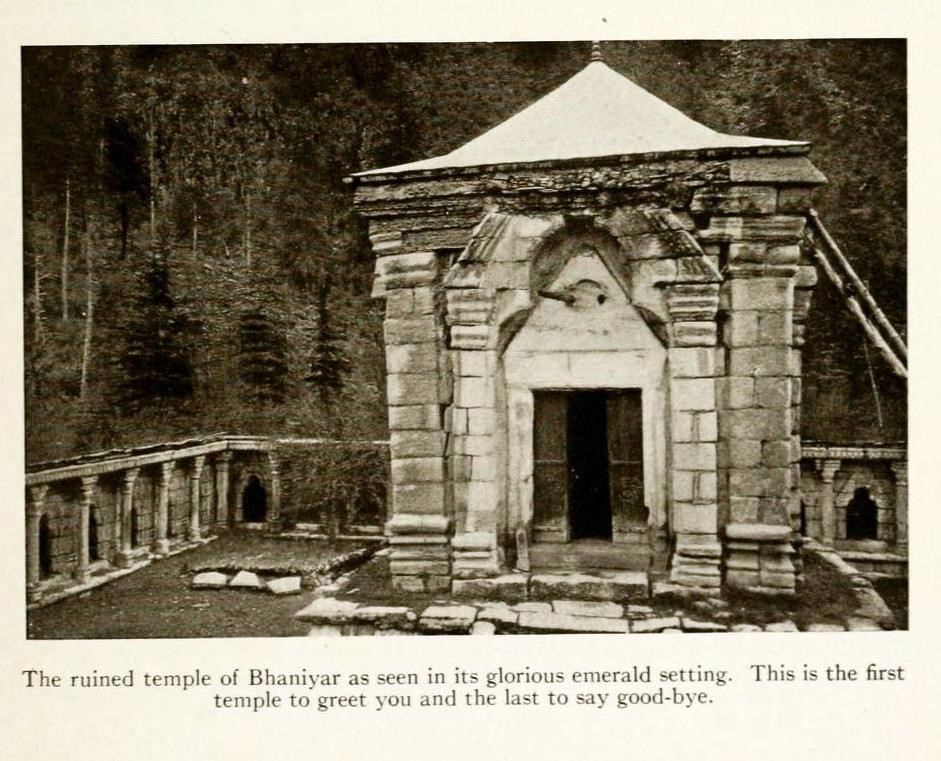
The naming of the site itself is a linguistic puzzle that reveals the shifting cultural layers of the region. When Alexander Cunningham, the first Director-General of the Archaeological Survey of India, arrived in the mid-19th century, he found the temple partially entombed in winter snow. Based on the accounts of local Pandits, he recorded the name as “Bhawaniyar,” identifying it as a shrine to the goddess Bhawani. A few decades later, William Garden Cowie, a chaplain and later Bishop of Auckland, noted a different phonetic variation: “Bhaniyar.” He recorded a local legend of a founder named Bonadutt, whose brother was said to have built a sister shrine at nearby Venapora.
Yet, there is a more organic theory for the name “Boniyar” that resonates with the valley’s ecology. Some scholars suggest the name is a derivative of boonyi—the Kashmiri word for the majestic chinar tree. The riverbanks were once thick with these sprawling giants, and the intersection of the sacred stone and the sacred grove likely gave the settlement its identity. Even today, the presence of chinars around the site lends a sense of continuity to this environmental history.
The intellectual discovery of Boniyar by the Western world was a comedy of errors before it became a triumph of documentation. In 1835, the traveler Karl Alexander von Hügel misidentified the site as a “well-preserved Buddhist structure.” While he was wrong about the faith, he was sensing the aesthetic DNA of the building. By 1844, G.T. Vigne was more cautious, labeling it simply a “Hindu ruin.” It wasn’t until Cowie’s systematic excavation in 1865 that the temple’s true dimensions were revealed.
Cowie described a sanctum of roughly thirteen square feet, elevated on a four-foot basement and enclosed within a grand, cloistered quadrangle. He was struck by the material, a pale, coarse granite. Because no quarries of this stone existed on the Jhelum’s left bank, geologists of the time concluded that the massive blocks must have been ferried across the river from distant valleys, a feat of logistics that underscores the importance the builders placed on this specific location. Cowie even theorized that the central shrine might have originally been surrounded by a water moat, supported by the discovery of ancient wells and a serpent-shaped drainage spout designed for ritual ablutions.
As the 19th century progressed, the art historian James Fergusson noted something revolutionary about Boniyar: its “Gandharan” or Greco-Buddhist influence. The colonnaded design and fluted columns were echoes of a style born from the encounter between Greek aesthetics and Indian spirituality centuries earlier. This fusion is what gives Kashmiri architecture its unique “classical” look, the trefoil arches and pediments that feel strangely reminiscent of a Mediterranean temple transported to the heart of Asia.
The most authoritative account came in 1933 from R.C. Kak, whose work Ancient Monuments in Kashmir remains the definitive guide. Kak detailed a complex centered on a double-based shrine, protected by a peristyle of fifty-three rectangular cells. Each cell, once perhaps a dwelling for a monk or a niche for a deity, featured a trefoiled entrance. The gateway was a masterpiece of its own—a double-chambered portal with voluted capitals and a pyramidal roof decorated with kīrtimukhas (lion-like “faces of glory”) and miniature niches.
Inside the square sanctum, the original deity likely an image of Vishnu has long since vanished. In its place, small Shiva-lingas brought from the Narmada River now receive the prayers of the faithful, a testament to the living, breathing nature of these sites where traditions evolve rather than die. The domical ceiling that 19th-century explorers marveled at has also disappeared, leaving the interior open to the elements and the gaze of history.
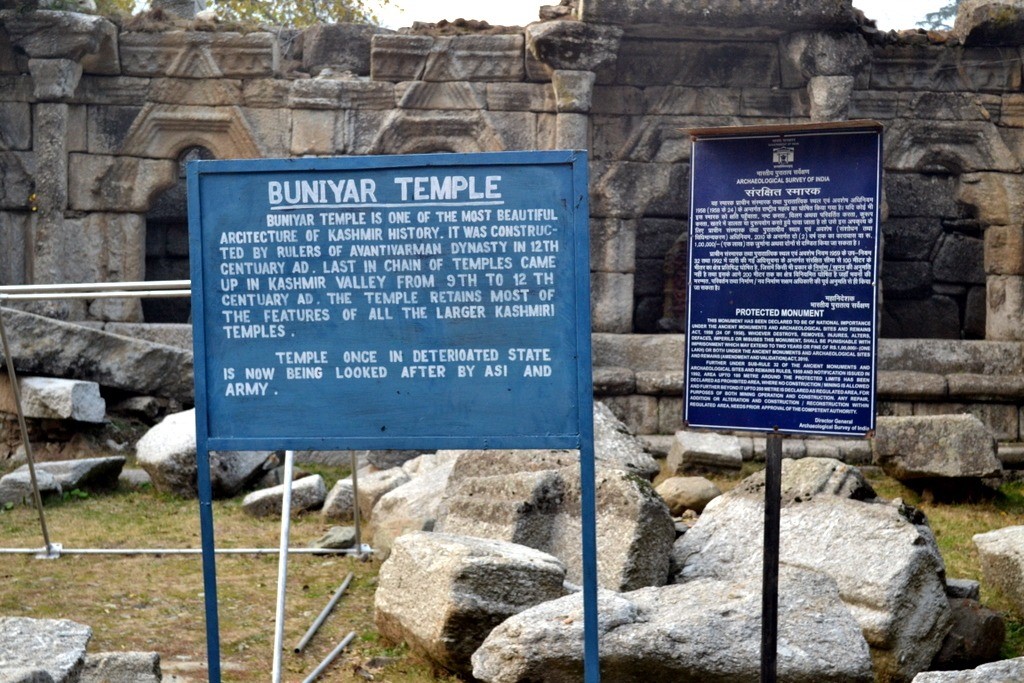
Today, the Boniyar temple exists in a unique state of “protected” limbo. Recognized as a monument of national importance under the Archaeological Survey of India (ASI), it sits within the confines of an Indian Army camp. This proximity has created a strange symbiosis; while the military presence restricts easy public access, it has also provided a layer of protection and assistance in conservation efforts that might have otherwise bypassed such a remote location.
The temple at Boniyar is more than a collection of weathered granite. It is a “silent witness” to the transitions of the Jhelum valley. It has survived the fall of dynasties, the shifts from Buddhism to Brahmanism, the arrival of Islam, the footprints of colonial explorers, and the geopolitical tremors of the modern era. In its modest scale, it captures the essence of Kashmir’s heritage: a blend of the monumental and the intimate, the mythological and the historical. As modern conservation looks beyond the famous gardens of Srinagar and the sun temple of Martand, Boniyar stands as a reminder that the true history of the valley is often found in these quieter spaces—waiting to be read like a stone manuscript of a shared, spiritual past.
The views expressed in this article are solely those of the author and do not necessarily reflect the opinions or views of this Magazine. The author can be reached at [email protected]
Leave a Reply