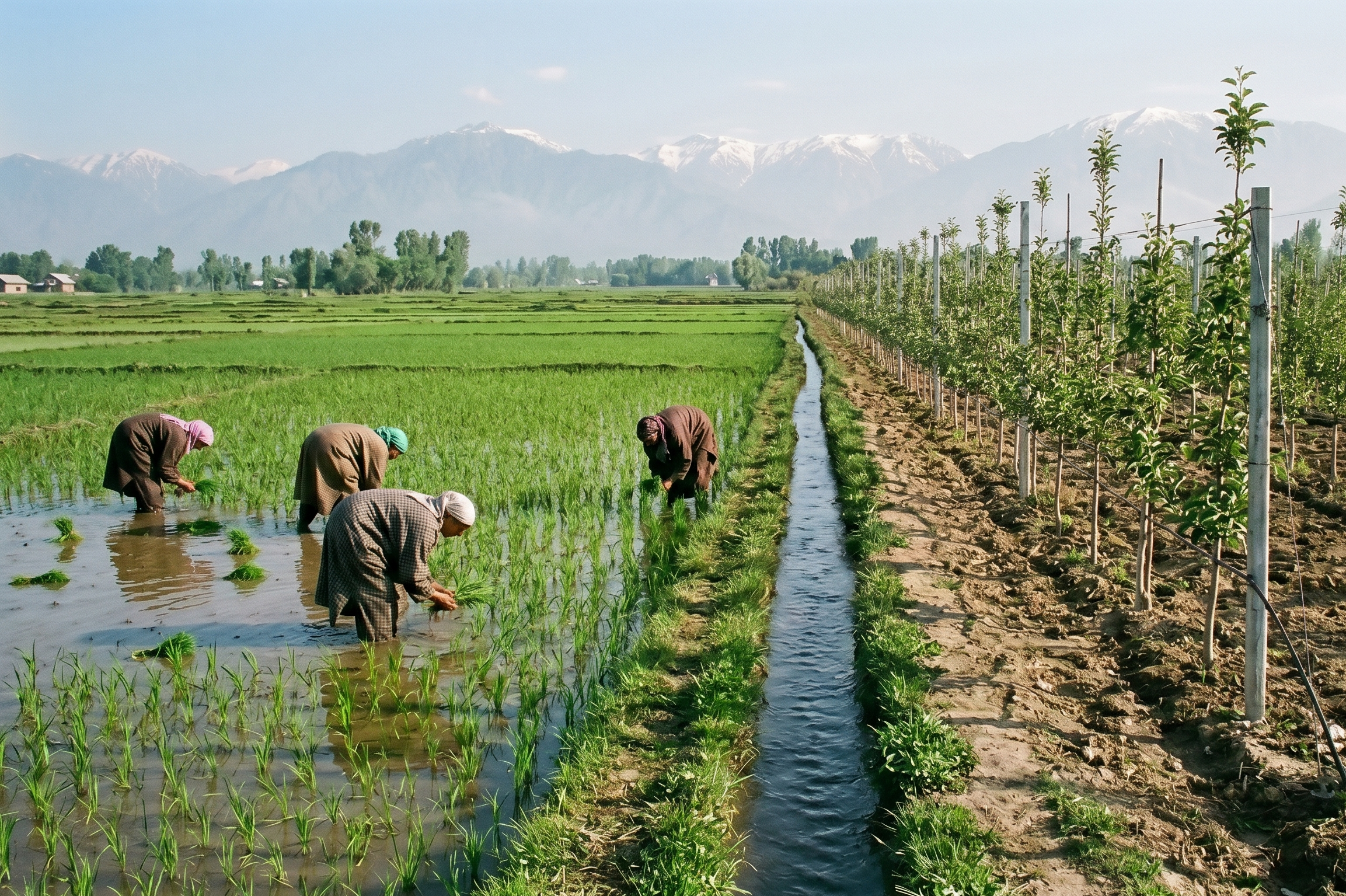
Kashmir is trading its historic food sovereignty for the high-profit lure of modern horticulture. While orchards bring immediate wealth, the region faces a future of total dependence on outside states for its most basic staple.
By Ajaz Rashid
The emerald-green landscape of the Kashmir Valley, defined for centuries by the rhythmic swaying of paddy stalks, is undergoing a profound and potentially irreversible metamorphosis. From the southern reaches of Pulwama to the northern stretches of Baramulla, the “Rice Bowl” of the Himalayas is being re-tiled with the deep crimsons of high-density apple orchards and the grey husks of urban sprawl.
While this shift is often celebrated in economic ledgers as a “horticultural revolution,” a darker reality is simmering beneath the surface. Kashmir is trading its food sovereignty for short-term profit, moving toward a future where every grain of rice on a local plate may soon have to travel across the treacherous mountain passes of the Pir Panjal.
The Vanishing Fields
Across several villages in Pulwama district including Achan, Armula, Nowpora, and Niloora, local estimates suggest that more than 50 percent of cultivable land has been diverted away from paddy in just the last few years. In some specific belts, that figure is reported as high as 70 percent.
This is not a localized phenomenon. Similar patterns are echoing through Anantnag, Kulgam, Budgam, and Central Kashmir. What was once a contiguous carpet of grain is now a fragmented mosaic.
“We once grew enough rice for our families and stored grain for the next season,” says Abdul Gafar, a farmer in Shopian whose family has tilled the same soil for generations. “Today, orchards and housing colonies stand where our fields used to be. Young people find it easier to sell land than to farm it.”
The numbers tell a staggering story of attrition. Between 1996 and 2023, the region lost nearly 34,000 hectares of agricultural land. Specifically looking at paddy, the acreage in the Union Territory plummeted from 162,309 hectares in 2012–13 to just 134,067 hectares by 2021–22, a 17 percent drop in a single decade. Experts warn that the pace has only accelerated since then.
The Economics of the Orchard
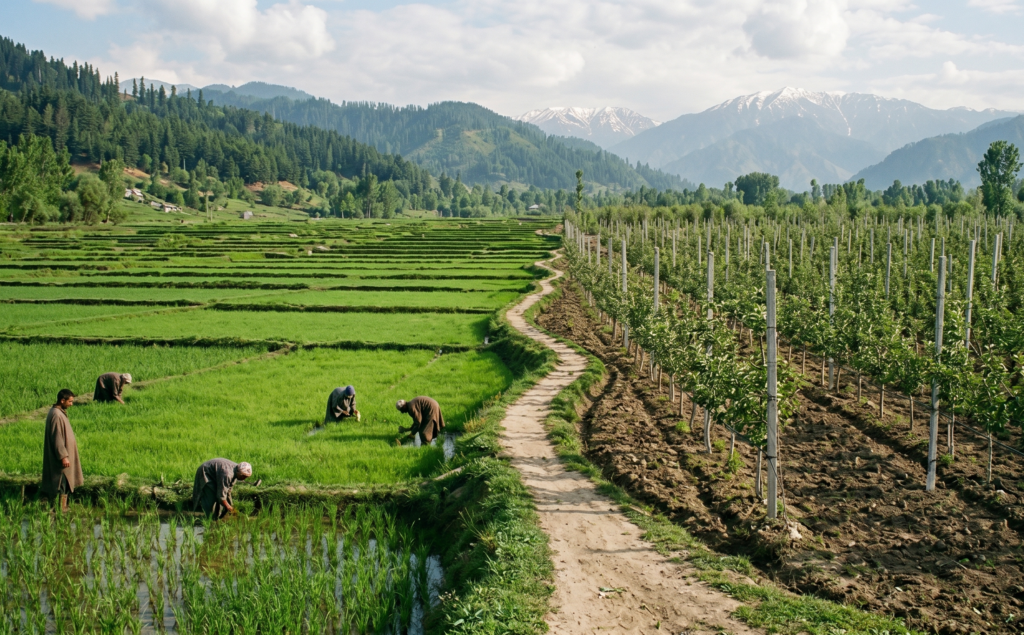
The catalyst for this transformation is simple: the ledger. Traditional paddy cultivation has become an increasingly difficult proposition for the Kashmiri farmer. Rising labor costs, the unpredictability of irrigation, and a stagnant market price for local rice varieties have made the “staple” a luxury the farmers can no longer afford to grow.
In contrast, high-density apple plantations offer a siren song of modern prosperity. These varieties promise higher yields per kanal, faster returns on investment, and a stable demand from the massive markets of mainland India.
-
Kashmir currently produces only 45 million tonnes of food grains against a requirement of 1.34 million tonnes. This leaves an annual deficit of 0.89 million tonnes that must be imported.
-
Experts warn that if the current rate of land conversion continues, the region could become 100% dependent on outside states (Punjab, Haryana, and UP) for its staple food, rice.
-
While high-density horticulture offers higher immediate financial returns for farmers, it creates a “fragile” food system vulnerable to highway closures, price volatility, and supply chain disruptions.
-
The 2022 easing of land-conversion restrictions has accelerated the transition, allowing larger tracts of agricultural land to be repurposed for commercial and residential use with 30-day approvals.
-
Agriculturalists emphasize that once fertile paddy land is converted into orchards or concrete, it is nearly impossible to reclaim for grain cultivation, permanently altering the region’s self-sufficiency.
-
Because 60–70% of consumed rice is currently imported, any blockage of the National Highway leads to immediate price hikes and potential food shortages in the Valley.
“Horticulture undoubtedly boosts farmers’ incomes, but it also exposes the region to external risks,” notes one official from the agriculture sector. “Any disruption in supply chains, whether due to natural disasters, transport issues, or political instability can trigger food shortages.”
The Deficit Dilemma
As the orchards expand, the food gap widens. The region currently produces approximately 0.45 million tonnes of food grains against an annual requirement of 1.34 million tonnes. This leaves a massive deficit of 0.89 million tonnes, a gap that is currently bridged by massive imports from Punjab, Haryana, and Uttar Pradesh.
The math of dependence is becoming precarious. Experts suggest the region is already 40 to 50 percent dependent on external food sources. If current trends hold, that deficit could reach 36 percent by the end of this year and potentially exceed 50 percent by 2030.
“On one hand, we are aggressively promoting high-density horticulture; on the other, we are surrendering control over our food security,” says a senior agriculture expert. “Apples may bring income, but rice ensures survival. Once paddy land is lost, it is almost impossible to recover.”
The Food Security Gap at a Glance
| Metric | Current Status | Projected (2030) |
| Annual Grain Requirement | 1.34 Million Tonnes | ~1.6 Million Tonnes |
| Local Production | 0.45 Million Tonnes | Declining |
| Current Deficit | 0.89 Million Tonnes | >1.0 Million Tonnes |
| Import Dependence | 60–70% (Rice) | 100% (Projected) |
Policy and the Concrete Jungle
It isn’t just the allure of the apple that is eating the fields; it is also the pressure of a growing population. Residential colonies and commercial structures are mushrooming in areas that were once prime agricultural zones.
In 2022, policy shifts further eased the path for this transition. The government removed the previous 400-square-meter cap on converting agricultural land for non-farm use. Under the revised rules, applications are processed by district-level committees within 30 days. While the policy was intended to facilitate “development” and ease the bureaucratic burden for homeowners, critics argue it has opened the floodgates.
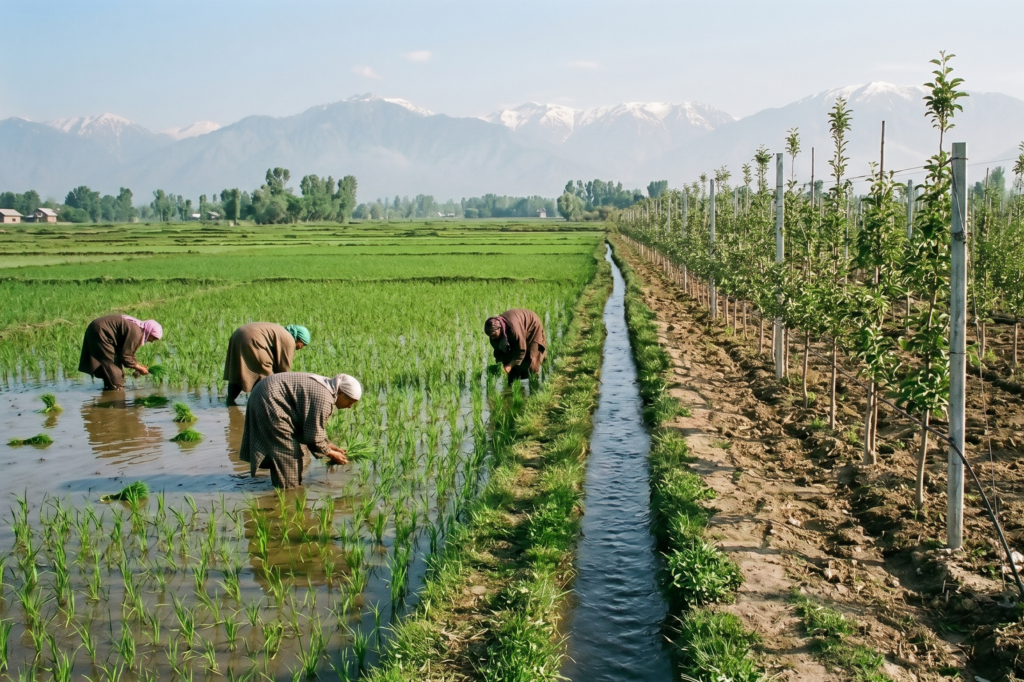
“The intention may be development, but the outcome is farmland loss,” says an agricultural expert requesting anonymity. “Without strict safeguards, we are sacrificing long-term food security for short-term gains.”
Weak enforcement of existing land-use laws has allowed fertile “Saffron land” and “Rice bowls” to be paved over. “In Kulgam alone, more than 50 per cent of paddy fields have been lost to horticulture and urban expansion,” an official confirms.
The Fragility of the Highway
For the average resident in Srinagar or Pulwama, this shift is felt most acutely at the market. Because the majority of rice is now sourced through the Food Corporation of India (FCI) or private traders from outside the state, the Valley’s dinner table is at the mercy of the National Highway 44.
“Markets may look well-stocked, but almost everything comes from outside,” says a Pulwama resident. “If highways are closed for even a few days, prices jump immediately. That shows how dependent we’ve become.”
The vulnerability is not just logistical but also biological. While an apple tree can stand for decades, it cannot be eaten as a primary source of calories. A farmer from north Kashmir puts it bluntly: “Agriculture was our backbone. If this continues, future generations will have no land left to cultivate. Apples cannot replace rice on our plates.”
Seeking a Middle Path
Is there a way to have both the apple and the grain? Officials in the Agriculture Department insist they are trying to find a balance. They are promoting high-yielding paddy varieties that can compete with the economic returns of horticulture and offering better incentives for those who keep their lands “wet.”
However, the consensus among experts is that without a strict legal framework to halt the conversion of the remaining paddy land, the situation will soon reach a “point of no return.”
“High-density apples can boost income,” says an agriculturalist. “But food grains provide stability. Without safeguarding agricultural land, Kashmir risks trading short-term prosperity for long-term insecurity.”
As the sun sets over the shrinking fields of Pulwama, the question remains: Can a region truly be prosperous if it cannot feed itself? For now, the roar of the trucks bringing rice from the plains is the only answer.
“If this trend continues unchecked, Kashmir could become 100 per cent reliant on other states for rice in the coming years.”
Leave a Reply