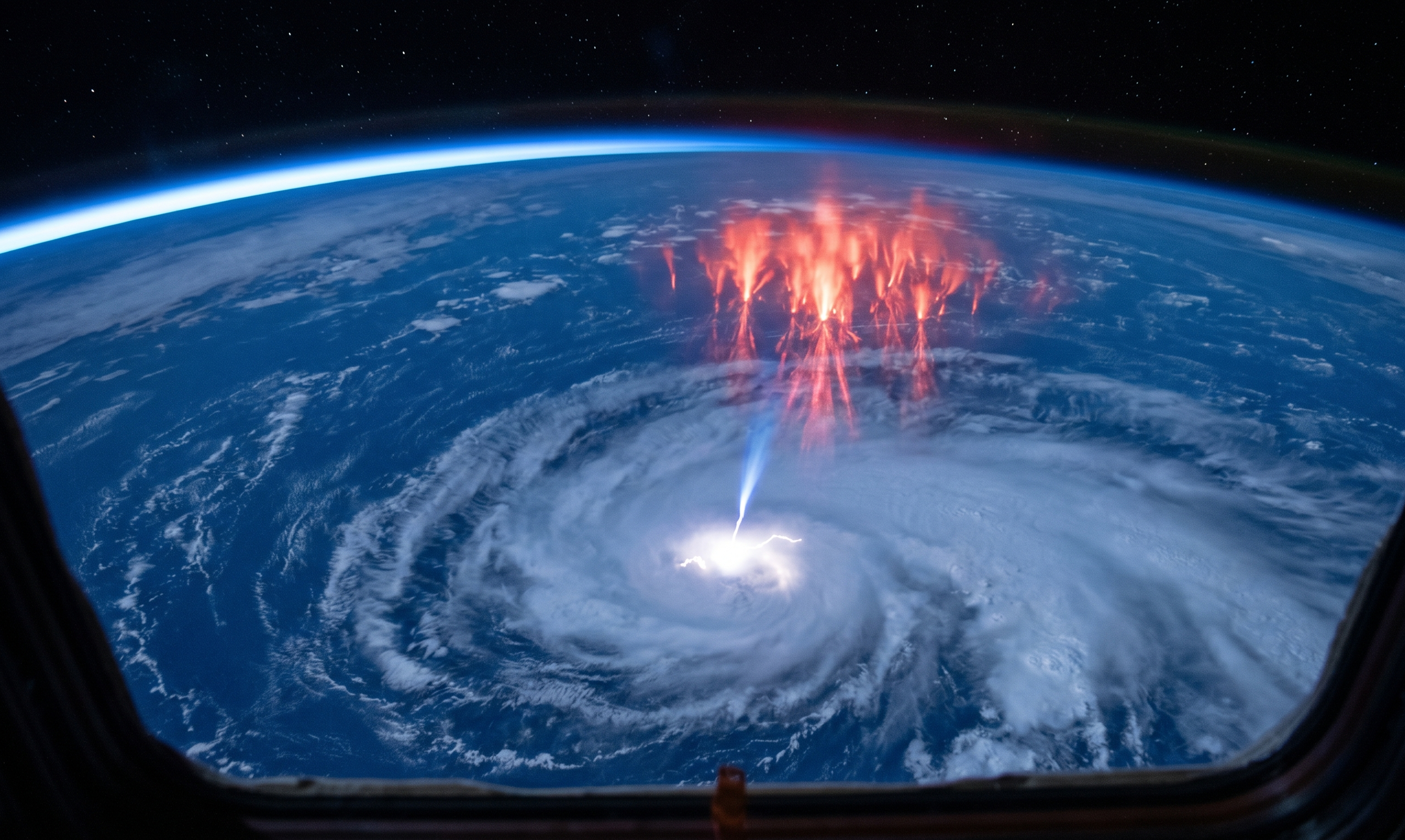
From the constant hum of life-support systems to the rare sight of sprites dancing above storm clouds, life in orbit reveals a planet that is far more kinetic than it appears from the ground.
By Syed Anaiyat Bukharie
The narrative of space exploration has long been dominated by cold physics and mechanical precision, but as veteran astronaut Sunita L. Williams suggests, the reality of orbit is far more visceral. Williams, who has spent a cumulative 322 days in space (surpassing her previous record of 286), provides a perspective that bridges the gap between the empirical and the existential. In her discussions, most recently highlighted in high-profile dialogues like those with Raj Shamani, she describes a universe that is not a silent void, but a high-energy theater of light, sound, and interconnectedness.
To understand the space experience, one must first dismantle the myth of “the silent vacuum.” Inside the International Space Station (ISS), silence is a luxury that doesn’t exist. Astronauts live within a constant mechanical hum, a 60 to 72-decibel symphony of air scrubbers, cooling fans, and life-support pumps. This noise is the sound of survival; a sudden silence would be the most terrifying thing an astronaut could hear.
Outside the hull, the environment is equally kinetic. Williams and her peers describe Earth not as a static map, but as a living organism. From 250 miles above, the atmosphere is revealed as a “thin blue line,” a fragile membrane barely 60 miles thick that protects all known life from the harsh radiation of the cosmos. Within this membrane, Earth’s energy is constantly discharging. Astronauts witness 16 sunrises and sunsets every 24 hours, but the real show is the electrical activity.
Modern meteorology, aided by the vantage point of the ISS, has confirmed that Earth’s weather is a vertical phenomenon. When massive thunderstorms roll across the plains or the oceans, they don’t just rain downward. They discharge upward into the ionosphere.
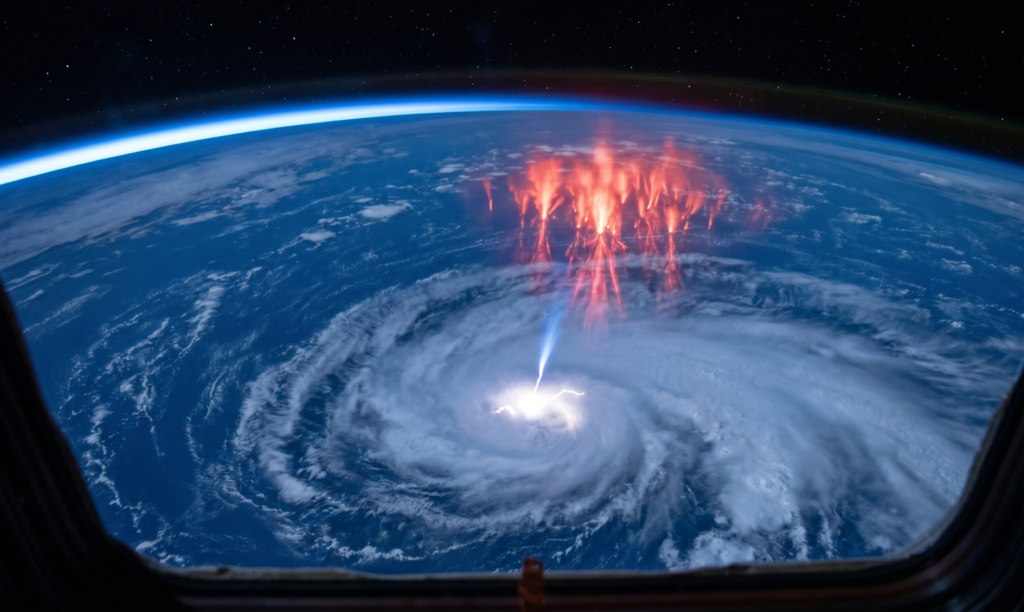
Astronauts have documented “Transient Luminous Events” (TLEs), exotic phenomena known as sprites, blue jets, and elves. Sprites appear as reddish, jellyfish-like flashes, while blue jets are cones of light that shoot upward from the tops of clouds. These are not merely visual wonders; they represent a massive exchange of energy between our atmosphere and the edge of space. They prove that Earth is chemically and electrically “leaking” into the universe, serving as a reminder that we are not a closed system.
As our observation tools sharpen, the “biological promise” of the universe has expanded. We no longer look only for “Earth-like” planets; we look for water in any form. The discovery of saltwater streaks on Mars and the plumes of water vapor erupting from Saturn’s moon Enceladus and Jupiter’s moon Europa have shifted the narrative.
NASA’s Europa Clipper mission, launched to investigate these “ocean worlds,” is predicated on the idea that where there is liquid water and chemical energy, life, even in microbial form is a statistical probability. The detection of complex organic molecules in interstellar clouds further suggests that the “seeds” of life are a fundamental component of the universe’s chemistry, rather than a terrestrial fluke.
For many, these revelations do not contradict faith but rather expand its canvas. In Islamic theology, the universe is described as a “multi-layered” creation ($Al-Samawat$), governed by precise laws. The Qur’an frequently invites humanity to “reflect upon the signs” ($Ayat$) in the heavens. To a believer, the discovery of invisible forces, dark matter, electromagnetic fields, and high-velocity particles parallels the spiritual concept of the $Ghayb$, or the unseen realm.
Perhaps the most profound “data point” Sunita Williams offers is the psychological shift known as the Overview Effect. From orbit, the borders that define our wars and politics are invisible. The Earth appears as a single, unified system where the smoke from a wildfire in one continent drifts over the oceans of another.
This perspective creates a sense of “cosmic humility.” As Williams notes, the arrival of massive satellite constellations like Starlink has added a new layer to the night sky. While these represent a triumph of human connectivity, they also clutter the pristine view of the stars, reminding us of our capacity to alter even the environment beyond our world.
As of 2026, humanity stands on the precipice of becoming a multi-planetary species. With the Artemis missions aiming to return humans to the Moon and eventually Mars, the questions we ask are changing. We are moving past “Can we go?” to “How will going change us?”
Science provides the “how” the equations of orbital mechanics and the chemistry of rocket fuel. Faith and philosophy provide the “why” the innate human drive to seek meaning in the vastness. As Sunita Williams’ experiences illustrate, space exploration is not about leaving Earth behind; it is about looking back at our home and realizing that every breath we take is part of a much larger, much more mysterious cosmic dance. Whether through a telescope or a prayer mat, the conclusion remains the same: we are small, the universe is vast, and our journey of understanding has only just begun.
The views expressed in this article are solely those of the author and do not necessarily reflect the opinions or views of this Magazine. The author can be reached at [email protected]
Leave a Reply