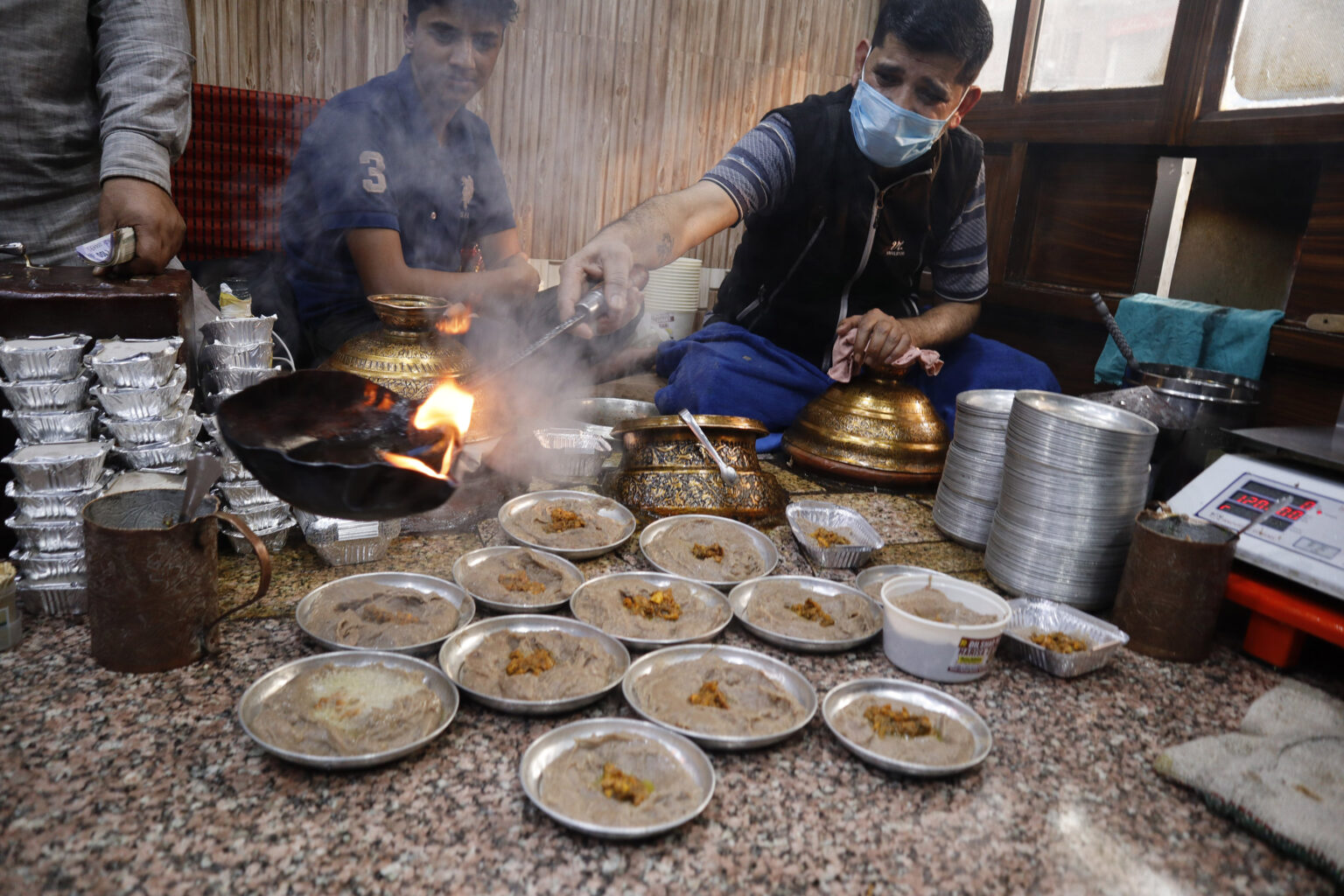
Imagine the scent of slow-cooked mutton, the sizzle of hot mustard oil, and the warmth of a freshly baked Girda. Harissa isn’t just a dish; it’s a morning ritual that brings the community together in the pre-dawn frost.

By Manzoor Akash
When the frost of Chillaikalan—the harshest forty-day period of the Kashmiri winter—tightens its grip on the Valley, the landscape transforms into a monochrome of gray and white. It is a season of struggle and darkness, yet it is also a time of profound internal warmth. P.B. Shelley’s immortal line, “If winter comes, can spring be far behind?” rings with a specific resonance here. While it suggests that renewal is inevitable, for Kashmiris, the endurance of winter is not merely a waiting game for spring; it is a season defined by a unique culinary resilience. At the very heart of this cold-weather identity lies Harissa: a dish that is less of a meal and more of a cultural heartbeat.
Harissa is an authentic, mouth-watering traditional delicacy that transforms the bitter mornings of the Valley into a celebration of flavor. This culinary treasure is a labor of love, consisting of mutton slow-cooked overnight with a symphony of fragrant spices and a touch of rice flour. Through hours of patient mashing and simmering in large earthenware pots, the meat dissolves into a rich, velvety, porridge-like consistency. The resulting gravy is deep and hearty, a concentrated essence of warmth that serves as the ultimate antidote to the sub-zero temperatures outside.
The ritual of consuming Harissa is as significant as its preparation. Usually served steaming hot during the early dawn hours, it is traditionally paired with Kander Tchot—freshly baked bread from the local baker—specifically the thick, dimpled Girda. While many now take it home, the most authentic experience remains at the Harissa Wan (the Harissa shop). In these snug, steam-filled spaces, the dish acts as a social glue. As patrons lean over their plates, they exchange the morning’s gossip and discuss the day’s affairs, keeping alive a communal spirit that has flourished for centuries. It is an emotion that connects the people of the Valley, providing a physical and social warmth that no modern heating system can replicate.
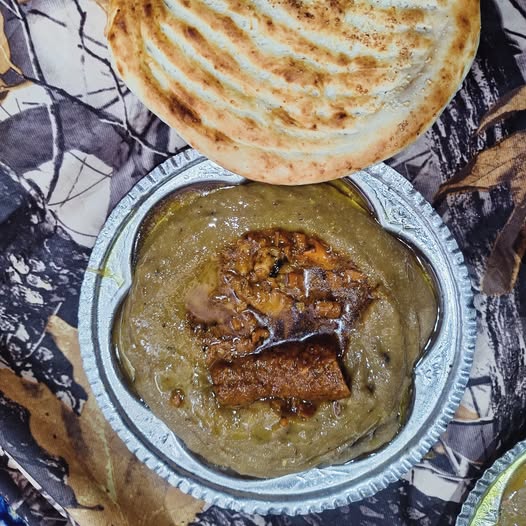
While the soul of Harissa remains unchanged, its presentation has evolved into a sophisticated art form. In the past, it was served with a humble simplicity. Today, it has become a decadent affair, often adorned with succulent Kabab pieces and Methi Maaz—finely chopped lamb intestines cooked with dried fenugreek. For the truly discerning palate, some master chefs offer Zaffrani Harissa, infused with premium saffron to elevate the aroma and taste to a regal level.
The roots of this dish stretch far beyond the borders of the Valley, tracing back to the 14th century. It is believed to have arrived with the caravans of traders and the revered Sufi saint, Mir Syed Ali Hamadani (RA), whose arrival from Central Asia and Iran profoundly influenced Kashmiri art, culture, and spirituality. These early travelers used Harissa as a high-calorie fuel to survive the treacherous Himalayan passes and the biting local winters. The people of Kashmir, deeply impressed by the lifestyle and customs of the Hamadani Sadat (the disciples of the saint), adopted the dish, weaving it permanently into the fabric of their winter traditions.
Srinagar remains the undisputed capital of this culinary craft. Throughout the Old City, the most legendary Harissa shops are strategically located near the historic bridges—Aali Kadal, Saraf Kadal, Fateh Kadal, and Safa Kadal. These locations are more than just storefronts; they are landmarks of heritage. The visual theater of the Harissa shop is a draw in itself. To entice customers and seal in the heat, the sellers perform a dramatic ritual of pouring smoking-hot mustard oil over the plated Harissa. The oil crackles and hisses, creating a momentary flare of flame and a fragrant cloud of steam that signals the dish is ready for consumption.

Dr. Rafeeq Masoodi, a noted broadcaster and former Secretary of the Cultural Academy, notes that Harissa is the undisputed king of the Kashmiri winter. “It keeps you warm in the cold,” Masoodi observes. “If you have not relished it yet, you have not truly experienced the authentic taste of Kashmir’s cuisine. It is a flavor one must experience at least once in a lifetime to understand the depth of our heritage.” While its popularity has spread to other districts and even to the diaspora, the spirit of the dish remains anchored in the cobblestone alleys of Srinagar.
Ultimately, Harissa stands as a testament to the Valley’s legacy of resilience. It is a symbol of community and identity that refuses to be dampened by the freezing winds. As Kashmiris navigate the challenges of the season, the warmth of this traditional delicacy serves as a potent reminder that even in the deepest winter, there is comfort to be found in the shared traditions that warm both the body and the heart. It is a slow-cooked promise that as long as the Harissa pots are simmering, the spirit of the Valley remains unbreakable.
The views expressed in this article are solely those of the author and do not necessarily reflect the opinions or views of this Magazine. The author can be reached at [email protected]
Leave a Reply