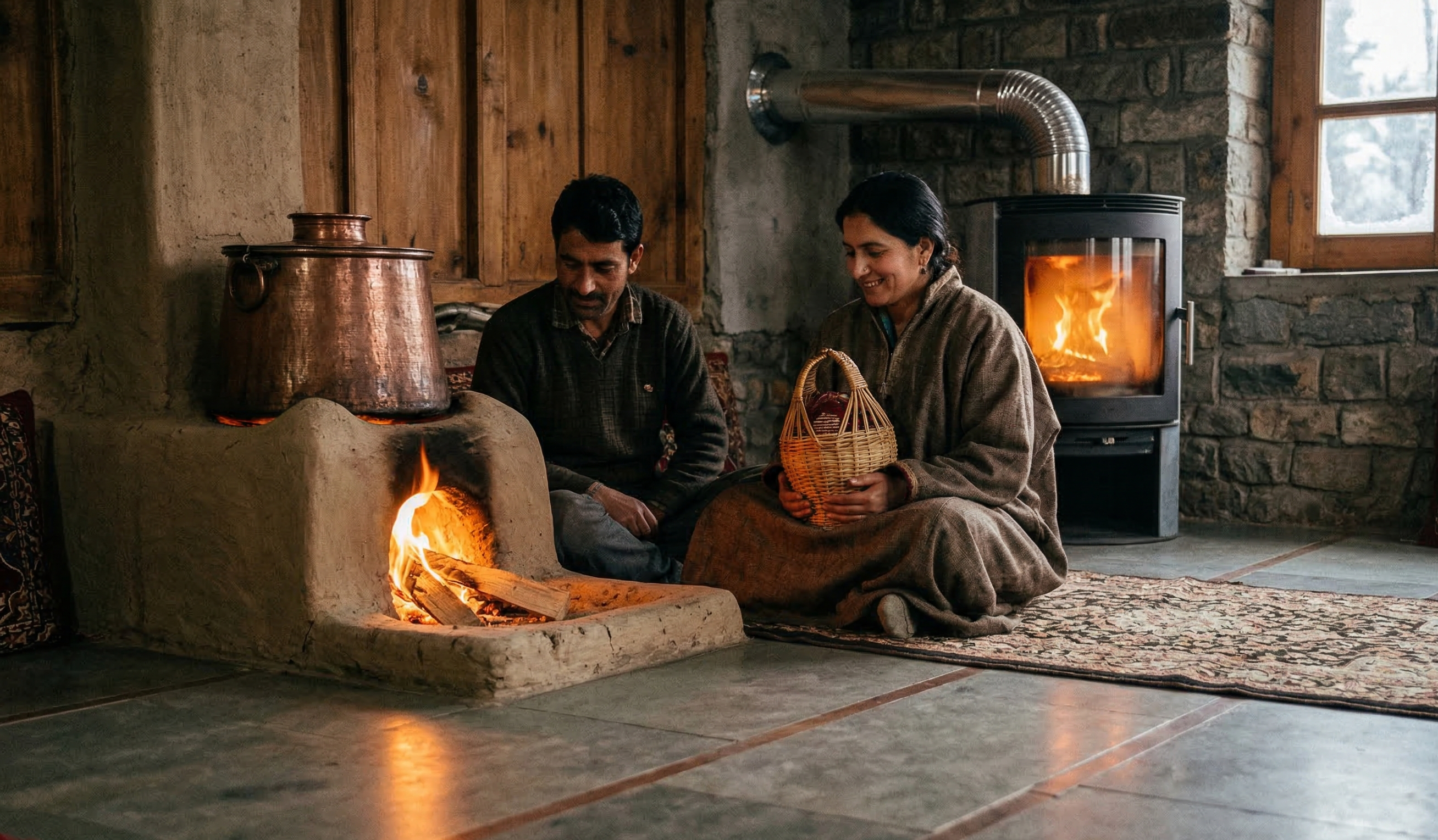
From the primitive era of pit-dwellers to the contemporary age of automated climate control, the Kashmiri people have engineered a sophisticated survivalist culture to counter some of the harshest winters in the Indian subcontinent
By Zahid Iqbal Sheikh
The old adage that necessity is the mother of invention finds its most literal expression in the frost-nipped valleys of Kashmir. From the primitive era of pit-dwellers to the contemporary age of automated climate control, the Kashmiri people have engineered a sophisticated survivalist culture to counter some of the harshest winters in the Indian subcontinent. This is not merely a history of staying warm; it is a multi-millennial saga of adaptation, innovation, and architectural resilience. Winter in the Valley is more than a season, it is a formidable social and technological architect that has dictated everything from the weave of a cloak to the layout of a home.
Humanity’s mastery of fire began roughly 1.5 million years ago, but its application in the high-altitude Himalayan basin took a distinctively domestic turn. In the Indian subcontinent, the earliest evidence of controlled fire dates back 55,000 years to the Belan archaeological site, yet the specific Kashmiri evolution of the hearth, known as the Daan or Danbur, represents a unique branch of thermal engineering. The Daan was never just a stove; it was the thermal heart of the household. Constructed from clay, it served a dual purpose: cooking the family’s sustenance while simultaneously heating the surrounding living space. Integrated with copper or clay tanks called mat’e for constant hot water, the Daan was the centerpiece of a social ecosystem that kept families huddled together against the sub-zero temperatures of Chillai-Kalan, the 40-day period of peak winter.
As the Kashmiri lifestyle became more mobile and the need for personalized warmth grew, the Kangri emerged—a portable firepot that remains the region’s most enduring cultural icon. Encased in intricate wickerwork and filled with smoldering charcoal embers, the Kangri is a feat of ergonomic design. It is meant to be tucked beneath the Pheran, the voluminous traditional woolen cloak, creating a private microclimate for the wearer. This practice, documented with fascination by 19th-century travelers like G.T. Vigne, remains a staple of Kashmiri life despite the advent of modern heaters. While its exact origins are debated, historical records confirm its dominance by the 15th century. When the patron saint of Kashmir, Sheikh-ul-Alam, passed away in 1438, tradition holds he was buried with a Chrar-Kangri, underscoring the object’s transition from a mere tool to a sacred cultural artifact. Today, the regions of Chrar-e-Sharief, Bandipora, and Kulgam continue to produce these firepots, blending ancient craftsmanship with functional necessity.
The evolution of indoor heating took a monumental leap with the introduction of the Hamam. Often misunderstood as a simple bathroom, the Kashmiri Hamam is a sophisticated sub-floor heating system. As noted by Saleem Beg of INTACH, while the concept has Turkic roots, it was likely popularized in the region during the Afghan era. The system involves a room with a thick limestone floor supported by short pillars, creating a hollow space beneath. Firewood is burned in a specialized oven outside or beneath the room, heating the stones which then radiate a gentle, consistent warmth for up to 24 hours. Historically a luxury for the elite or a communal feature of mosques, the Hamam has seen a massive democratic resurgence. Recent data suggests a surge in residential Hamam construction across Srinagar and rural districts, fueled by the development of “electric hamams.” These modern iterations use high-grade heating elements embedded in the floor, offering the traditional bone-deep warmth of stone without the logistical burden of storing metric tons of firewood.
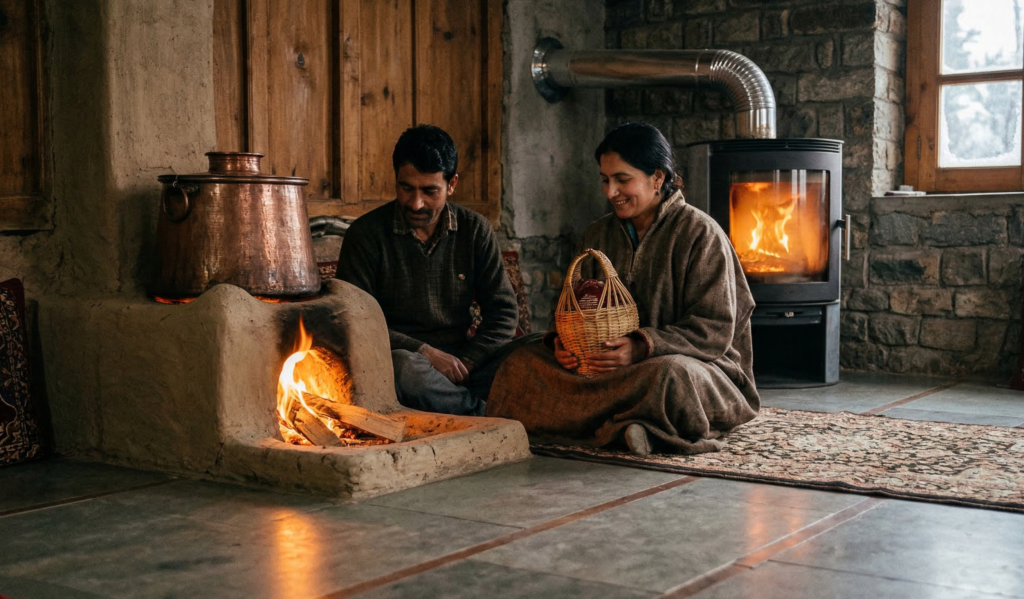
Parallel to the Hamam is the Bukhari, the iron-clad workhorse of the Kashmiri winter. A cylindrical metal stove with a long chimney pipe extending through a window, the Bukhari became the standard for middle-class households and public offices. However, the Bukhari of 2026 is a far cry from the soot-heavy wood burners of the past. The market has shifted toward high-efficiency “Turkish Bukharis,” which feature aesthetic glass windows, multi-fuel capabilities, and secondary combustion systems that reduce smoke and maximize heat output. In urban centers, LPG-powered Bukharis and oil-filled radiators have become common, reflecting a transition toward cleaner energy, though the classic wood-burning model remains the backbone of rural survival where electricity and gas supplies can be intermittent during heavy snowfall.
This trajectory from the Daan to the Turkish Bukhari is more than a timeline of gadgets; it is a testament to a people’s refusal to be sidelined by their geography. Each innovation represents a layer of Kashmiri identity, the communal warmth of the Hamam, the individualist resilience of the Kangri, and the industrial utility of the Bukhari. As climate patterns shift and energy costs fluctuate, the Kashmiri response remains consistent: a blend of ancestral wisdom and modern ingenuity. The contemporary Kashmiri home is now a hybrid space where a 600-year-old firepot sits atop a floor heated by 21st-century electric coils. It is a living museum of thermal evolution, proving that in the face of the freeze, the spirit of innovation remains the warmest fire of all.
The views expressed in this article are solely those of the author and do not necessarily reflect the opinions or views of this Magazine. The author can be reached at reached at [email protected]
Leave a Reply