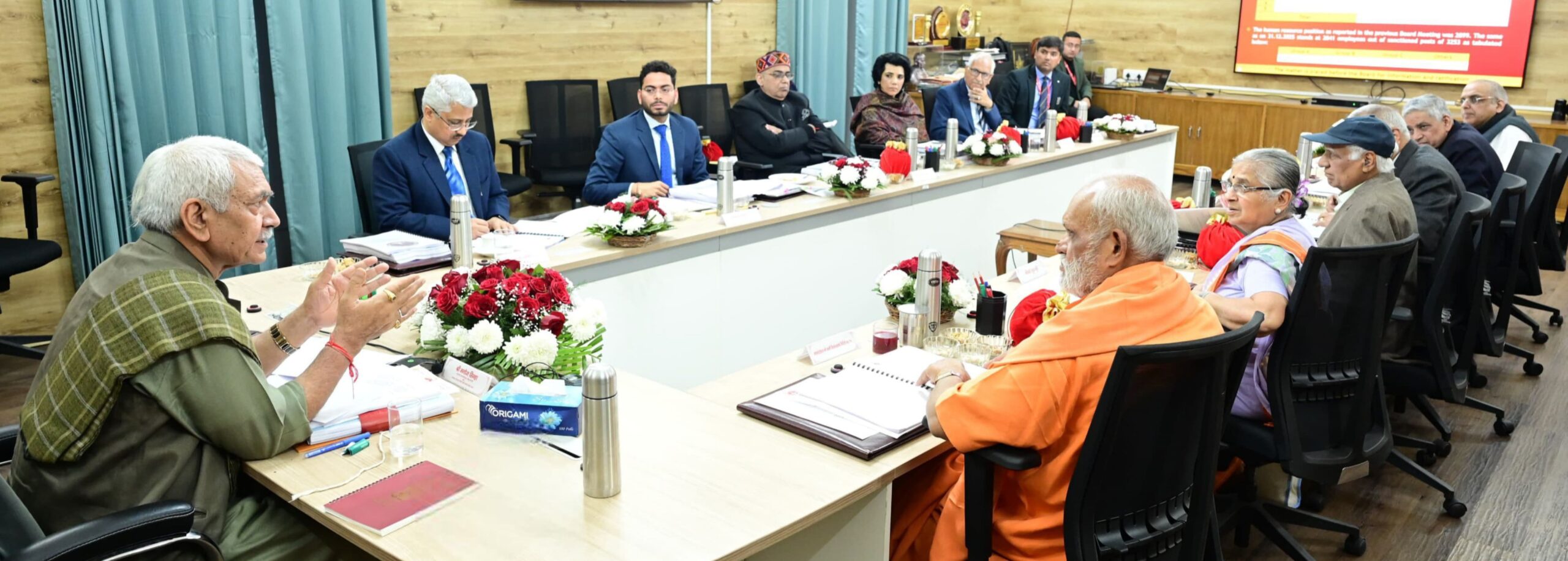
JAMMU, Feb 8, 2026 — In a move designed to position the Mata Vaishno Devi Shrine as a global spiritual destination, the Shrine Board (SMVDSB) on Sunday approved a sweeping set of initiatives, including the establishment of an international museum, a 100% hike in pilgrim insurance coverage, and a major push for the local economy.
The high-level meeting, chaired by Lieutenant Governor Manoj Sinha, resulted in 25 key decisions aimed at transforming both the pilgrim experience and the socio-economic fabric of the Katra region.
Global Branding and Cultural Heritage
The Board endorsed the preliminary concept for a first-of-its-kind “International Shakti Museum” to be built at Natali, Katra, in consultation with the Asian Heritage Foundation. Planned as a religious and educational hub, the project is slated for completion within two years.
To further enhance the spiritual ambience, the Board approved a high-tech sound-and-light spectacle modeled on global pilgrimage sites, designed to bring mythology to life through a fusion of tradition and innovation. A documentary on the Shrine was also greenlit to boost its international visibility.
Pilgrim Welfare and Safety
Addressing safety concerns, the Board doubled the insurance cover for pilgrims from ₹5 lakh to ₹10 lakh.
A new committee has been constituted to formulate strategies for managing expanding pilgrim numbers while improving their experience. The Board also reviewed major ongoing infrastructure projects, including the widening of the track from Sanjichhat to Bhawan, the new Vaishnavi Bhawan, and the construction of an exit track.
In a significant connectivity boost, the Board approved a revised MoU to allow helicopter services for both the Vaishno Devi and Shiv Khori shrines to operate from a single helipad at Village Hutt. The SMVDSB will also provide a one-time financial grant to the Shri Shiv Khori Shrine Board to upgrade its infrastructure.
Boosting Local Economy and Youth Development
The meeting marked a major policy shift toward community integration. The Board resolved to source the Shrine’s offerings and other procurements specifically from local self-help groups, women, and young entrepreneurs to “supercharge” the regional economy.
For the youth of the region, the SMVDSB approved the establishment of coaching centers providing free NEET preparation. Additionally, the Board decided to spearhead sports development across the Jammu region with the goal of transforming the Union Territory into a “national sporting powerhouse.”
Katra Town Transformation
Acknowledging the symbiotic relationship between the Shrine and the base camp, the Board decided to contribute directly to the transformation of Katra city. This includes funding for cleanliness, vibrancy, and modern infrastructure.
Furthermore, in compliance with National Green Tribunal (NGT) directives, the Board approved a rehabilitation plan for service providers on the track, including ponywallas, ensuring a phased and sustainable transition.
Inaugurations and Foundations
On the sidelines of the meet, LG Sinha laid the foundation stones for three new temples in Reasi and the restoration of two ancient temples in Jammu. He also launched an improvised “Pouch Prasad,” which includes dry fruits, a commemorative coin, and a sacred Mouli for free distribution to pilgrims.
Leave a Reply