In the silence of the dark moon, the subject and object dissolve into one. This is the essence of Kashmiri Shivratri, a profound celebration of universal consciousness. We delve into the Tantric roots of Bhairavotsava and the sacred symbolism of the Vatuk Puja that continues to guide seekers toward the light of Shiva.
By Satish Mahaldar
In the cold, crystalline air of the Kashmir Valley, where the mountains stand as silent sentinels to ancient wisdom, there exists a tradition that transcends mere ritual. This is the Krama system of Kashmir Shaivism, a philosophical powerhouse that has pulsated through the region since the third century AD. At the heart of this spiritual landscape lies Shivaratri—or as the locals affectionately call it, Herath—a festival that has defined the cultural and metaphysical identity of Kashmir for over a millennium.
From the sixth-century Nilmat Purana to the ninth-century devotional hymns of Acharya Utpaldeva, the records are clear: Shivaratri is not just a date on a lunar calendar; it is a profound exercise in maintaining the balance of universal awareness.
The Philosophy of the Dark Moon
The timing of Shivaratri is deeply symbolic. Falling on the fourteenth day of the dark half of the month, just before the Amavasya (New Moon), it marks a moment of total absorption. Just as neither the sun nor the moon is visible on a New Moon night, the spiritual seeker aims for a state where the subject and the object—the observer and the observed—merge into a single reality.
In his treatise Shivastotravali, Utpaldeva describes this “radiant night” as a celestial event where the sun and moon (representing the prana and apana, or the inhaling and exhaling breaths) and the stars (representing thought constructions) set simultaneously. What remains is the Madhya Dham, the central junction of rest where the seeker glimpses the infinite consciousness of Shiva.
Bhairavotsava
In the Kashmiri tradition, Maha Shivaratri is often referred to as Bhairavotsava. In Tantric texts, this is the occasion where Bhairava and his cosmic energy, Bhairavi, are propitiated.
The etymology of “Bhairava” itself encapsulates the cycle of existence:
- Bha: Maintenance of the universe (sthiti).
- Ra: Withdrawal or dissolution (samhara).
- Va: Manifestation or projection (shristi).
Bhairava is the “Terrible One” only to the ego; to the seeker, he is the Supreme Reality who releases the soul from worldly entanglements. He is Prakasha-Vimarshamaya—the pure light of consciousness (Prakasha) combined with the self-reflective power (Vimarsha) that allows the universe to know itself.
The Legend of ‘Herath’ and the Afghan Governor
While the spiritual roots are ancient, the name “Herath” carries a more recent, local legend. During the 18th century, under the harsh rule of the Afghan governor Abdul Jabbar, a decree was issued to test the faith of the Kashmiri Pandits. Jabbar ordered that Shivaratri be celebrated in the sweltering heat of June rather than the snowy days of February, mocking the belief that snow was a divine accompaniment to the festival.
Defying the seasons, a freak blizzard blanketed the valley in June. Stunned, the governor reportedly exclaimed, “Hai-rut!” (How astonishing!). Over time, “Hai-rut” morphed into Herath, a linguistic monument to a miracle that reinforced the bond between the land, its people, and their deity.
A Twenty-Five Day Odyssey
Unlike the single-night celebrations common in other parts of India, the Kashmiri Pandit tradition—following ancient Kulachar (family customs)—observes a festival spanning up to twenty-five days. This “Satyayuga” tradition begins on Haur Eakdhou (the first day of the dark fortnight of Phalguna) and culminates on the bright tenth day of the following fortnight.
The rituals are a masterclass in domestic sanctity. The word Haur signifies cleansing; from the very first day, homes are scrubbed, and consciousness is cleared. As the festival progresses, specific days take on unique identities:
- Haur Ashtami: Celebrated as the birthday of Sita Mata.
- Haur Dashami: A day for newly married women to visit their in-laws with gifts of rice, dry fruits, and sugar candies.
- Gaad Kaha (11th Day): Symbolizing the purification of the eleven senses (ten sense organs plus the mind), often involving fish offerings to represent the “vacillating nature” of the human appetite being brought under control.
The Sacred Clay
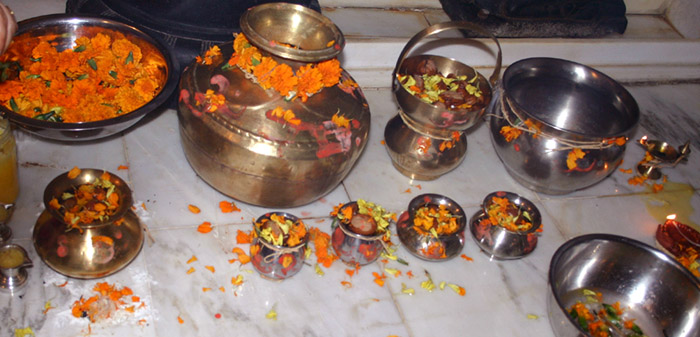
The visual centerpiece of Herath is the Vatuk Puja. A dedicated room is decorated for the assembly of earthen pots, each representing a different divine principle.
- Vatuk Bhairava: The primary large vessel filled with water and walnuts.
- Reshya Duliz: An open-mouthed pot representing the Sattvic (pure) element, offered vegetarian delicacies like kheer.
- Sanya Puttal: A clay model representing the inseparable union of Shiva and Shakti.
- Vagur: Representing the Anahata Chakra and the “binding and releasing” forces of the universe.
- Sanyavaara: A hollow clay model symbolizing the primordial void (Shunya).
The use of walnuts is particularly significant. With their four internal sections, they represent the four Vedas. Their oval shape mimics the universe, and the two halves of the shell symbolize the duality of Shiva and Shakti. These walnuts are kept in the water of the Vatuk pots for several days, absorbing the vibrations of the mantras before being distributed as the primary prasad.
The Final Ascent
The festival reaches its spiritual zenith on Shiv Chaturdashi (the 14th night). This is the night of intense prayer, where the “Jwala Lingam”—the pillar of fire—is meditated upon. It is followed by Doon Mavas, the day the walnuts are finally taken out and shared among friends and kin.
Through these elaborate rites, the Kashmiri Shaivite does not merely worship a god; they participate in a cosmic drama. By placing the Vasur (a weed representing the earth element) around the neck of the Vatuk pot, the devotee signals their intent to ascend from the densest form of matter to the subtlest heights of Shiva-consciousness.
The Pulse of Culture
As we look at the rituals of Herath today—now practiced by a diaspora spread across the globe, it is clear that culture is indeed the lifeblood of society. It is the lens through which we imagine the future while honoring the past. Whether through the five-day intensive Panak beverage offerings or the 108 names of Bhairava recited over a sacrificial fire (Vaishvadeva Vyahriti), the essence remains
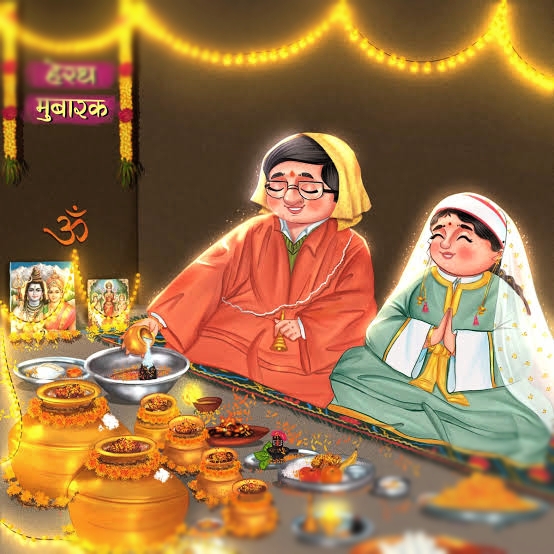
Shivaratri in Kashmir is a reminder that even in the darkest half of the month, there exists a self-luminous light that requires no external fuel. It is a celebration of the “Subject” finding itself in the “Object,” and a community finding its soul in the eternal dance of Hara.
The views expressed in this article are solely those of the author and do not necessarily reflect the opinions or views of this Magazine. The author can be reached at [email protected]
Leave a Reply