In the quiet shade of Najar Mohalla, history isn’t found in books or monuments, but in the patient hands of women gathering fallen branches. A reflection on the legacy of Hazrat Haji Bahram Saeb (RA), where silence feels complete and the bitter harvest of winter becomes a sacred feast.
By Khursheed Dar
Last spring, amidst the awakening landscape of my vicinity, I found myself paused by a tableau that felt less like a daily occurrence and more like a living fragment of history. Beneath the sprawling canopies of ancient walnut trees, a group of women and children were engaged in a quiet, rhythmic labor, bending periodically to retrieve what the trees had discarded. They were collecting the thin, dry rachis of walnut catkins, known in the local Kashmiri lexicon as Dunimvur—handling these brittle remnants with a patience that bordered on reverence. To the uninitiated eye, this might appear to be a mundane gathering of kindling or waste, for these catkins are notoriously bitter, possessing an astringency so potent that even grazing animals, usually indiscriminate in their foraging, refuse to consume them. Yet, as I watched their hands move, I was not reminded of the botanical biological cycle of the walnut tree, nor was I struck by thoughts of hunger or material hardship; rather, I was transported into the deep, resonant well of cultural memory. This seemingly simple act was a direct conduit to a saint who once walked quietly among us, Hazrat Haji Bahram Saeb (RA), whose life serves as a testament to the profound spirituality that often thrives in the shadows of obscurity.
Oral tradition, that stubborn keeper of truths which official histories often overlook, tells us that Dunimvur was this saint’s sustenance during times of scarcity, transforming a botanical reject into a symbol of survival and ascetic discipline. Even today, on the occasion of his Urs, this bitter harvest is cooked in certain villages, a culinary ritual that ensures the saint lives on not through dusty manuscripts or marble monuments, but through the visceral habit of taste and community practice. It is a reminder that some saints simply do not fit inside the rigid margins of pages; their lives are too expansive, too fluid to be contained by dates, footnotes, or the linear narratives of long biographies. Instead, they remain vibrantly alive through food, through silence, and through gestures passed down unconsciously from one generation to the next. Hazrat Haji Bahram Saeb (RA) was undeniably one such figure, a mystic whose existence was defined by a humility so absolute that it sought to erase the self entirely. Very little is formally written about him, with even Peer Hassan Shah Kohihami, the preeminent historian and chronicler of Kashmir, offering only a brief mention, no elaborate hagiography, no extended praise, yet perhaps that archival silence says more than a thousand eulogies ever could, suggesting that a life devoted to humility leaves no trace for the scribe, for those who erase the self do not seek to be remembered, leaving behind no noise, only enduring echoes.
His shrine, situated at Najar Mohalla in Wahipora Langate, barely three kilometers from my own residence, embodies this philosophy of understated grace. It does not announce itself with towering minarets or gilded domes demanding the attention of the passerby; rather, it rests quietly amidst a grove of trees and stones, enveloped in a stillness that feels ancient and undisturbed. Standing there, one does not feel the overwhelming weight of architectural grandeur but rather a profound sense of calm, a place where nothing speaks loudly yet every element invites deep reflection, creating an atmosphere where silence feels not like an absence, but a completion. Hazrat Haji Bahram Saeb (RA) was a disciple of the revered Hazrat Sheikh Hamzah Maqdoomi (RA) and remained intrinsically connected to the spiritual lineage of Baba Naseeb-ud-Din Ghazi (RA), belonging to the Najar family, yet beyond these genealogical anchors, history grows silent. However, where the text fades, the village itself begins to speak, carrying in its soil not just the remnants of prayer but the physical weight of time. The land here remembers Sultan Zain-ul-Abidin, affectionately known as Budshah (1420–1470 CE), a ruler whom Kashmir recalls with a rare tenderness, speaking of him as though he had only just passed by the riverbank.
Oral accounts vividly recount how Budshah once dreamed of a massive engineering feat to divert the waters of the Pohru River towards Zaingeer, hoping to irrigate the parched lands and ease the burdens of the peasantry. While that ambitious dream remained unfinished, the evidence of his intent still litters the landscape; tons of black stones lie scattered in the riverbed at Bonagom Langate, heavy, unmoved, and patient, resembling unfinished sentences of care and kingly intention. Nearby, a simple prayer stone rests without any carving to declare its royal association or structure to protect it from the elements, preserved solely by the strength of local belief. It is said that Sultan Zain-ul-Abidin used to offer his prayers on this very stone, and I often imagine him standing there, stripped of the trappings of monarchy, not as a king clothed in absolute power, but as a man briefly unburdened, seeking guidance like any other mortal. In this quiet corner of Langate, power bends toward humility, and history does not dominate the land but settles into it softly, like a prayer whispered rather than proclaimed.
Hazrat Haji Bahram Saeb (RA) spent the majority of his life in this charged landscape at Bonagam village, near the banks of Nallah Pohru, living a life absorbed in deep meditation and prayer. He was not a preacher who sought to gather crowds or command followers; he taught exclusively through the act of living. His asceticism was rigorous, fasting often and sometimes continuously, never consuming meat, and meditating through the turning of days and nights. He wore khraw, the traditional wooden Kashmiri footwear, even in the harshest depths of winter, and never used warm water for ablution, proving that his devotion was not symbolic but intensely physical, a faith that demanded the full participation of the body against the elements. Oral tradition asserts that he performed the Hajj pilgrimage on foot twelve times, in Kashmiri, bah means twelve, and thus he came to be known as Haji Bahram, a name earned through the sheer mileage of devotion. Peer Hassan Shah Kohihami corroborates this, noting that these arduous journeys were undertaken quietly, without announcement or the expectation of social recognition, a stark contrast to an age where spirituality is often performed for an audience.
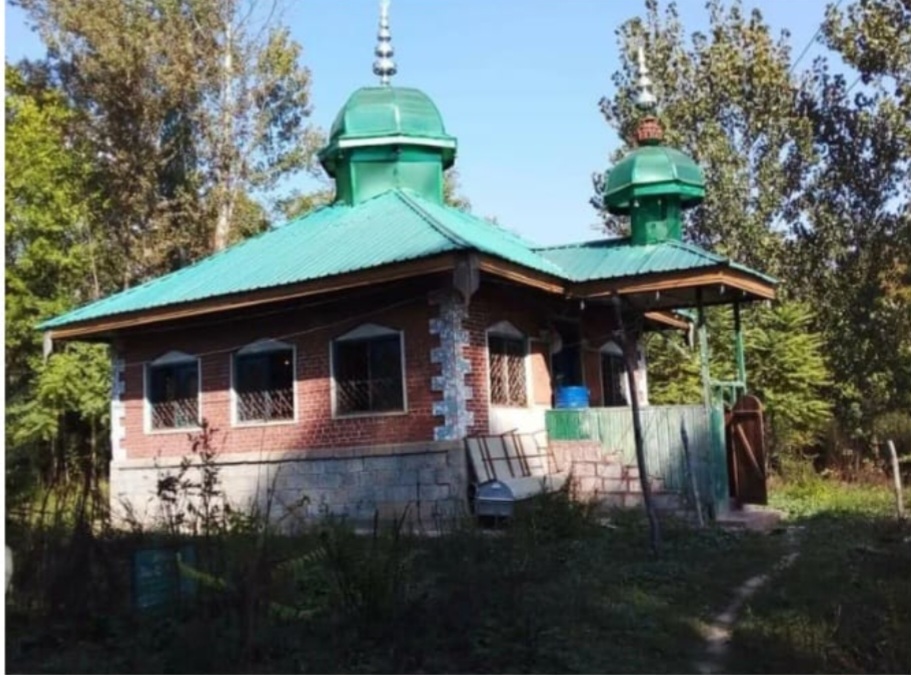
There is a small, illuminating incident recorded by Peer Hassan Shah Kohihami that reveals the saint’s moral depth, involving a subedar named Hafiz Allah Khan who once offered him fifty rupees—a significant sum at the time. The saint refused the offering, and when the subedar pressed repeatedly, he accepted only a single rupee, teaching that saints often instruct us not by what they accept from the world, but by what they decline. Hazrat Haji Bahram Saeb (RA) passed away at the age of ninety, first buried at Bonagam Langate and later reinterred at Wahipora Langate, with shrines at both locations continuing to command respect. A devastating fire once swept through the shrine, destroying many sacred relics and reducing the structure to ash, yet a large flat stone bearing a weathered inscription survived the inferno, perhaps remaining to remind us that meaning survives even when material objects perish.
The Urs of Hazrat Haji Bahram Saeb (RA), observed each January, is marked not by spectacle but by communal sharing, where Dunimvur is cooked and offered as homage, and yellow rice is distributed among the children. I recall with a pang of nostalgia that before the geopolitical turmoil of the 1990s, when a bride entered the village, her first journey was to the shrine for blessings, and during droughts, people gathered for Bandhar, a community meal where everyone sat together, eating without distinction of class or caste. I have personally witnessed these gatherings, and I understand now that for the saints of Kashmir, eating was never an indulgence but a discipline; hunger was not an enemy to be feared but a teacher to be heeded. What the land offered, however bitter the catkin, was enough, for Dunimvur was not merely food but a profound lesson that simplicity can be sacred, scarcity can be dignified, and restraint is the ultimate act of devotion.
The views expressed in this article are solely those of the author and do not necessarily reflect the opinions or views of this Magazine. The author can be reached at [email protected]
Leave a Reply