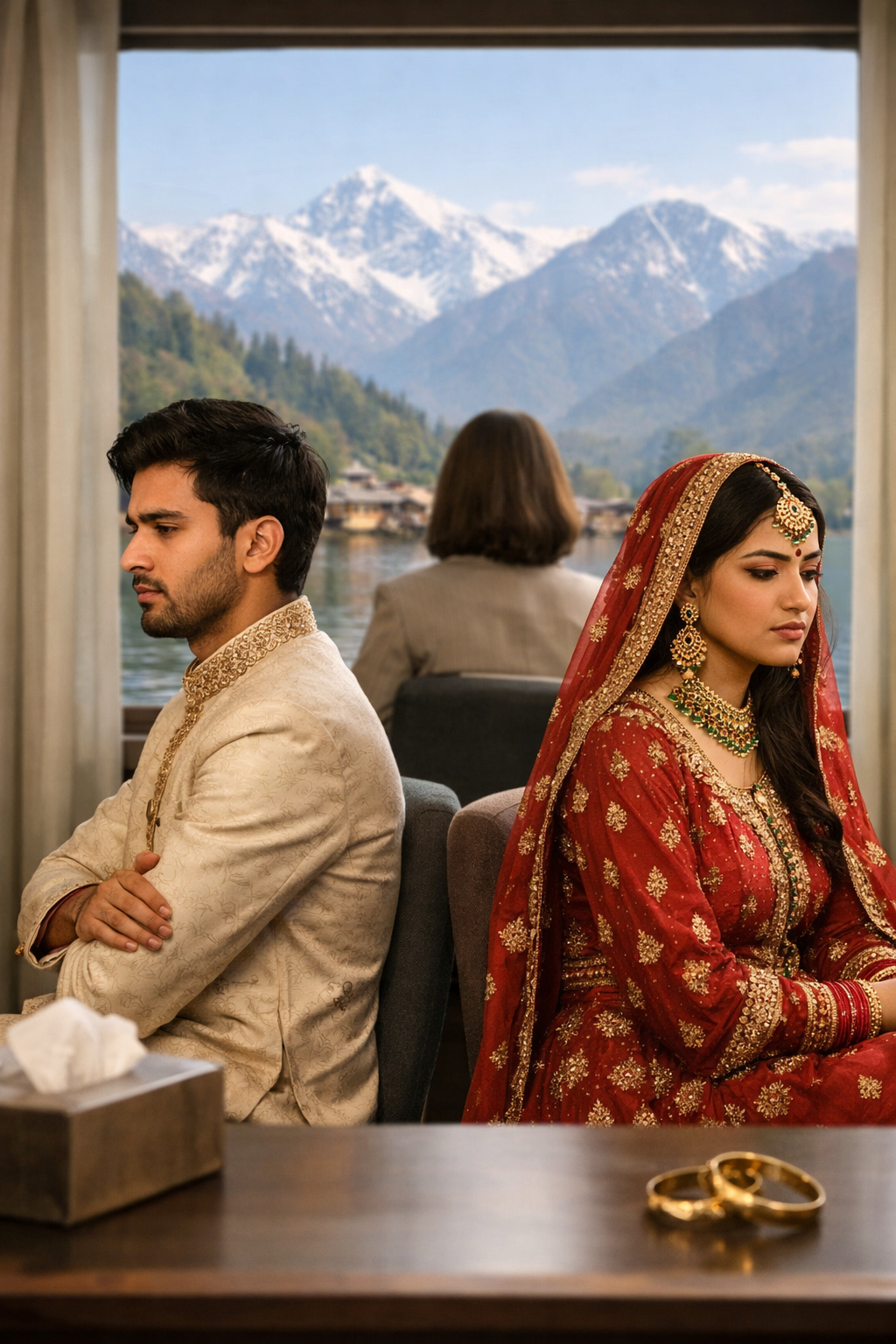
Why Kashmir’s Couples Are Choosing Therapy Before the ‘Qabool Hai’
By Sualiha Zubair
The Chinar leaves had just begun their descent into fiery hues of crimson and gold back in October when the household of 26-year-old Mir Afsa (Name changed) in Sanat Nagar was buzzing with a familiar, frenetic energy. It was the peak of the wedding season in the Valley, a time when the crisp autumn air carries the aroma of saffron and the heavy, savory scent of wazwan.
For the bride-to-be, the script was written in the grand tradition of the ‘Big Fat Kashmiri Wedding.’ The copper tramis were being counted for the feast, and videographers were booking slots for drone shots to capture the pictures. To the outside observer, it was a fairytale unfolding. But inside the walls of her home—and more importantly, inside her mind—Afsa found herself drowning.
As the countdown to the big day ticked away, she realized that the sheer chaos of planning and the crushing weight of societal expectations were doing the opposite of what a wedding should do: they were growing the distance between her and her fiancé.
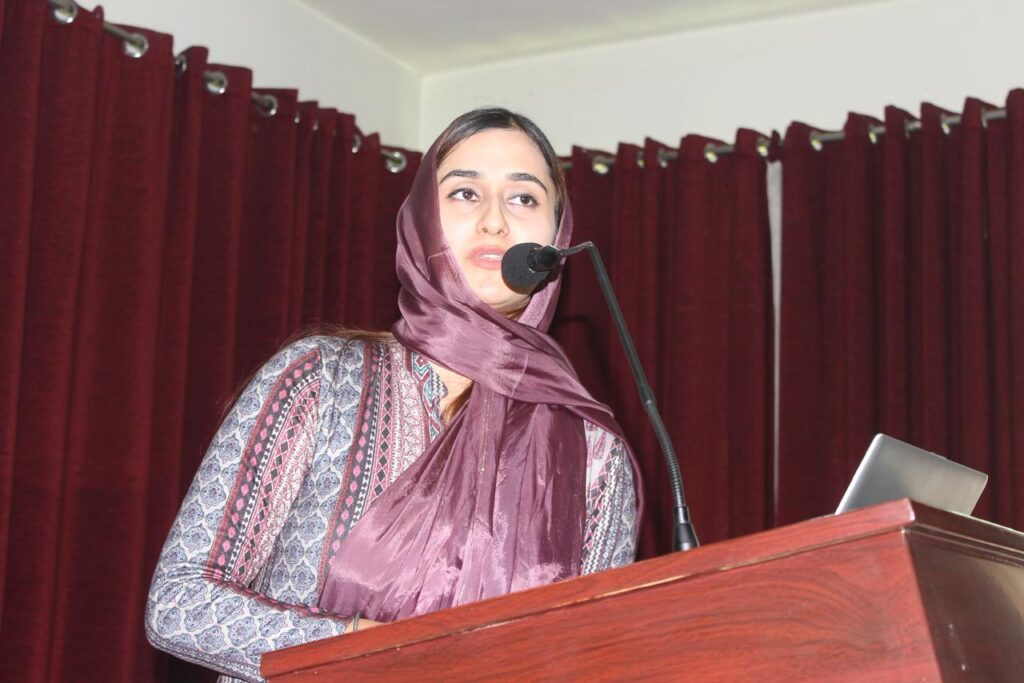
“There was no space for me and my fiancé to actually talk about big things,” Afsa recalls, looking back at those stressful weeks. “Small disagreements started feeling like massive red flags. The noise of the wedding was drowning out the relationship itself.”
In a society where pre-wedding jitters are often dismissed as nerves to be soothed with gold jewelry or reassurance from elders, Afsa took an unconventional route. Confiding in a cousin, she admitted her fears. On her cousin’s advice, she decided to intervene in her own destiny before it was too late. In May, months before the wedding festivities kicked into high gear, Afsa opted for premarital counseling.
Initially starting with individual sessions to sort through her own anxieties, she eventually brought her partner into the fold. The transformation, she says, was palpable.
“We are learning how to reflect instead of reacting, and how to express without blame, thanks to this counseling,” she says, a wide smile spreading across her face, a stark contrast to the overwhelmed bride of a few months ago.
Afsa is part of a quiet but significant shift in Kashmir’s social fabric. As divorce rates climb and the glitz of social media weddings often masks deeper incompatibilities, a growing number of young couples are turning to professionals to learn the grammar of marriage before signing the contract.
In an exclusive interview with The Kashmir Scan, Urooj Manzoor, a prominent Kashmir-based Mental Health Counsellor, breaks down this emerging trend. Holding an additional degree in Gender and Women Empowerment and currently serving as a mental health counselor at the Islamic University of Science and Technology (IUST), Awantipora, Manzoor offers a clinical yet deeply empathetic perspective on why the traditional advice to “just adjust” is no longer enough.
KS: To begin with, for those who might be skeptical or unaware, what exactly is premarital counseling, and what does it typically involve?
Urooj Manzoor: Premarital counseling is, at its core, a preventative form of therapy. It is a type of counseling designed to help couples prepare emotionally, mentally, and practically for married life. It isn’t just about fixing what is broken; it is about strengthening what is already there.
Typically, it involves structured conversations facilitated by a trained psychologist covering essential areas that are often overlooked in the romance of courtship—topics like communication styles, conflict resolution, financial management, sexual expectations, core values, and long-term goals.
From a psychological standpoint, I view premarital counseling not just as a way to “solve problems” before marriage, but more as an opportunity to build a foundation or a base of mutual understanding and realistic expectations. It does not guarantee you no conflicts in the future—conflict is inevitable in human relationships—but rather, it provides healthier and logical ways to deal with them.
Think of it like this: Just like people get a health check-up before a major surgery to ensure their body can handle the stress, couples benefit immensely from emotionally and practically preparing for the massive life transition that is married life. The therapist empowers couples with various tools and techniques to work on their goals and improve their relationship dynamics.
You wouldn’t jump into a business partnership without discussing the terms, reading the fine print, and understanding the risks, right? Marriage is the biggest partnership there is. So, why leave it to chance? Psychology shows that couples who undergo premarital counseling have significantly higher relationship satisfaction and lower rates of divorce (Stanley, Amato, Johnson & Markman, 2006). It’s an investment in the relationship’s longevity.
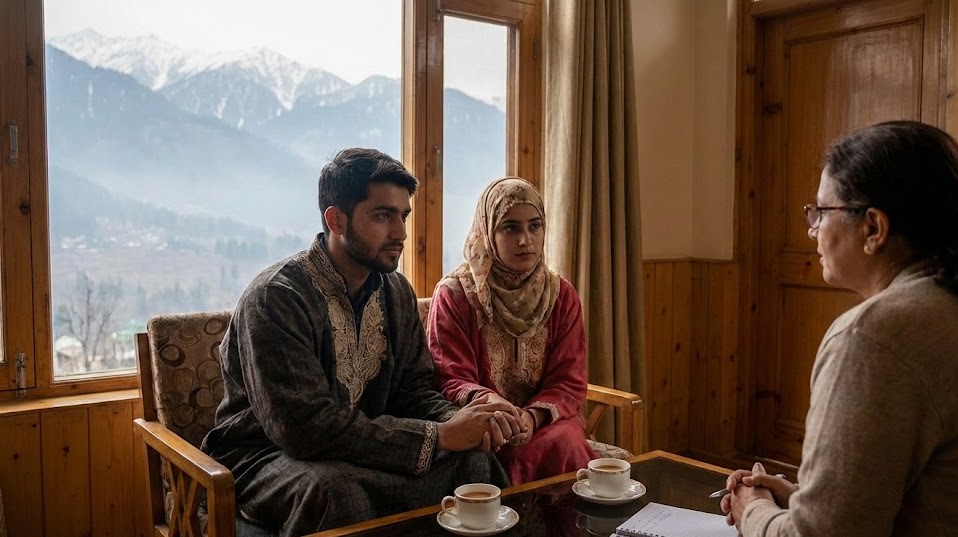
KS: You mentioned the broader implications. In what ways can premarital counseling help build an emotionally healthier and stable society, particularly in the context of Kashmir?
Urooj Manzoor: I believe that premarital counseling, when made accessible and normalized, has the power to fundamentally reshape our social fabric. It has the potential to reduce divorce rates, lower instances of domestic violence, improve overall mental health outcomes, and help in conflict resolution across Kashmiri society.
While premarital counseling may seem like a strictly personal choice, its absence has widespread social consequences. When marriages crumble due to unresolved emotional issues or lack of communication, the fallout isn’t just private; it ripples through families, affects children deeply, and destabilizes communities.
In Kashmir, we have seen a rise in mental health issues. Cases of depression, anxiety, substance abuse, and even violent crimes have often had roots in broken family structures and dysfunctional home environments. Therefore, when young people are emotionally prepared before they enter these unions, relationships become more respectful and grounded. This creates a society less prone to violence and helps break the cycle of generational trauma that many families in the Valley unknowingly perpetuate.
KS: There is a reported surge in divorce cases in Kashmir, with some reports suggesting a 30 percent rise since 2012. Do you think premarital counseling can genuinely help stem this tide and strengthen marriages?
Urooj Manzoor: Yes, there is a definite, undeniable rise in divorce cases. And no, it’s not just a trend or some modern “Western influence,” as is often dismissively claimed in our drawing room discussions. It is deeper than that.
For decades, couples in India, and specifically in Kashmir, were told to “adjust.” They were conditioned to stay in abusive marriages, to be quiet, and to constantly worry about “log kya kahenge” (what will people say). But things have changed. People today know their rights. They are more self-aware. If a relationship is toxic, they are walking out rather than suffering in silence. Today, more people are realizing that staying in a bad marriage isn’t a badge of honor.
However, a huge problem contributing to this surge is that couples don’t really sit and talk anymore. They assume, they avoid, they fight, or they just scroll through Instagram and social media, pretending everything is fine while drifting apart. Over time, these small resentments start building up like a pressure cooker. And when things finally go wrong, instead of working through it, people shut down or walk away straight away because they lack the tools to repair the damage.
So yes, for sure, premarital counseling can help in curbing these surging divorce cases. A lot of couples jump into marriage without ever really sitting down to talk about the stuff that actually matters—expectations, values, money, family dynamics, even basic communication styles.
Premarital counseling does not guarantee you a smooth path, but it definitely guarantees a way to better understand each other. Here, you can talk about the unglamorous realities: How will we encounter daily life? How do we handle stress? What are your boundaries regarding in-laws? What are your deepest dreams and fears?
Counseling helps couples build that understanding from day one. It makes you think beyond the romance and into the real world. And trust me, it’s better to talk now than regret later. If we view two persons through the lens of premarital counseling, we don’t just see two people in love; we see two entire histories sitting on that couch. Those histories come with baggage, which includes a variety of different thoughts, upbringing, and ideologies. A lot of people avoid talking about money, physical intimacy, unreal expectations, or even their families because they are afraid it will cause fights. Counseling forces those necessary conversations before they become deal-breakers.
KS: Finally, drawing from your experience at IUST and your private practice, what advice would you give to young couples about to embark on the journey of marriage?
Urooj Manzoor: My primary advice would be to understand that love is just the beginning; open communication and shared values are what will actually keep you together. Both real-life experience and psychological research show that lasting relationships are built on more than just high emotions or the adrenaline of a new romance.
Let us be honest: while feelings bring two people together, it is mutual respect, honesty, trust, emotional safety, and the sincere desire to grow together that hold them in place over time. People grow. Life changes us, sometimes in ways we don’t expect—career shifts, parenthood, loss. That patience to adapt to the new versions of your partner is necessary.
In places like Kashmir, where social expectations and family pressures often shape relationships, it’s easy to get caught up in the need to “look right” for the community. But a real, healthy relationship isn’t about how it appears to others; it’s about how it feels between the two of you when the guests have left and the door is closed.
You don’t need a perfect wedding photo or social media approval. All you need is an honest, open conversation, clear boundaries, and respect. Start your marriage with truth, not just celebration.
The views expressed in this article are solely those of the author and do not necessarily reflect the opinions or views of this Magazine.
Leave a Reply